
Doves singing
-From The Songs of Dzitbalche, written by Ah Bam and translated by John Curl
in the ceiba branches there,
flycatchers, little yellow birds,
cuckoos, mockingbirds there,
all happy,
the birds of the Lord.
It was seven o’clock in the morning when a sleepy-eyed border agent punched a Belizean exit stamp onto a free page in my passport. Humidity already hung in the air, although it was still early enough that the oppressive heat of the day had yet to set in. Vince, Bonnie, David, and I had awoken before the sunrise that morning so we would have time to stop for breakfast before driving to the border to meet our Guatemalan tour guide who would be taking us to Tikal National Park for the day.
Our guide, Omer from TikalGo, was waiting for us in no man’s land, just passed the Belizean exit station. He led us into the Guatemalan entrance station where we got the second of four stamps that this day tour would require, then we all climbed into the comfortable van that was waiting to transport us to Tikal National Park.
Farmland, lush rainforest, and shimmering lakes surrounded us for the two hour drive to the national park. We made one stop at a little gift shop where we got to sample Guatemalan coffee and tea, and a local dish very similar to the Salavadoran pupusas we’d tried earlier in the trip. In the back of the store was a sprawling scale model of the ancient city of Tikal, which was more likely called Yax Mutal by the ancient Mayans. Omer used the model to point out the sites we would be visiting, which occupied a shockingly small section of the total map. He said that it would take three days to explore the city in its entirety, but we would get to see the most impressive pieces of architecture on our day tour.
It didn’t take long for us to reach the boundaries of Tikal National Park after leaving the rest stop. Our driver turned off onto the park road, and all at once, we were enveloped in deep rainforest. We quizzed Omer about what kinds of animals could be found in the park, using the simple conversation as an opportunity to practice our Spanish, while eagerly looking out of the van’s windows. Omer told us about the local wildlife, making sure to speak slowly so we would be able to understand. We learned that coatimundis, a type of raccoon, are called pizotes in Guatemala, and that we would know a keel-billed toucan was near if we heard a loud, frog-like, croaking sound coming from the trees. Our driver slowed down and opened the windows when Omer heard the call of a collared aracari, another type of toucan, echoing through the forest.
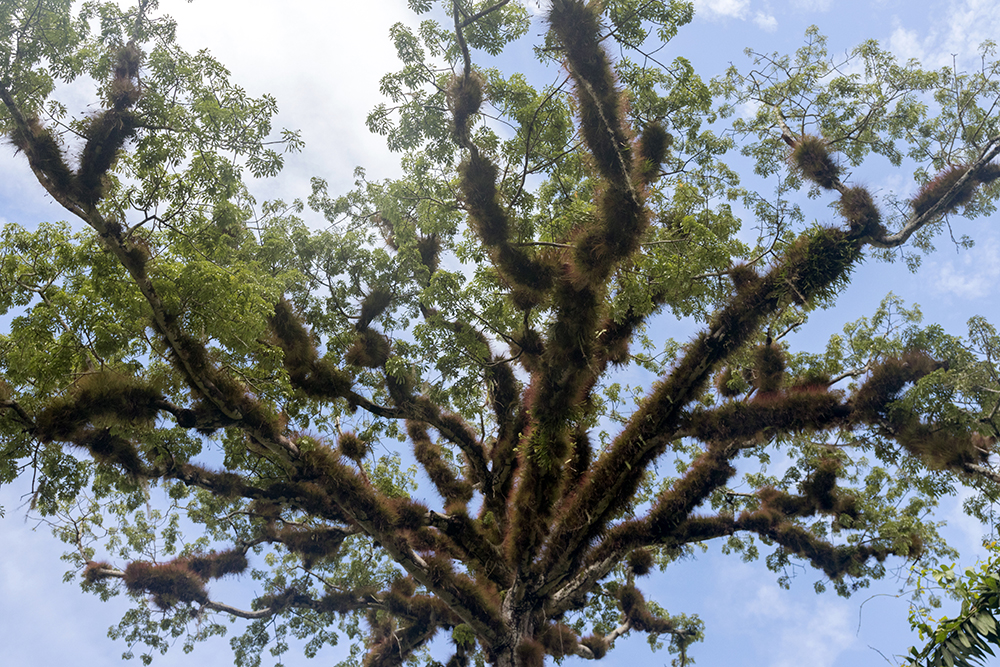
We were all eager to get hiking when we finally arrived at the park’s ticket station. Entrance fees were included in our private tour, so Omer purchased all of our tickets, and then we followed him along a wide trail. Trees along the path were supported by wide buttress roots, and bird song filled the morning air. We stopped to crane our necks upwards to look at the top branches of a gigantic ceiba tree which was covered in air plants that sprouted off of the branches like fireworks. Omer told us the ceiba is the national tree of Guatemala, and that it was sacred to the ancient Mayans, for whom it symbolized a connection between the underworld, the earth, and the heavens.
Just beyond the ceiba tree, I picked up on a familiar rustling of leaves high above our heads in my peripheral vision. It had to be monkeys. Omer’s eyes followed my appraising gaze and we both squinted at the leaves until a flash of dark brown fur came into view. It was spider monkeys, but they were too far away for us to get a very good look at them. Still, the encounter was enough to get me excited about the prospect of hopefully finding more of them as the day progressed. Spider monkeys are more elusive than the howler monkeys we’d seen the day the before, so it would be very neat to get a good look at one.
We left the distant monkeys behind and veered off of the main trail onto a narrow, winding path through the underbrush. The forest floor grew over a bed of glistening, white limestone, the very stone used to build the structures of the ancient city we were about to see. Bare stone was exposed on areas that received a lot of foot traffic, and it was very slippery because of the previous night’s rain storm. We had to choose our steps carefully to avoid slipping on the smooth stone as we followed Omer, who was telling a story of how easy it is to get lost in the National Park. In fact, a family of tourists had gotten lost in the jungle just a couple of weeks before our visit. They wandered the park for two whole days before being rescued, dehydrated and hungry, but luckily all alive. With that in mind, I was even more grateful for Omer, who kept us on track while providing us with all sorts of historical information that we wouldn’t have known if we visited on our own.
Before long, we stepped into a clearing where we stood in the shadow of a short pyramid. A row of uncarved stelae and round altars formed a line in front of the pyramid’s steps, and Omer told us that these altars would have been used to make sacrifices to Chaac, the god of rain. Offerings would have been anything ranging from produce to livestock to conquered enemies.
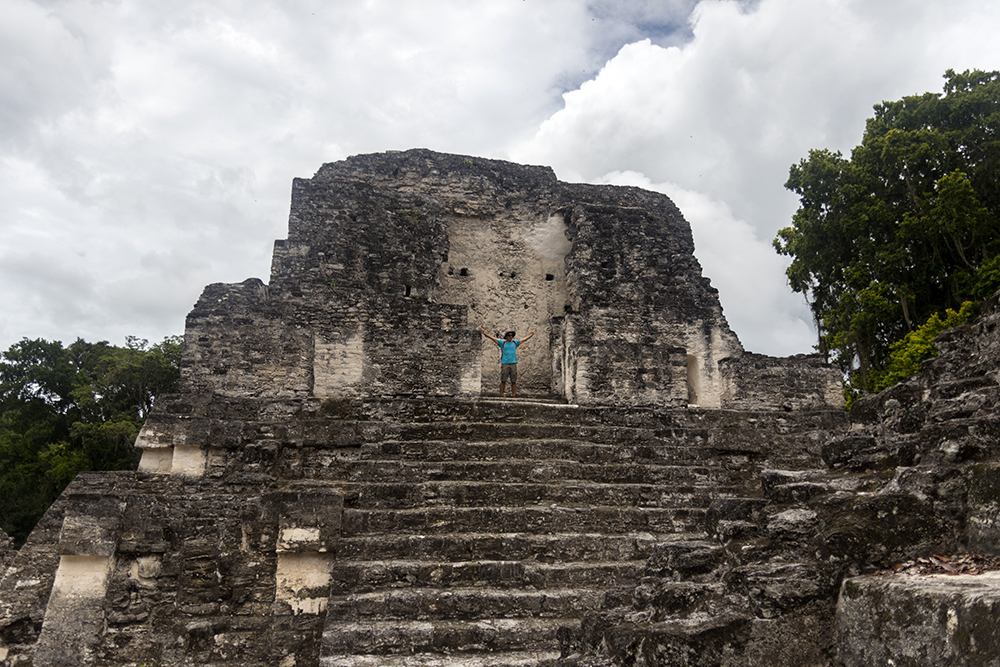
In Tikal’s heyday during the classical period, only nobles would have been allowed to climb the steps of its pyramids and temples, but after Omer’s explanation of the pyramid’s history, he invited us to climb to the top and look for a view of one of Tikal’s famous temples above the trees. This was a monumental moment for me because the two ancient Mayan cities I’ve visited in the past (Chichén-Itzá and Cobá) no longer allowed visitors to climb any of the ruins. I’ve heard countless stories from people who travelled to these sites back when climbing was still allowed, and I was thrilled to finally get to experience a view from on top of a Mayan structure instead of on the ground.
The heat of the day had finally set in once we started up the knee-high steps, and I could feel beads of sweat emerging all over my skin as I awkwardly hoisted myself over each tall layer of stone. But when we finally reached the top, I felt elated when the top of the temple came into view above the canopy.
I felt like we were on top of the world, and the best part was this was still just the beginning of our day-even better views were yet to come!


When we returned to the ground, it was time to get back on the trail. We walked through a path that was littered with un-excavated ruins. Cracked stelae rose from the earth, and larger structures looked like oddly shaped hills, completely buried by vegetation.

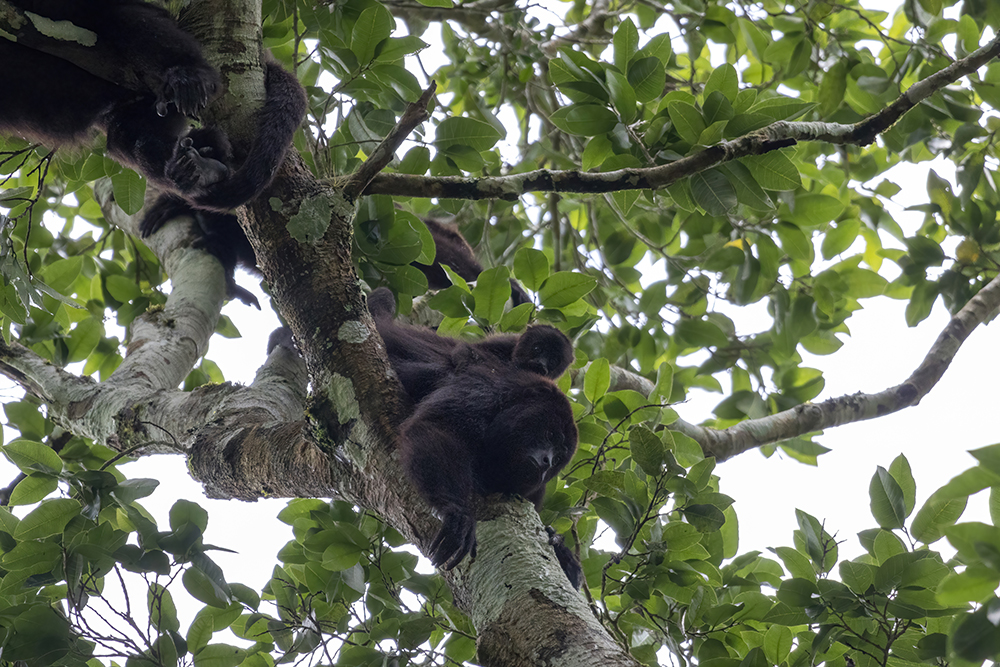
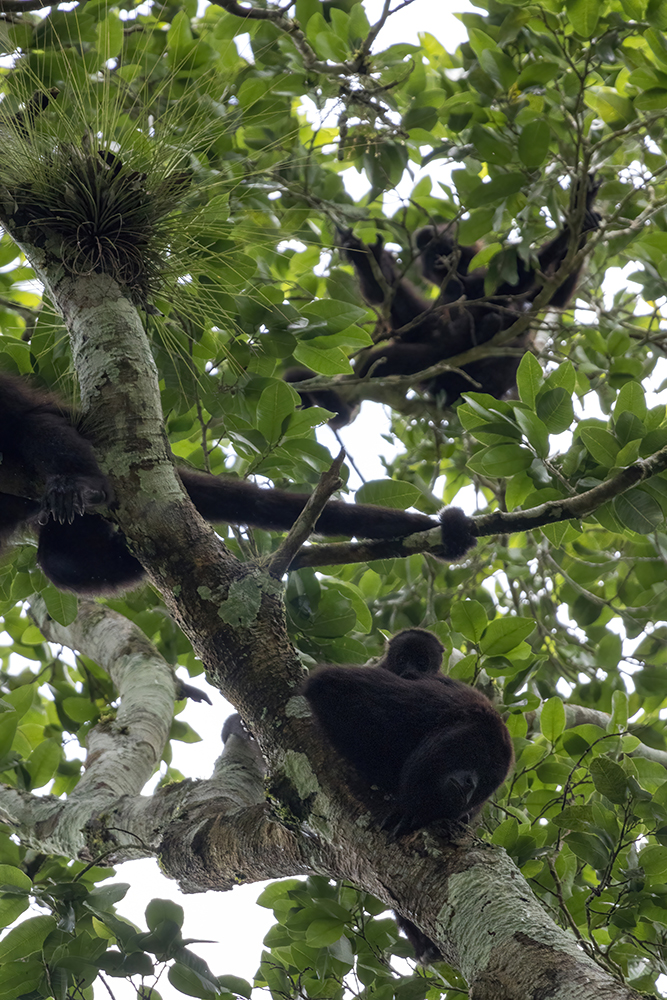
Omer was in the middle of telling us that the fall of Tikal was likely due to resource scarcity brought on by overpopulation, when a commotion from above drew our attention upwards where we saw a troop of howler monkeys. This was a much bigger family than we’d seen day before, and there was even a tiny baby monkey clinging to its mother’s back.

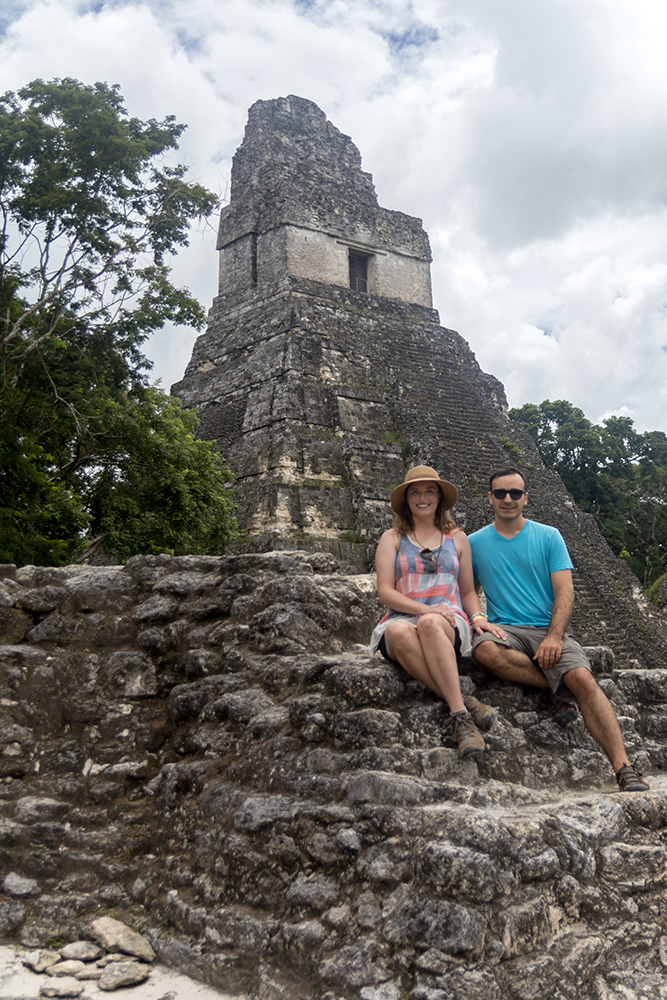
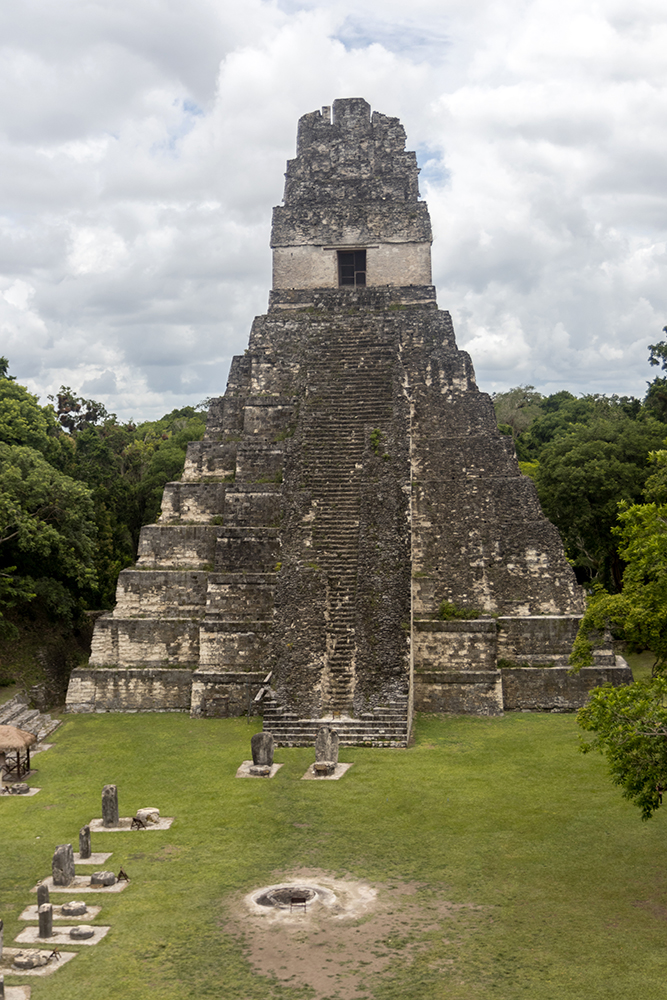
Vince was the first one to make the move to pry me and Bonnie away from photographing the monkeys so that we could get back on track with the tour. I looked over my shoulder as we walked away to get a last glimpse, and then continued along the trail until the back of Temple I, or the Jaguar Temple came into view behind a veil of leaves.
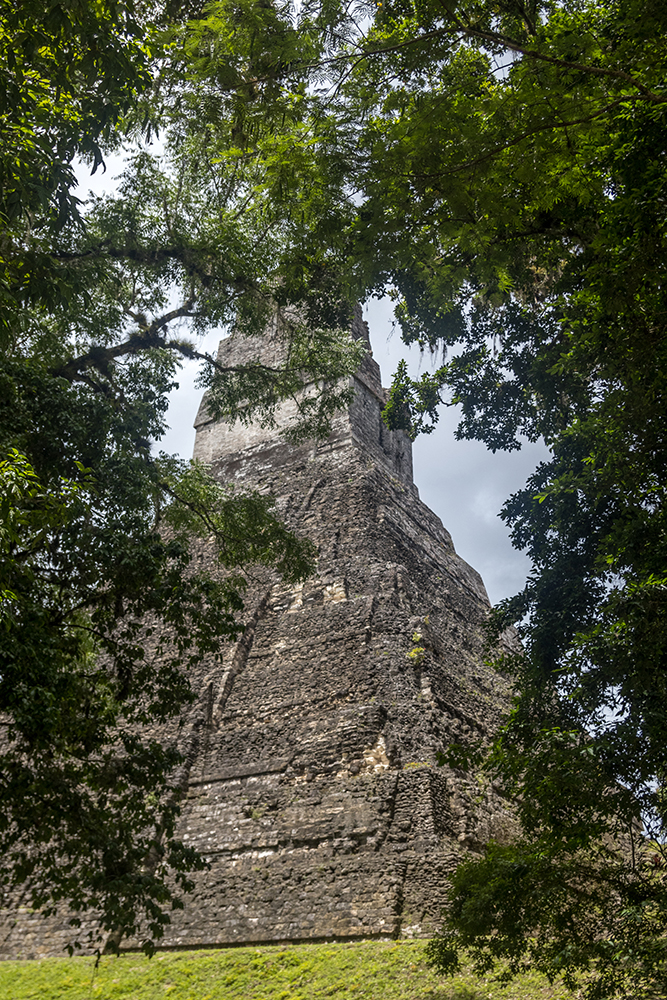
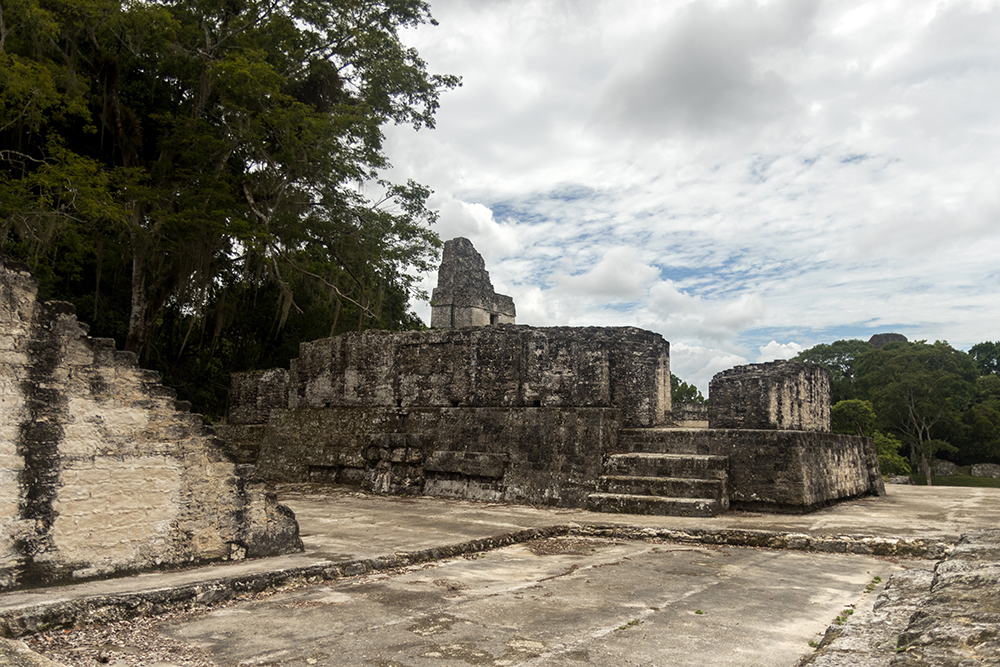
We walked around it until we stood square at its front in the middle of the Central Plaza. Here, we were surrounded by ruins on all four sides. The Jaguar Temple was the clear focal point of the scene, while the North and South Acropolises ran along either side of us, leading towards Temple II at the rear of the plaza. Temple II, the less grand of the set, was commissioned by the ruler Jasaw Chan K’awiil I to honor his wife, while his remains lie within Temple I.
Scanning the impressive scene of towering limestone, I couldn’t help but feel a bit surprised at how empty the plaza was. Handfuls of tourists wandered around in isolated pockets, but it was nothing like the crowds we’d seen while visiting Chichén-Itzá years ago. Omer set us free to explore the plaza on our own, telling us that we could climb up any steps other than the Jaguar Temple.
We started with the North Acropolis and then moved to the South, feeling as though we were living out our Indiana Jones dreams as we climbed around on layers of stone steps. My quads were already starting to burn by this point, and I had a feeling my legs would be sore for days with all of the Mayan ruins and hiking we had on our itinerary. But I also knew the pain would be worth the trade for the feeling of exploration and the jaw-dropping sights of ancient wonders.

Our time was running out by the time we reached a steep wooden staircase built onto the back of Temple II. We climbed up it quickly, despite the intense heat and my growing dehydration, and stepped onto a wide platform where we could see an astonishing view of the entire plaza.

After we’d had our fill of staring in awe at the ancient city sprawled out below us, we jogged back down the steps and found Omer waiting for us in a pavilion where we had the chance to buy water and Gatorade. I downed an entire bottle of Gatorade, then started in on a water as Omer led us along another trail where we could see the top of Temple III peaking out above the trees. Temple III has not been excavated, so the fact that a portion of it is still bare of trees is a testament to how tall it is. Its base is covered in foliage, but it’s gleaming white crown shone brightly in the afternoon sunlight.
Temple III marked the gateway to El Mundo Perdido, or The Lost World. We veered off on one of Omer’s shortcuts and emerged on the other side at another ancient grouping of buildings. Omer led us to a wooden staircase built on the side of a pyramid and told us to climb up and look at the view. This was the tallest climb yet, but I got a break about halfway up when I noticed some leaves rustling abnormally. My wish had come true! A lone spider monkey was foraging for berries in a nearby tree, in perfect view.

This time Vince didn’t have a chance of coaxing me away. He and David left me and Bonnie to our own devices, and we didn’t continue the climb until the monkey had vanished back into the cover of the canopy. Once it was gone we hurried up the remaining steps, and onto a platform where we were met with the most spectacular view of the day.
A sea of treetops spanned out below us, broken only by the tops of Temples I, II, III, and IV piercing through the canopy and meeting with the sky.
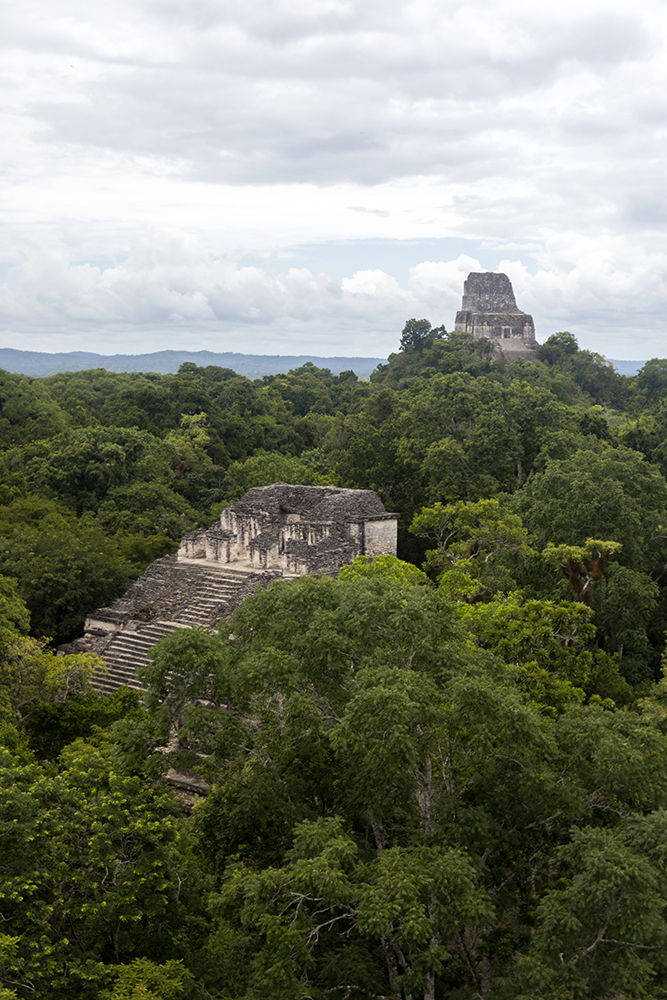


The scene was impossibly beautiful. In that moment I could imagine what it must have felt like for the first people who rediscovered Tikal long after it had been swallowed by the jungle and lost to time.
Tikal had truly surpassed all of my expectations, and as we hiked back down the stairs, I mentally marked it down as my favorite of the three Mayan sites I’d visited up to that point (little did I know the rankings would change again the very next morning). Omer greeted us once we were back on the ground, and then it was time to begin the journey all the way back to Belize. Our tour included a delicious lunch at a restaurant near the park entrance, then we boarded the bus and rode to the border where we said goodbye to Omer, and to Guatemala. Two more passport stamps later and we were on our way back to the Mariposa Jungle Lodge where we spent the evening hiking its trails, and swimming in the pool. Our time in Guatemala was over (for now at least), but our journey into the world of the ancient Mayans had just begun.








 birdsoftheairtravel.com
Thank you, Kaiti, for the fascinating tour! Greatly appreciated!
Joanna
What stunning sites you have visited. Such ancient culture, and great that you got an up-close look at some. Thanks for the great explanations and photos.