It felt like months had passed since we’d first arrived in Kathmandu to embark on our trek to Everest Base Camp. Of course, we’d only really been gone for about twelve days, but time had seemed to move differently in the Khumbu. Life there was limited to the pace of walking; everything we did took patience, and nothing could be rushed. Before the trek, I’d been excited to explore Kathmandu for a couple of days when we returned. Now that we were finally back in Nepal’s chaotic capital city, I felt overwhelmed by it. I was so used to the peaceful and quiet Khumbu region that the city now felt too loud, too crowded, and too overstimulating. Even all of the ammeneties at Hotel Lo Mustang were a bit jarring to me. Toilet paper was provided in the bathroom, Vince and I had a huge plush bed, and a giant TV hung from our wall. All of these comforts, while heavily appreciated, seemed extravagant somehow.
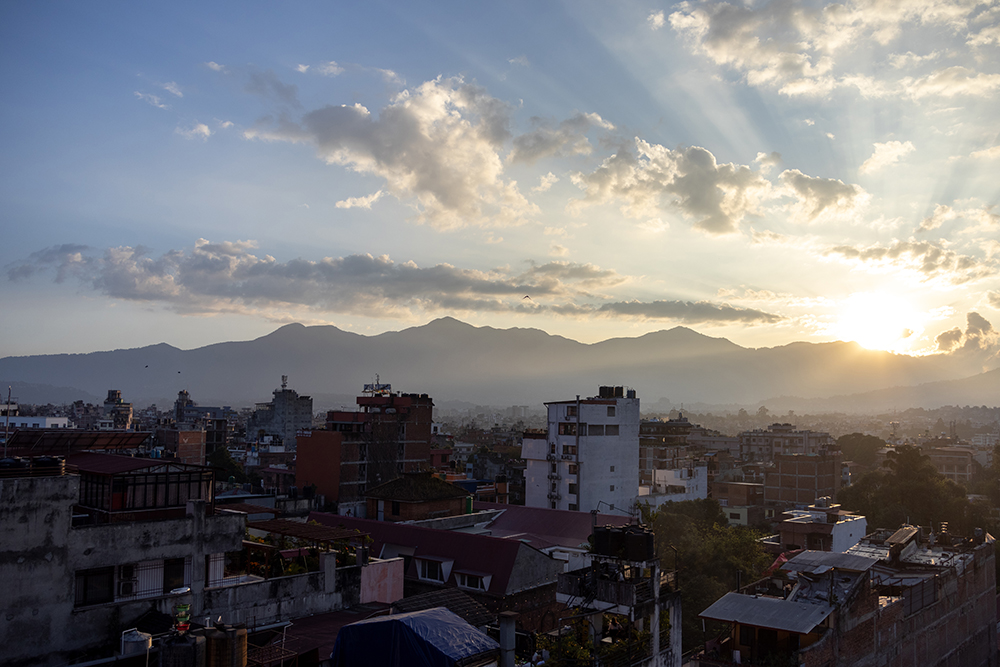
Vince, Thadd, and I decided to take our first day back in Kathmandu a bit slow. After getting cheeseburgers for lunch with PG and Tim, we went back to the hotel and soaked our feet in the rooftop pool while sipping local beers (cider for me). It was nice to take a few hours to relax. To my surprise, our ten day trek hadn’t made me very sore, that is until the very last day when we had to hike thirteen miles downhill. I was still recovering from that, and the cool pool water soothed my aching feet. We hung out on the roof until sunset, and watched as the city and surrounding hills were bathed in a golden glow, that was made extra atmospheric by the smog that consistently envelops Kathmandu.
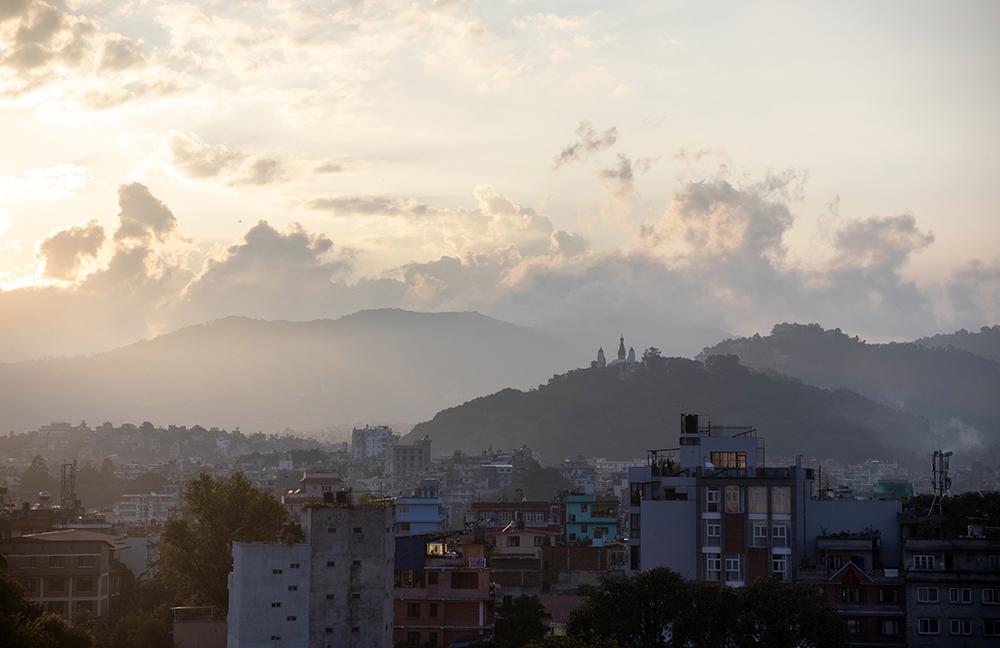
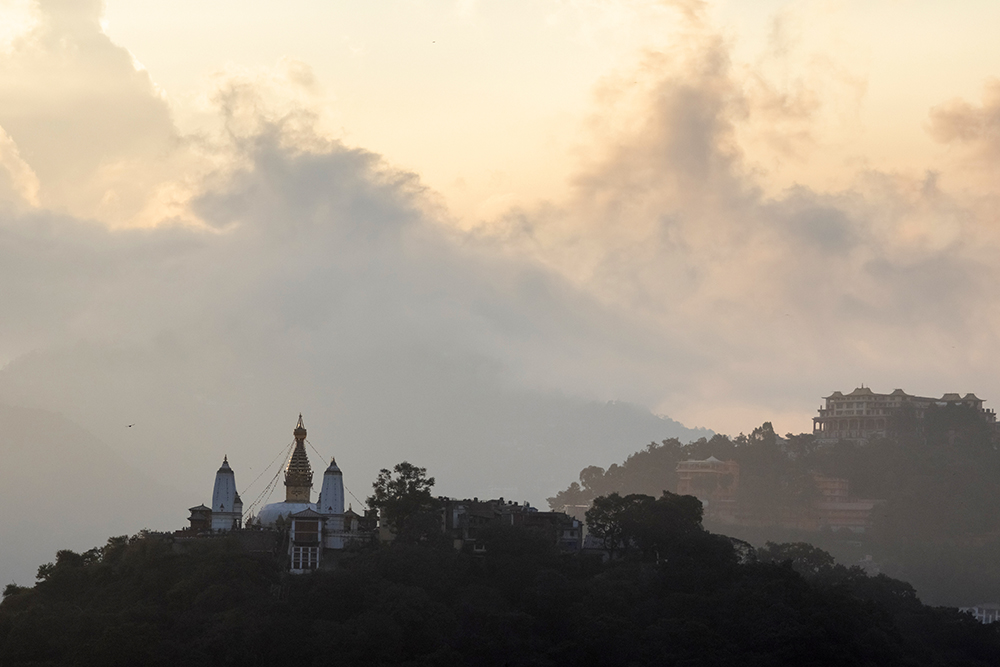
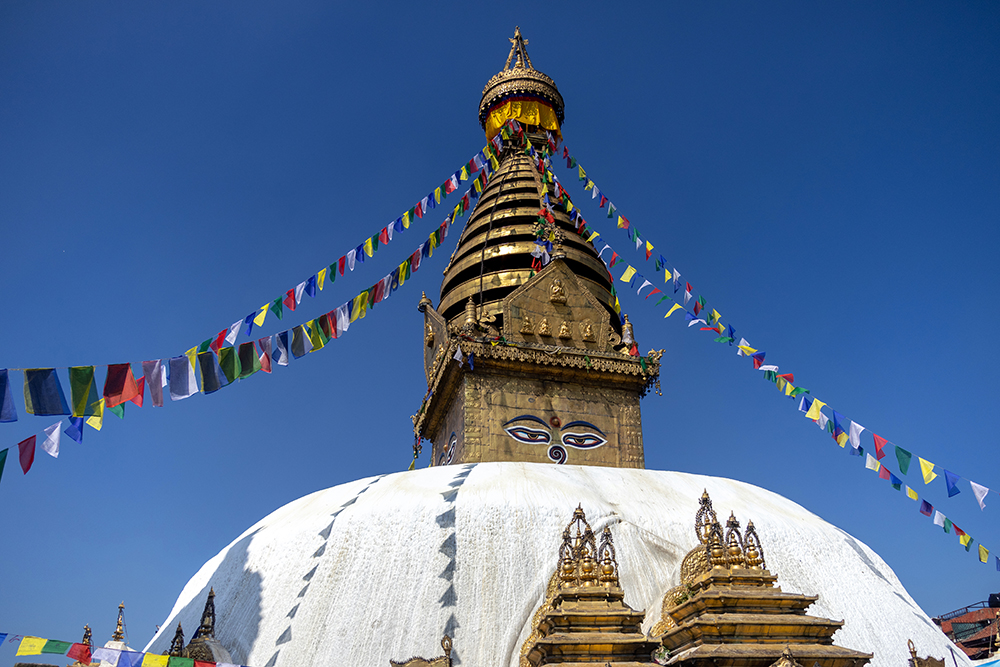
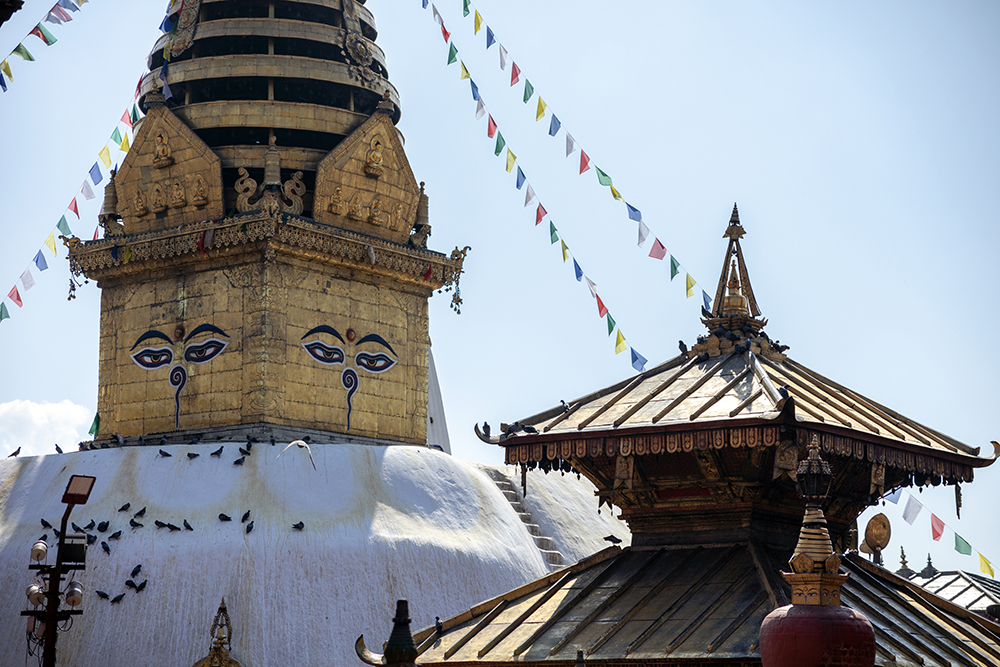
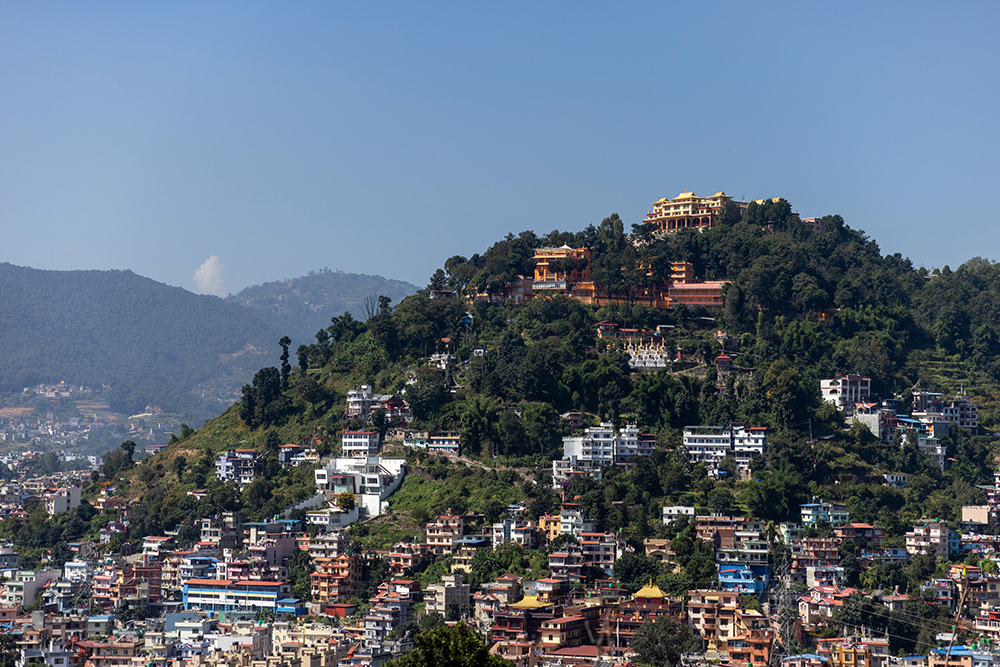
A hill rose up above the buildings in the near distance, and atop it sat a huge Stupa, its Eyes of Buddha seemingly watching over the city. I instantly recognized it at Swayambhunath, or the Monkey Temple, one of the most iconic temples in Kathmandu.
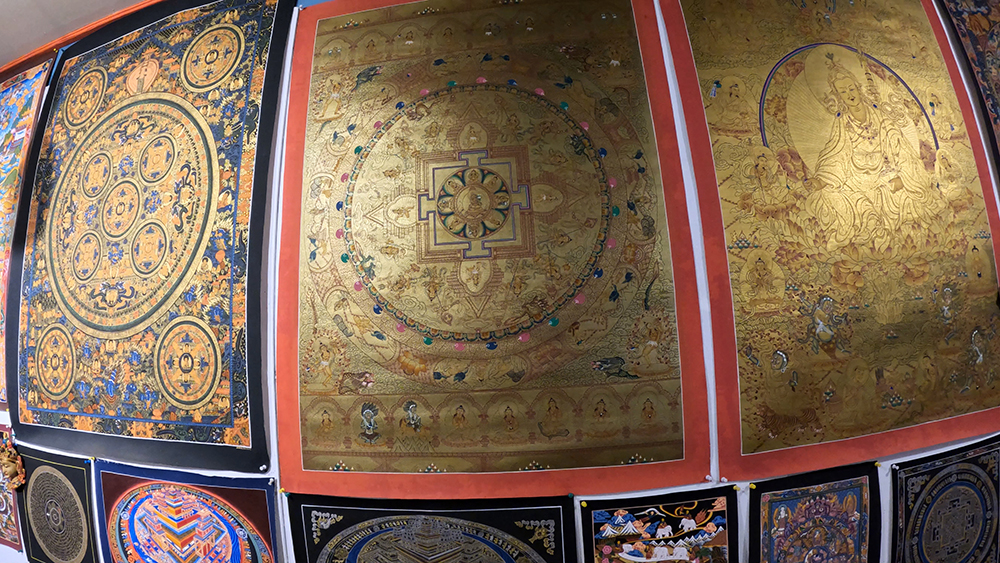
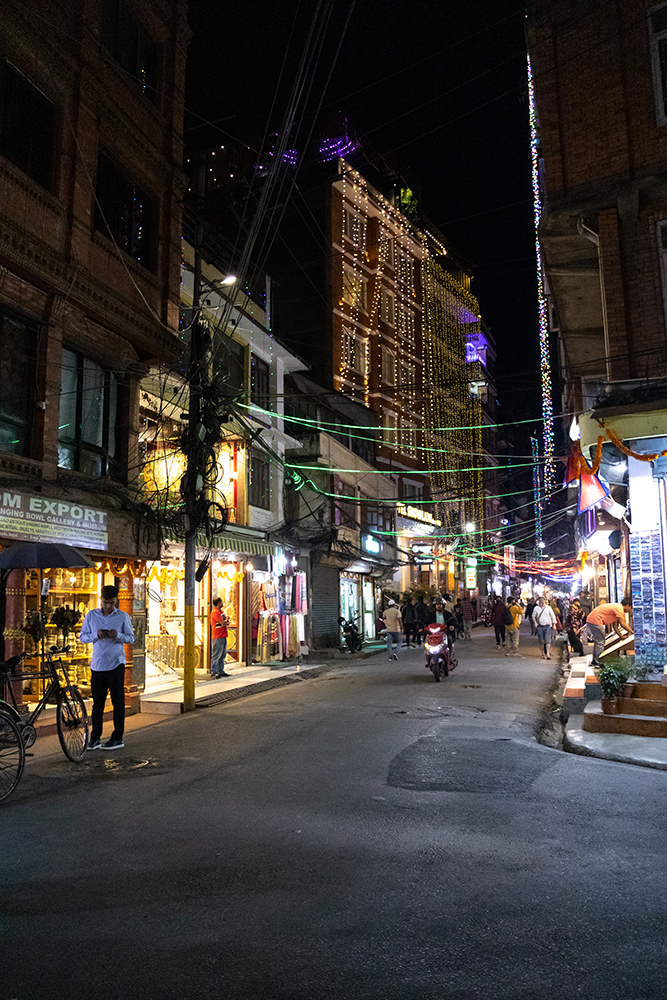
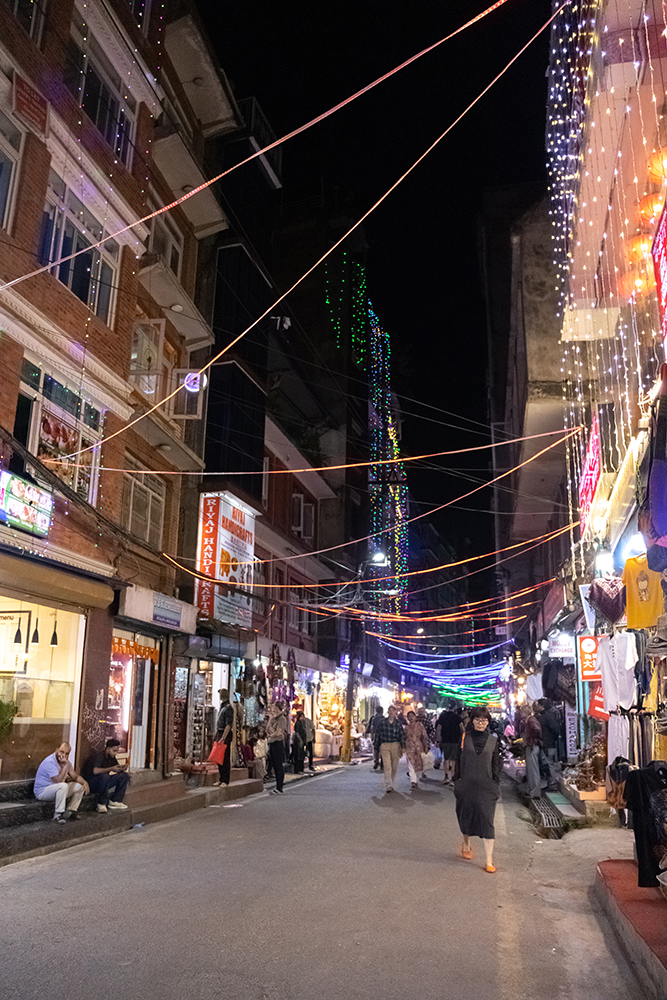
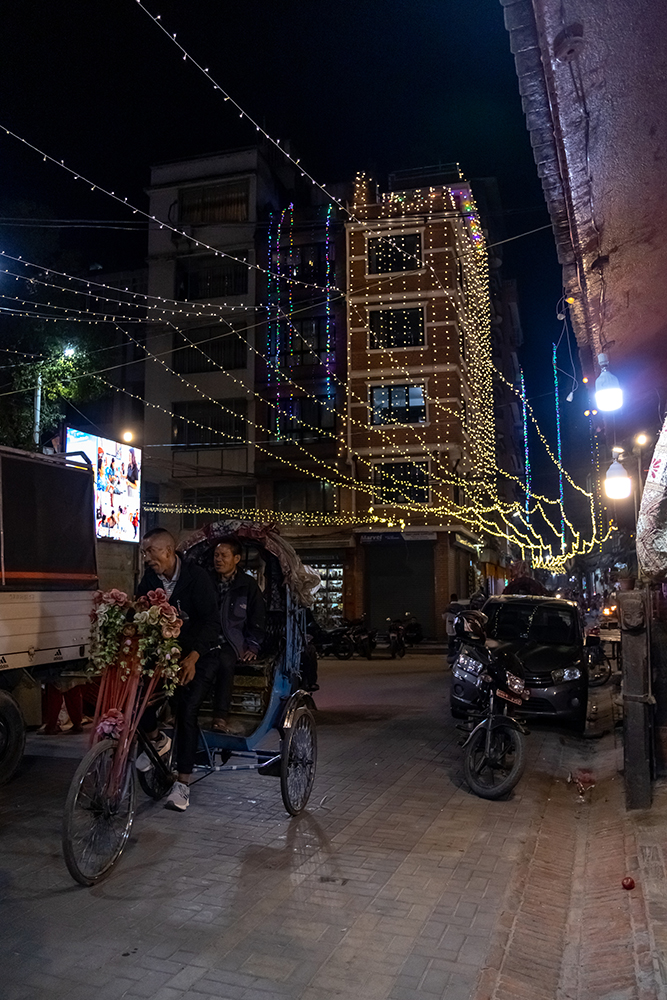
Looking out across the city was reenergizing. Suddenly, I was done with relaxing, and ready to go out and see what there was to see. So the three of us returned to our rooms to change out of our bathing suits, and then met back up in the lobby so we could go out and explore the Thamel neighborhood a bit. While we’d been gone, the shop owners and residents of Thamel had been busy hanging lights all over the streets in preparation for Tihar, and week long festival of lights similar to Diwali. We spent the evening wandering aimlessly around Thamel, shopping, and admiring all of the lights before grabbing a light dinner. Thadd and I each picked out a Thangka painting to bring home, a souvenir we’d both wanted since it’s a traditional art form local to Nepal and Tibet. Thangkas are intricate paintings done on silk or canvas scrolls, that depict Buddhist deities, or mandala designs. The owner of the shop that we ended up buying from showed us one of his own works in progress, along with several examples of student works and master works which were painted by his uncle who is a Lama. We ended up choosing masterpiece mandalas, and I still enjoy inspecting all of the beautifully painted details of mine. After we left the Thangka shop, we returned to the hotel to get some much needed sleep.
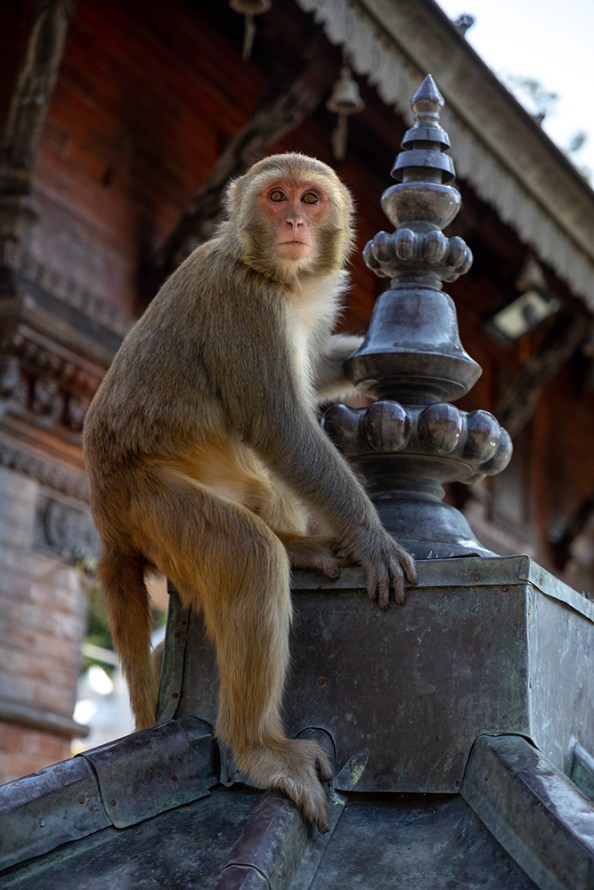
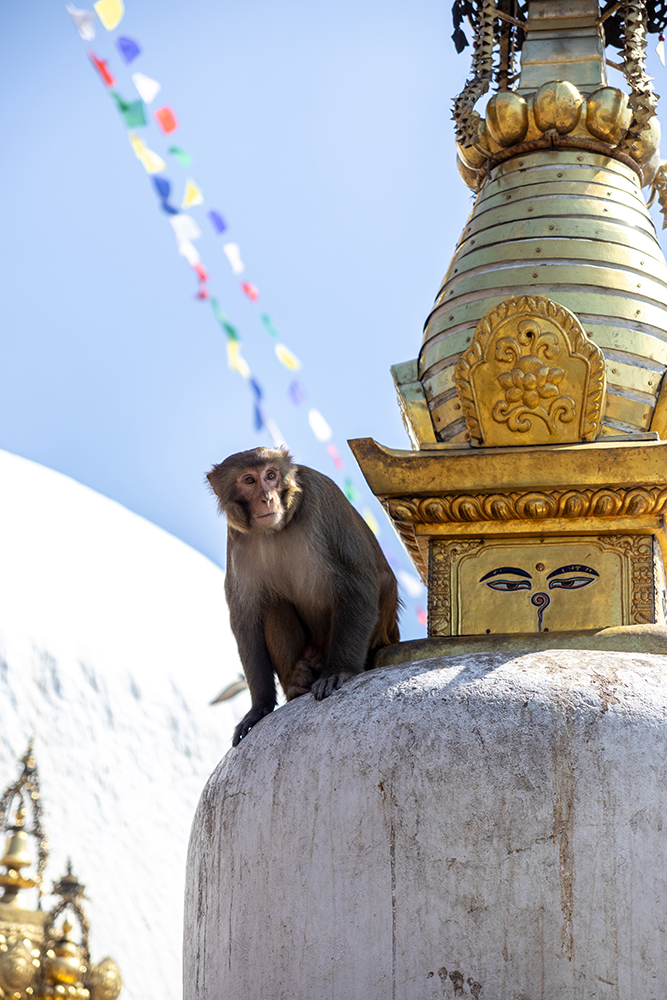
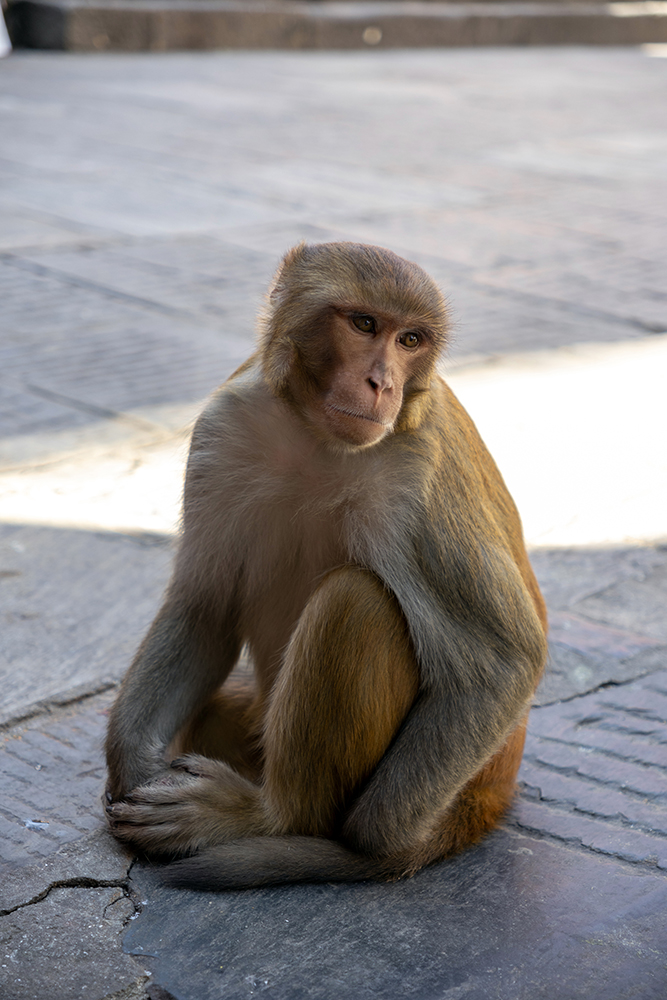
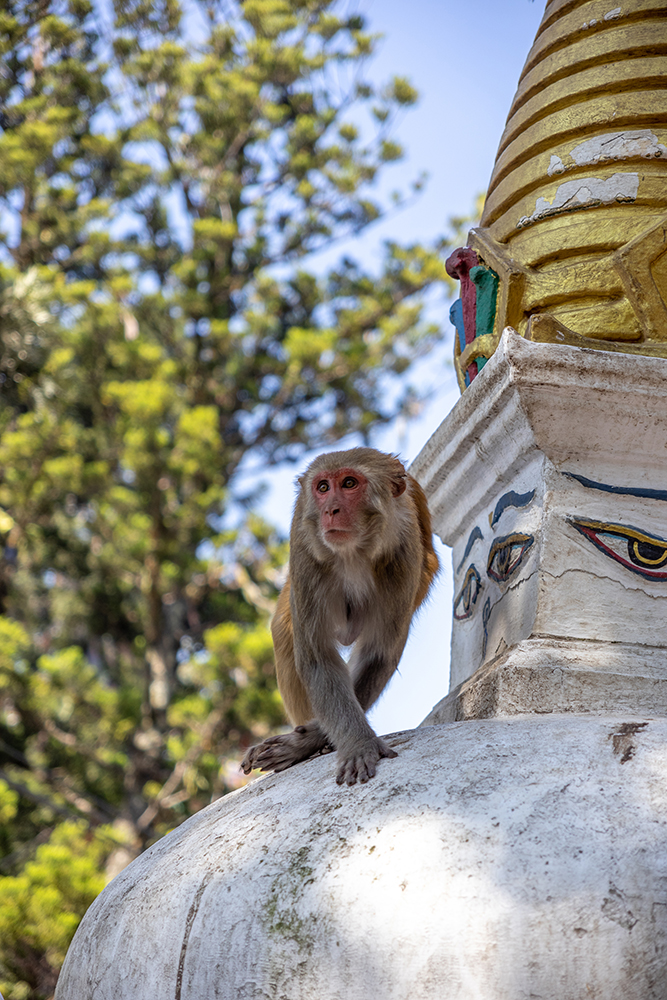
There is a lot to see and do in Kathmandu, and the next morning we got right to it because we’d planned a whole day’s worth of activities. We started the day at Swayambhunath, the Stupa we’d seen from the roof of the hotel the day before. Swayambhunath is one of the oldest Stupas in the world, and is one of the most sacred pilgrimage sites for Tibetan Buddhists. It’s name isn’t all that difficult to pronounce, but it does look a bit daunting on paper. I imagine this is why most tourists call Swayambhunath the “Monkey Temple.” That, and the temple complex is teeming with Rhesus Macaques, which we began to spot immediately after our taxi driver dropped us off at the base of the hill that the temple sits atop.
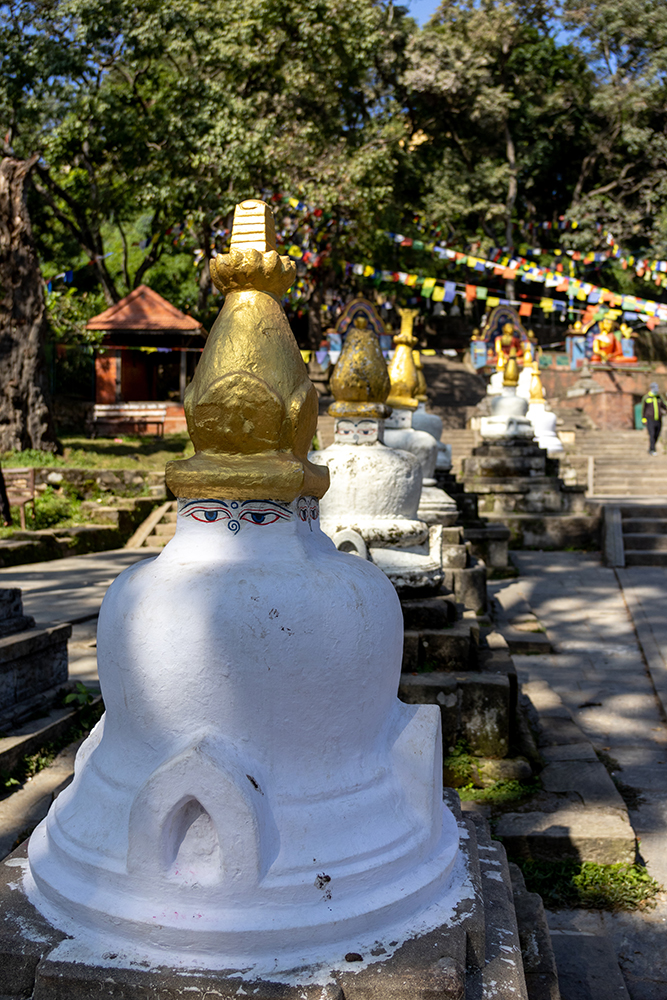
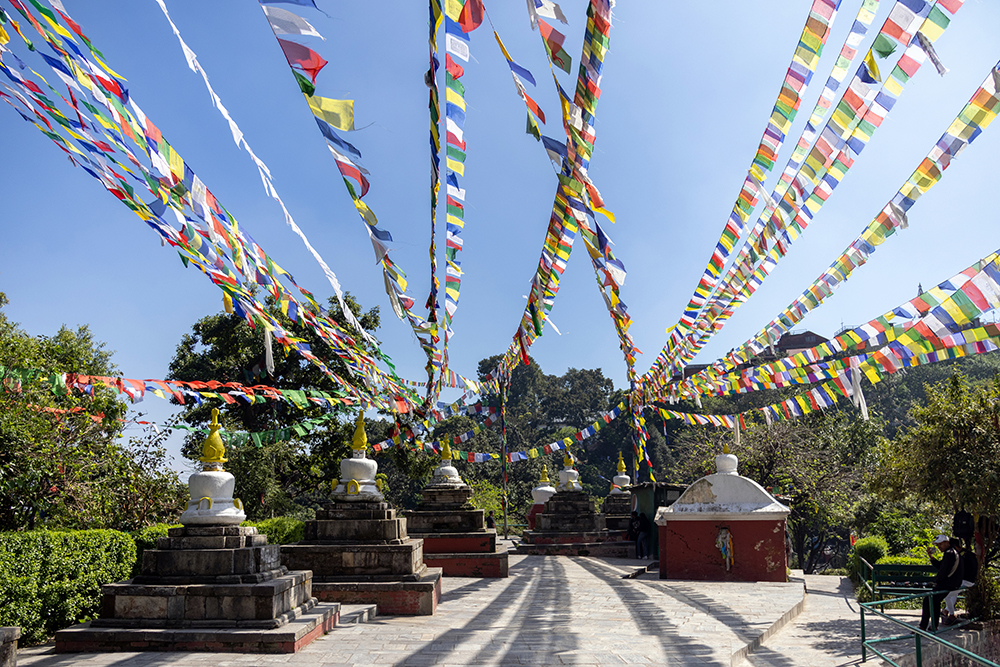
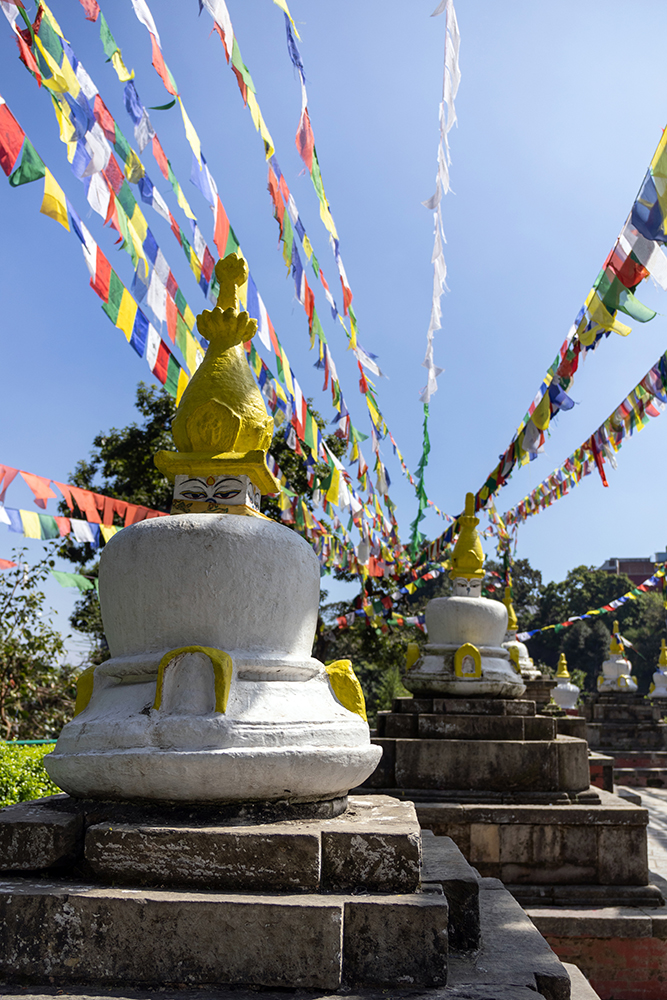
Small stupas and prayer flags lined a pathway that led us to a positively massive staircase. Having just spent the last week and a half walking about eighty miles, I was thouroughly unamused by this development. But with an air of long-suffering melodramaticism, I joined Vince and Thadd to trudge up one last steep staircase. In reality, this was a fitting bookend for our entire experience, since most of our training for the trek had involved climbing up and down a tall set of stairs on a hill in our city. Sweat was beading on my forehead by the time we made it to the top of the hill and bought our entrance tickets, but overall the climb wasn’t difficult in comparison to walking on flat ground at 17,000 feet above sea level. Just above the ticket booth, we mounted the last step and finally stood underneath the Stupa, its golden spire gleaming in the bright sunshine.
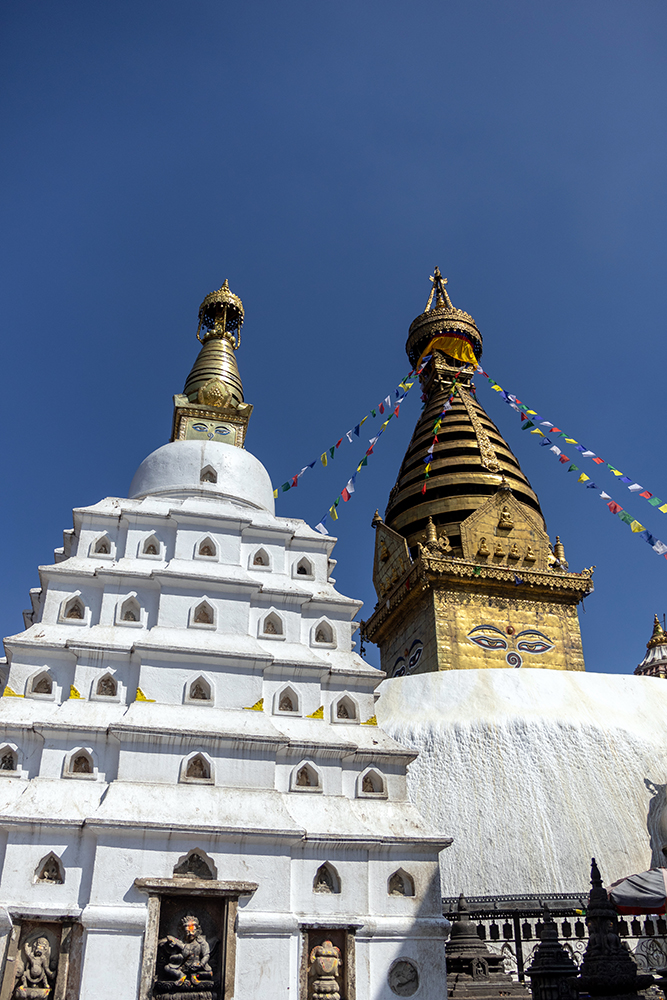
True to the temple’s nickname, there were macaques in every direction we looked. The temple complex is larger than it looks from far away, and there are several different buildings on the site. We got to go inside of a monastery, and admire panoramic views of the Kathmandu Valley. As we circumambulated the Stupa, we encountered lots of smaller sculptures and monuments, most of which were occupied by one or more monkeys. They especially seemed to like hanging out on the many smaller stupas found throughout the complex.
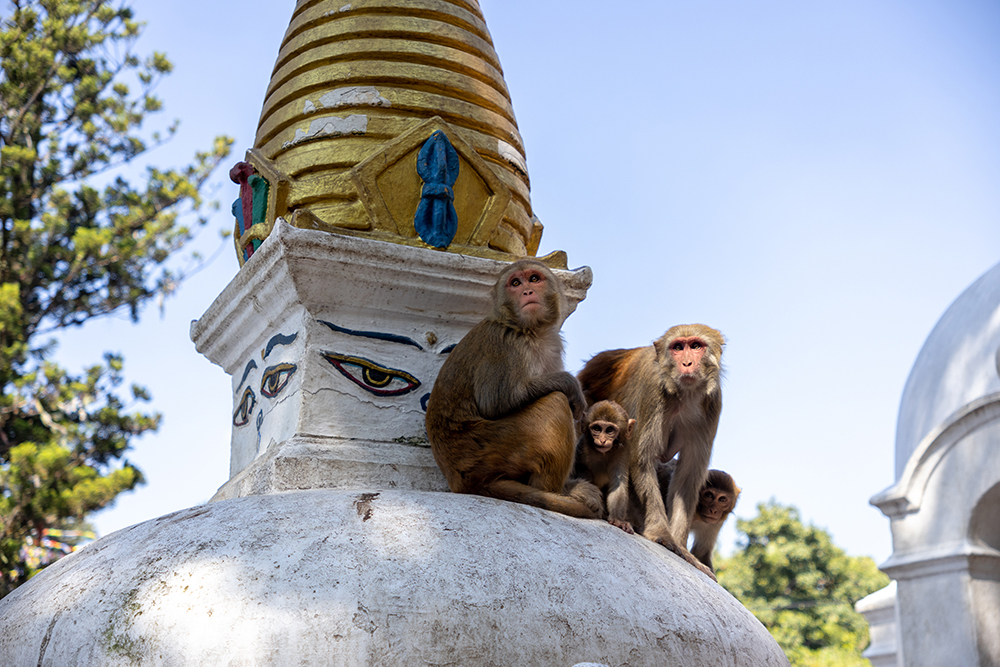
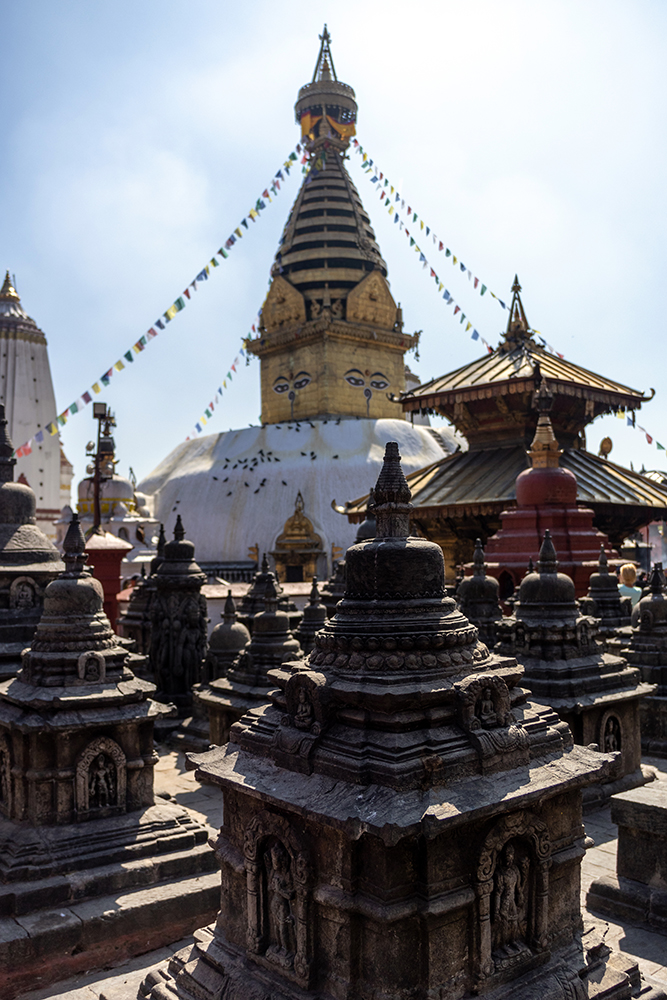
We ended up spending a lot of time at Swayambhunath because there were so many different areas to explore. I really appreciated the artistry and attention to detail in all of the architecture, and of course, it was a lot of fun watching the monkeys chase each other around and climb on sculptures.
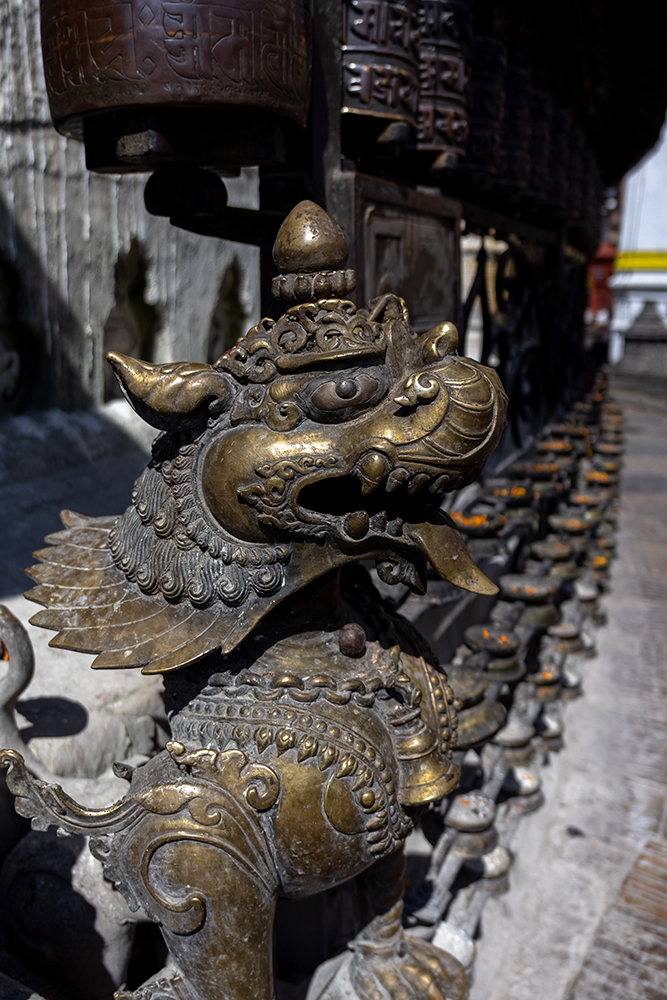
Just as we were getting ready to leave Swayambhunath, a rogue turd fell from a tree and landed right on Vince’s shorts. It was unclear whether the offending monkey actually threw the poop at him, or if it simply let loose right above him. Either way, a nearby shopkeeper assured Vince that getting pooped on was good luck.
Good luck or not, Vince wanted to stop back at the hotel and change into some clean pants. So we made a quick detour before heading over to Kathmandu Durbar Square. We didn’t have much time to spend there, but we wanted to at least take a look at it from the outside because it’s the historic hub of the city, filled with ancient palaces and temples. We got to see a few of the old temples from outside of the site, then we grabbed another cab and took it across town to the Boudanath Stupa.

It was lunch time now, and we met up with PG one last time to have a meal at his Aunt’s restaurant. We got to try rikikur, which are Sherpa potato pancakes, Sherpa stew, and fried momos. We also ordered two different kinds of Laphing, which is a Tibetan street food, and a staple of the area around Boudanath Stupa.
By the end of the meal, we were all stuffed to bursting. We thanked PG’s family, and then the four of us went back outside to visit the stupa.
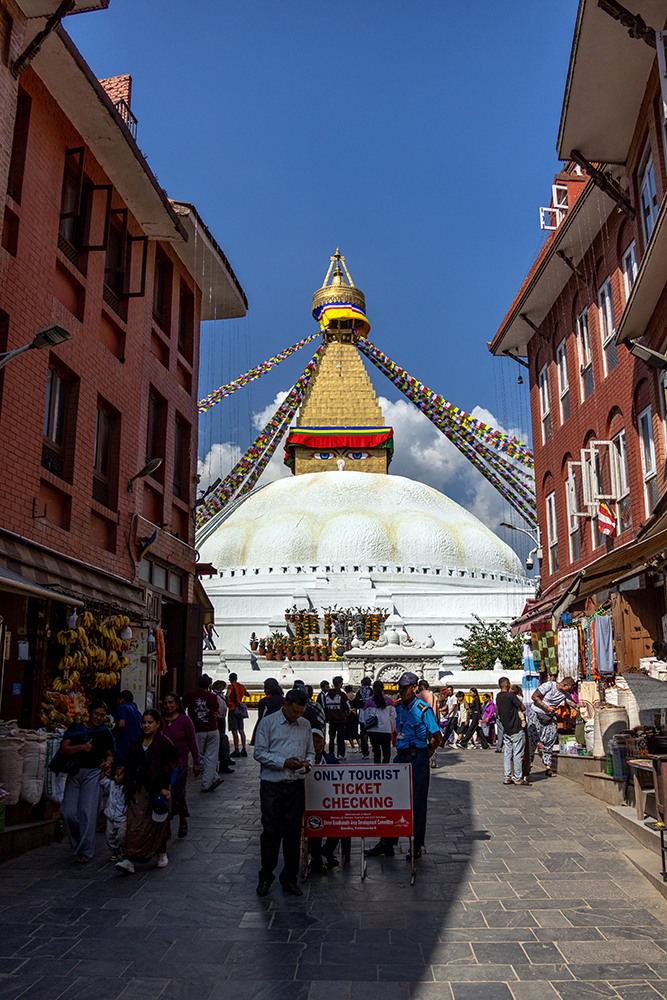
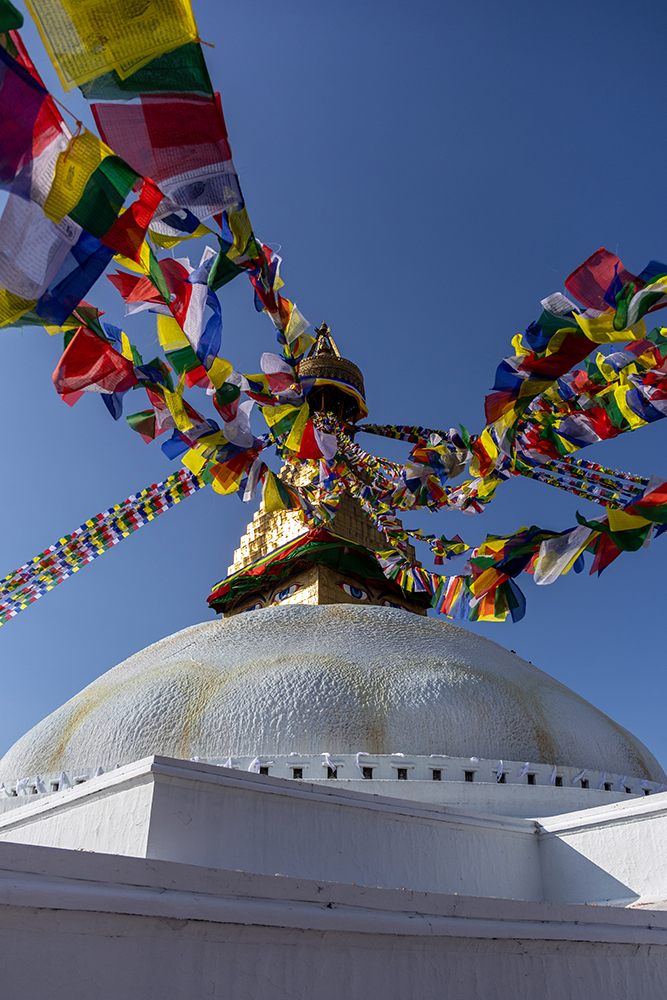
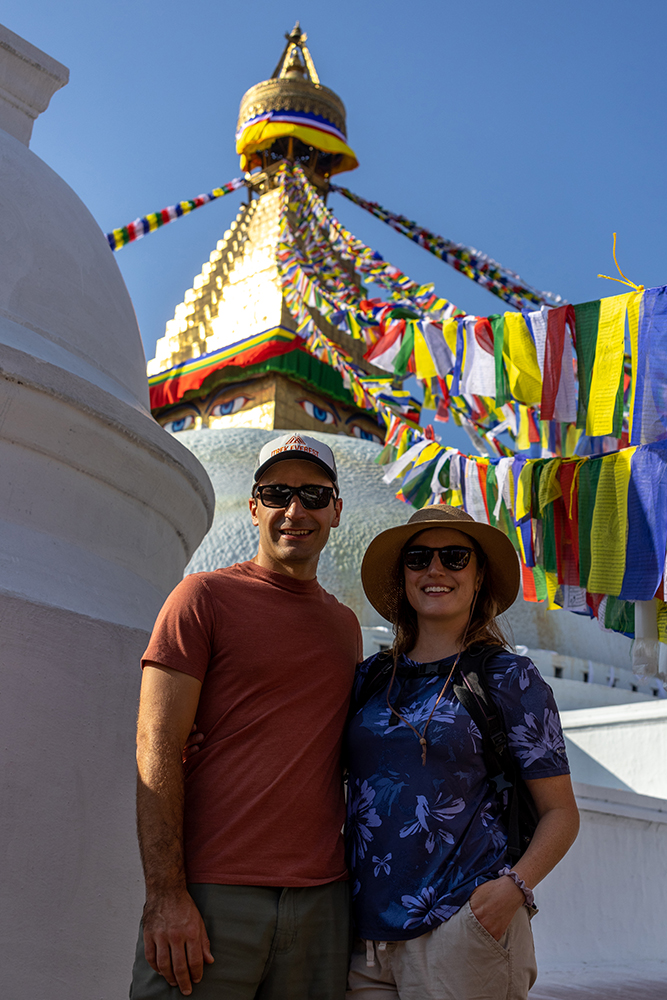
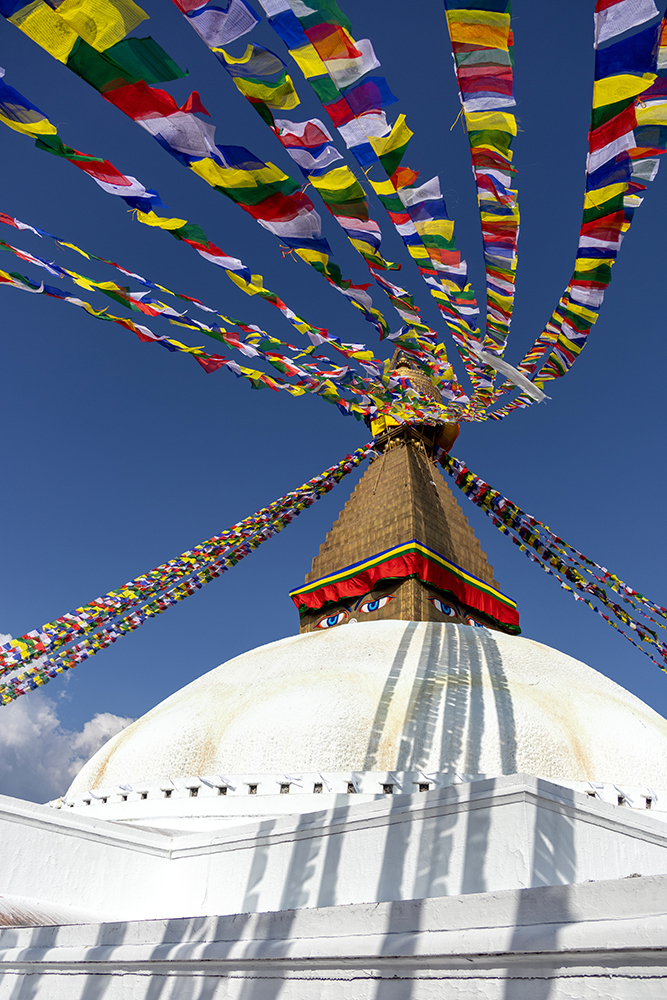
Boudanath Stupa, also known more simply as Boudha Stupa, is one of the largest spherical stupas in the world, and another important pilgrimage site for Tibetan Buddhists. Pigeons danced in the sky above the stupa’s towering spire, as prayer flags strung from the top wafted in a light breeze. We all took off our shoes and then climbed a small set of stairs onto the huge base on which the stupa stood. PG led us around the stupa in a clockwise direction, and we stopped every so often to snap pictures and watch the prayer flags moving with the wind.
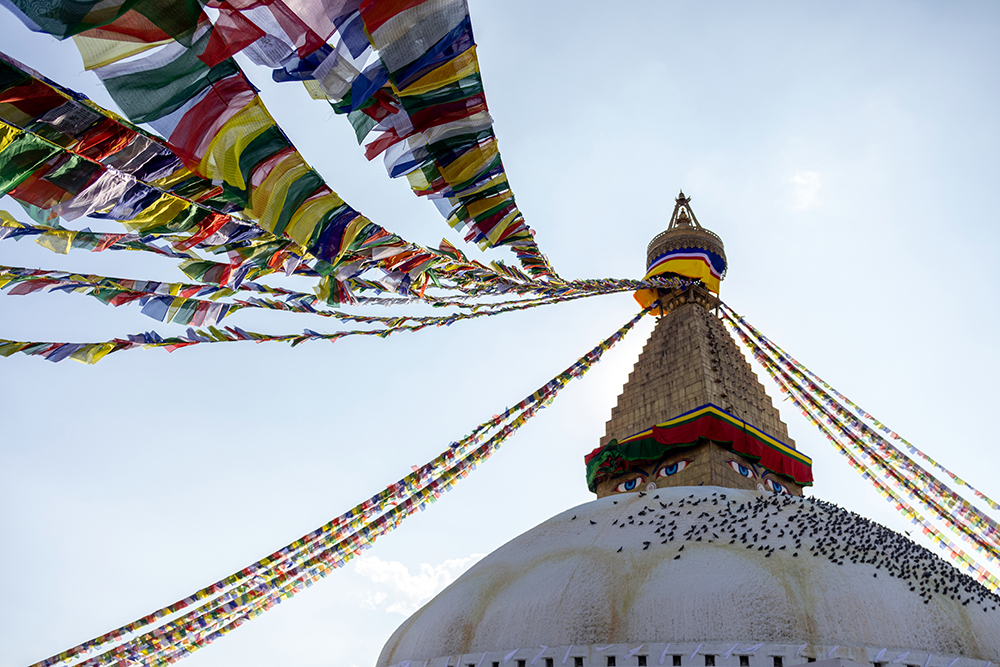
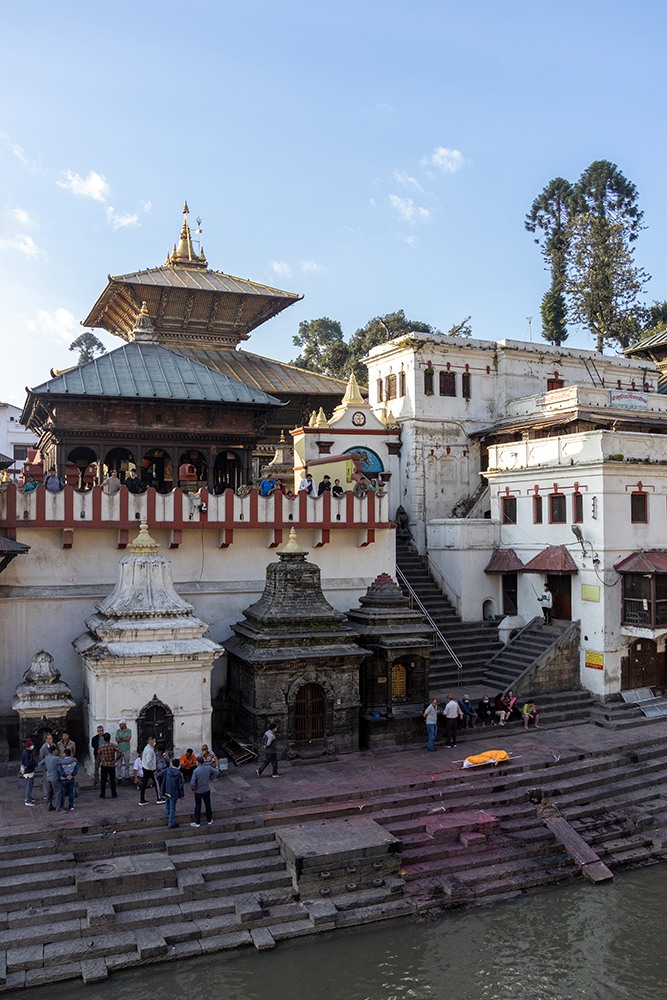
We said goodbye to PG after completing our circumambulation of Boudha Stupa. Then took another taxi over to our final destination of the day, Pashupatinath Temple. Pashupatinath is a Hindu temple that sits on the banks of the Bagmati River, and I was very intrigued to visit a Hindu site, especially because of all of the Tihar festivities that had been winding up around the city.
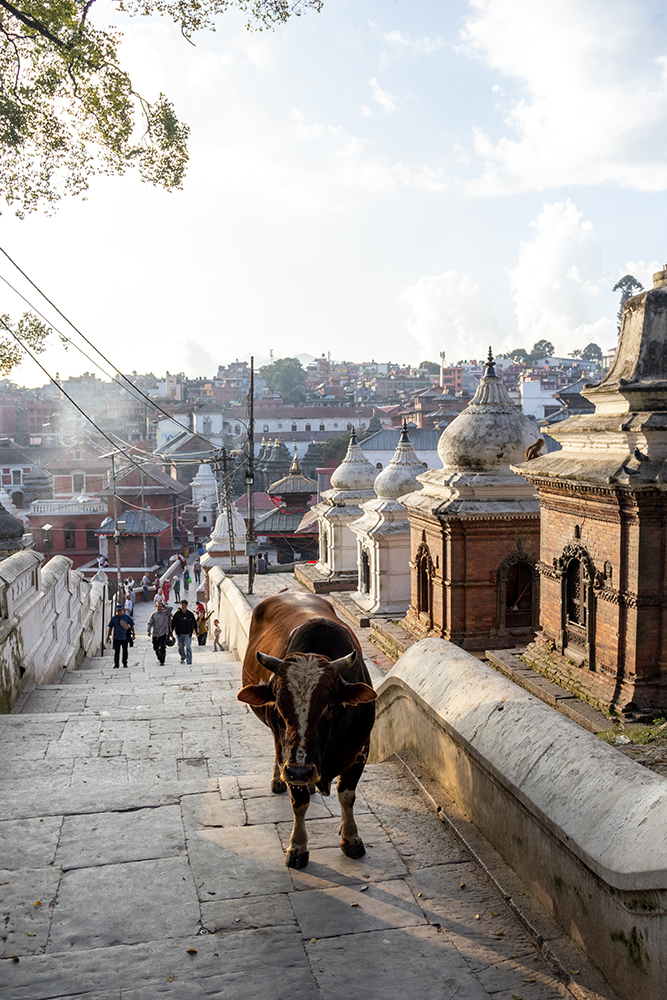
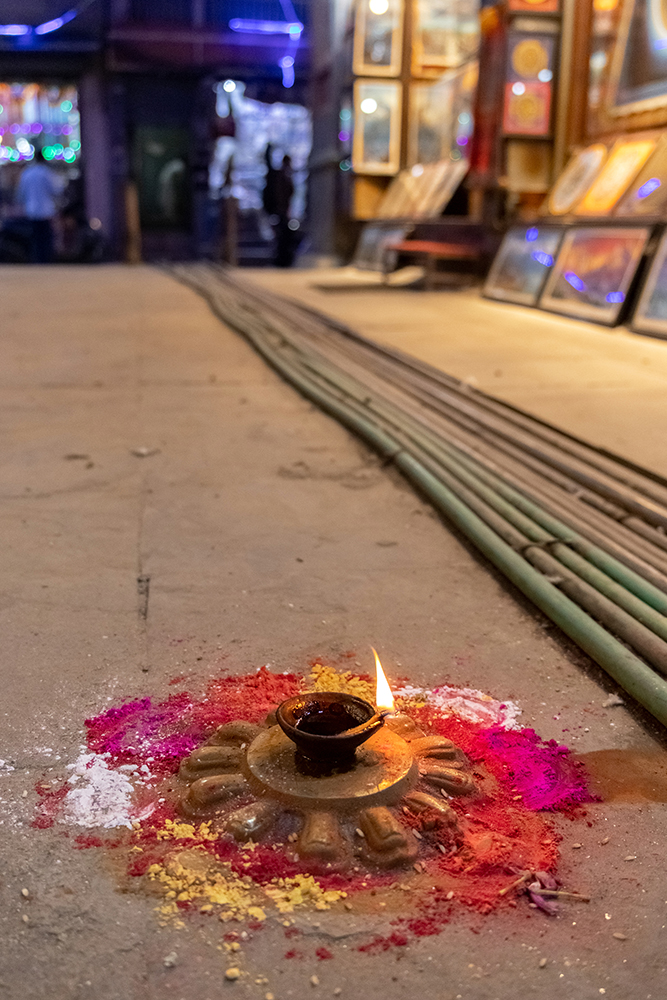
Our taxi driver dropped us off about a block away from the temple, and as we walked toward the complex, we could immediately sense that this neighborhood had a very different feeling than the other parts of Kathmandu that we had seen. For starters, there were cows wandering through the streets, something that we had definitely not encountered in Thamel. The local shops were also selling very different items. Instead of trekking gear and souvenirs, they sold cut flowers, Rangoli powder, and diya lamps. All of these items would be used throughout the city as the Tihar celebrations amplified with each passing day.
This was the first of the five days of Tihar. The first four days of the festival are dedicated to the worship of different animals, and on the fifth day, brothers and sisters worship each other. The first day of the festival is called Kaag Tihar, and is dedicated to the worship of crows. People worship the crows by saving part of everything they cook and put it out on the streets and on their rooftops to feed the crows. I didn’t notice any crows throughout the day, but the pigeons were definitely enjoying all the offerings. As we neared Pashupatinath’s entrance, we passed by a large flock of pigeons who were cooing loudly as they pecked at seeds that were scattered on the ground.
At the entrance gate, a site guide advised us that we should hire him to show us around the temple. We initially declined, assuming we could figure the complex out on our own. He gave us a knowing look and said, “Okay, come back and get me if you change your mind.”
Within five minutes of entering the site, we’d changed our minds. There was no denying that we had no idea where to go or what anything was. So, somewhat sheepishly, we returned to the entrance and hired the guide. To his credit, he didn’t even say, “I told you so.”
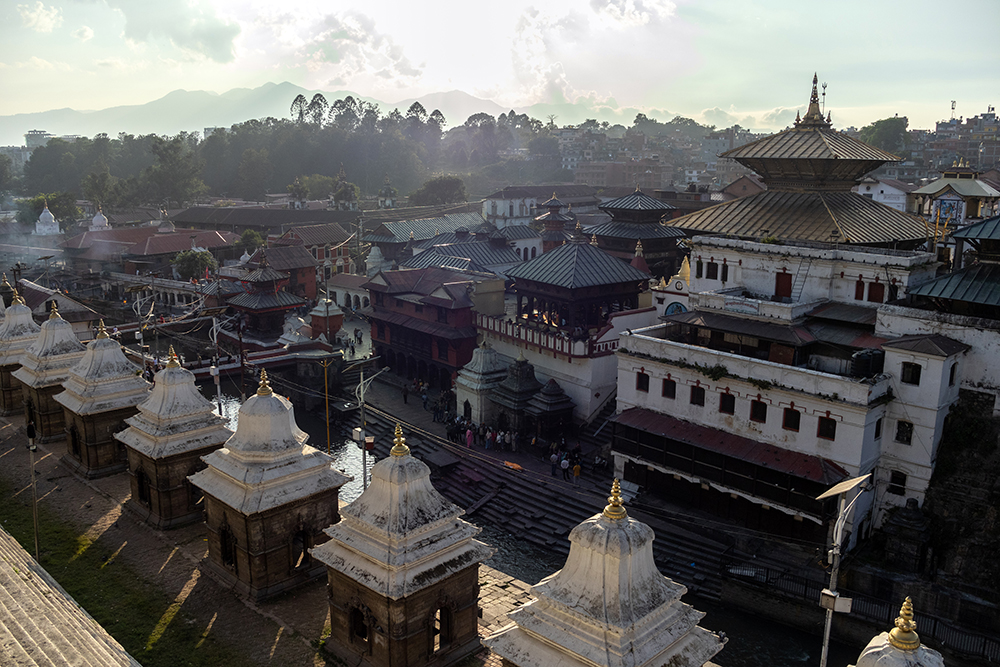
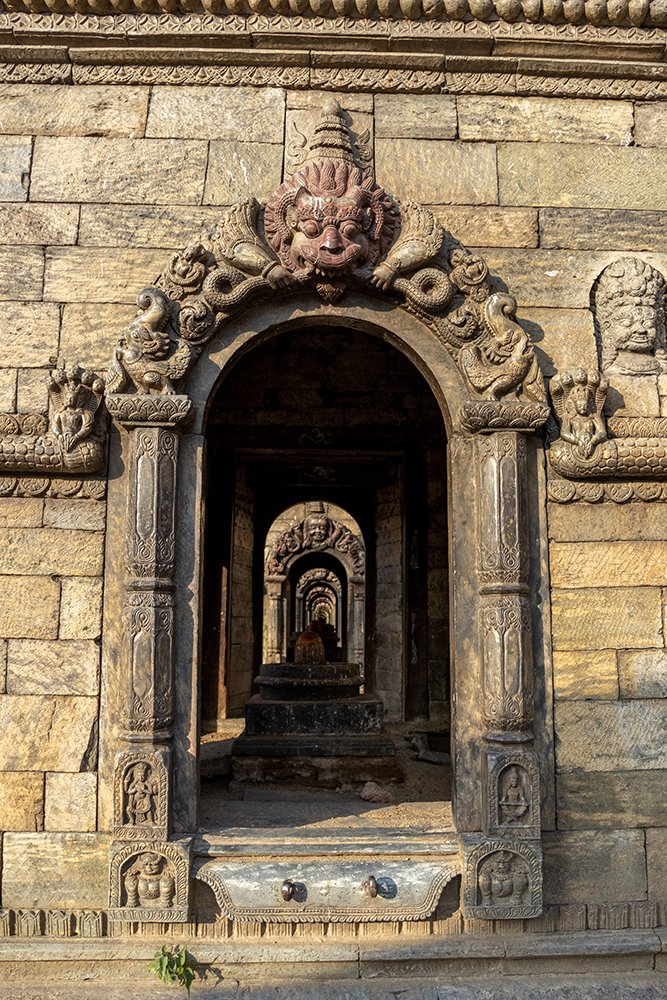
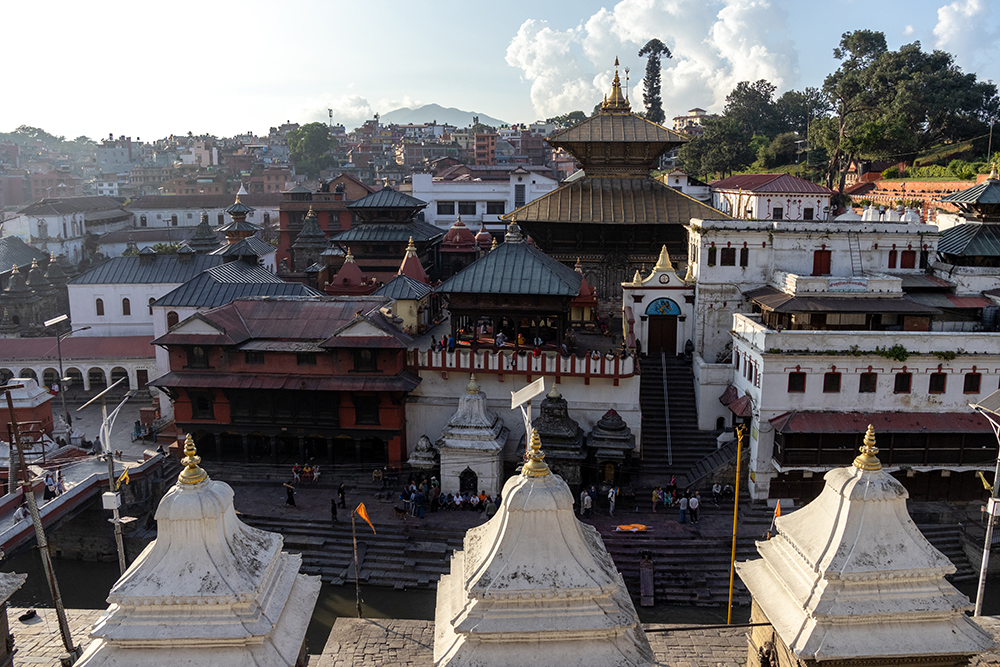
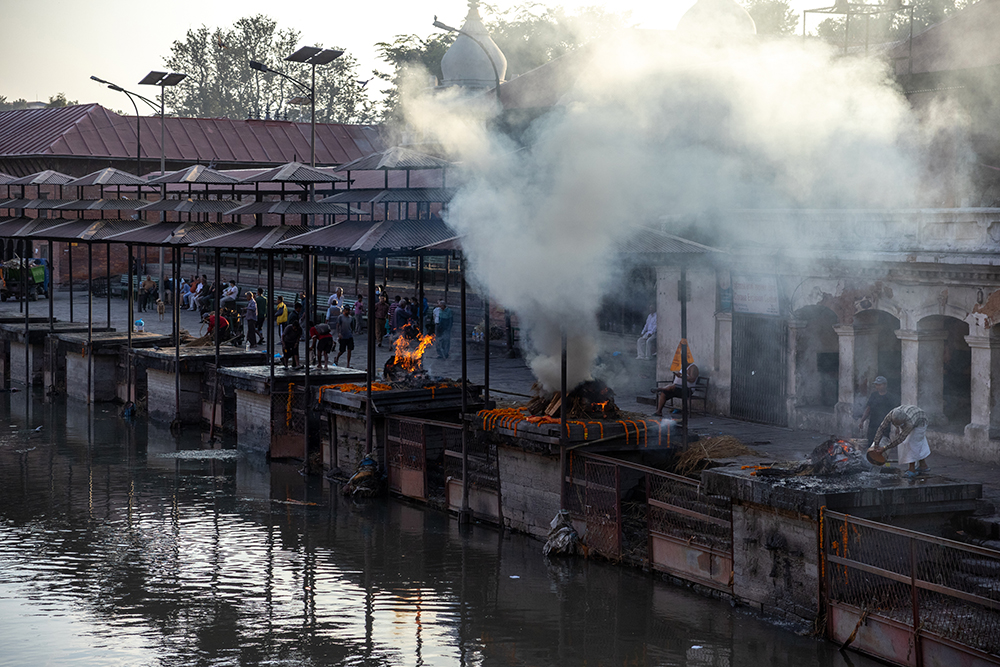
As he led us into the complex, he explained that Pashupatinath is the oldest Hindu temple in Kathmandu, and is dedicated to Pashupati, which is a form of Shiva. Only Hindus can enter the main temple on the site, but the complex is quite large, and there is a lot to see even without going into the temple. He led us around the temple, and pointed out an ambulance that was parked right next to a side entrance. The ambulance, he explained, was dropping off the body of someone who had passed away earlier that day. One of the things that Pashupatinath is most known for, is that there are cremation ceremonies taking place outside of the temple around the clock. Cremations are held on the same day that someone dies. The fires burn for several hours, and when they are done, the ashes are scattered in the Bagmati River.
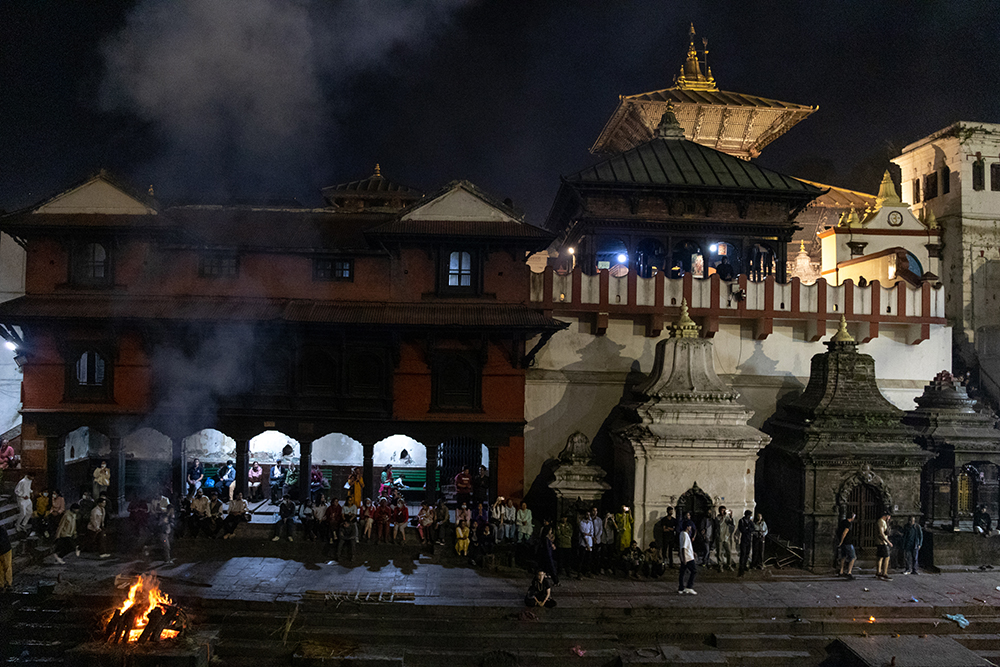
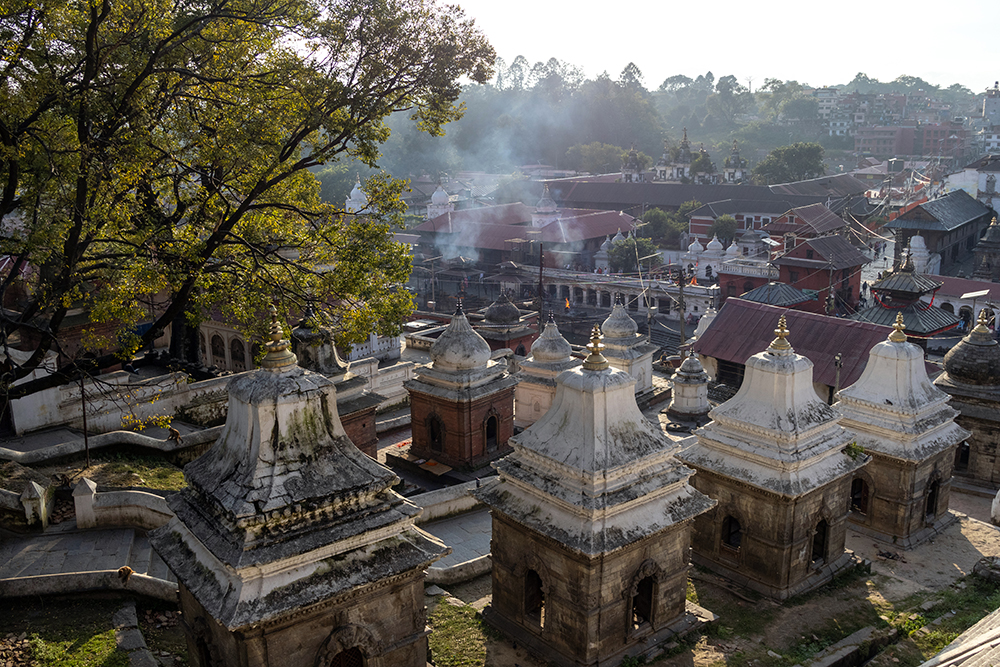
By the time he finished explaining this, we had reached the bank of the river, where a couple of cremation fires were currently burning, sending plumes of thick, gray smoke into the sky. Tendrils of smoke clung to the air around the river, which was thick with an acrid scent.
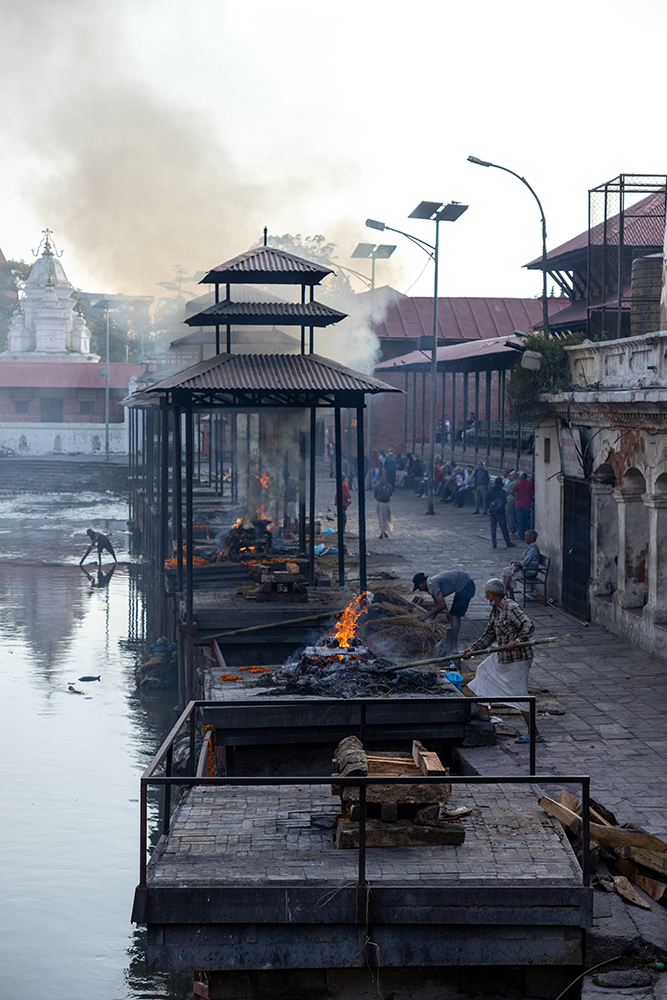
Our moods all grew somber as our guide taught us that in the Hindu faith, cremation releases a soul from its body, and later it will be reborn into a new body. As an American who is used to funerals being relatively private affairs, it was very interesting to see how public the cremations were. Tourists wandered around the banks of the river taking pictures, and a local was feeding a bunch of stray dogs who were vying for scraps in a frenzied pack. Meanwhile, another processional had started towards the pyre. Amidst all of the activity, a family was carrying the body of a loved one, wrapped in orange cloth and flowers, towards a platform that had been prepared for them. A woman walking behind the body wailed loudly, and our guide remarked that she must be Buddhist, because Hindus don’t cry at funerals. I have no idea if that’s true, but that’s what he said.
Once the processional had passed by us, we crossed a stone bridge that spanned the river, and started walking up a wide staircase on the other side. Along the way, our guide pointed out a couple of spots that can be seen in the Movie Doctor Strange, which filmed on location throughout Kathmandu.
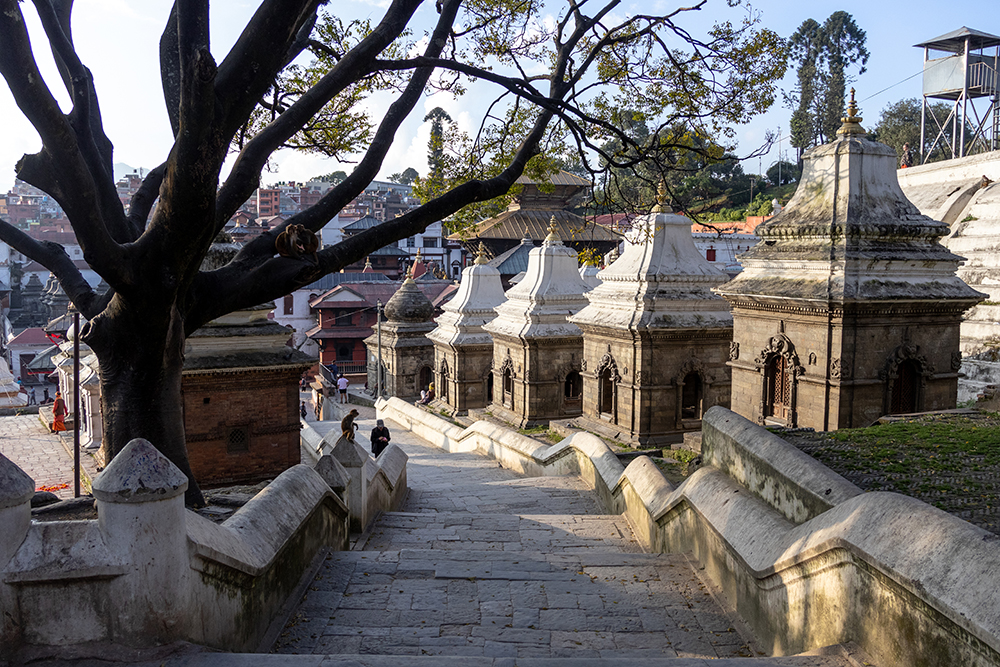
He also took us to the best spots to see panoramic views of the entire temple complex, which is sprawling. All the while, smoke from the cremation fires hung in the air, and mingled with the smog that already enveloped the entire city.
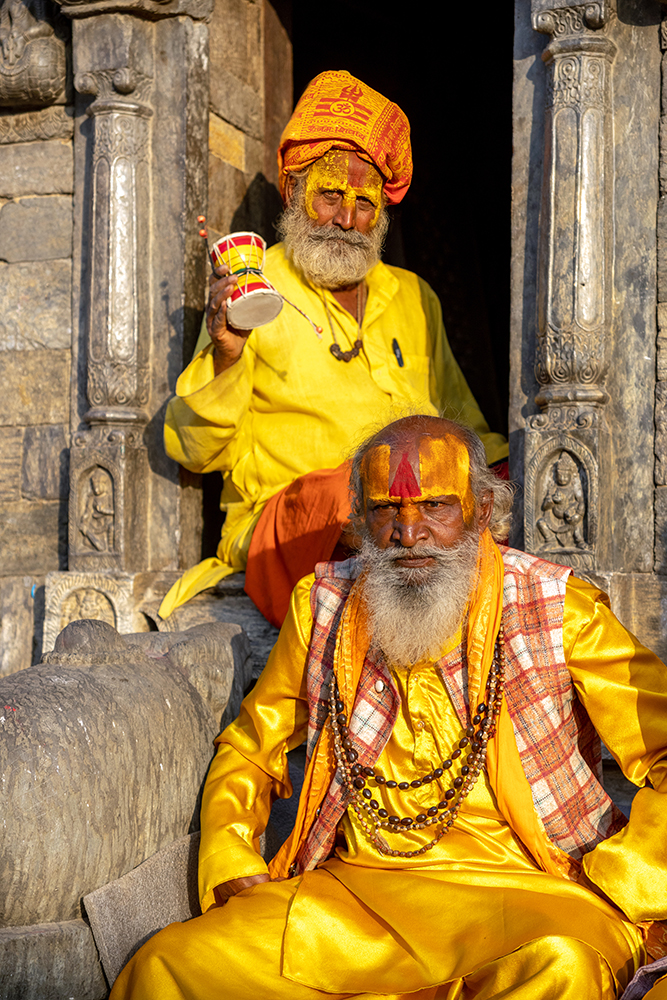
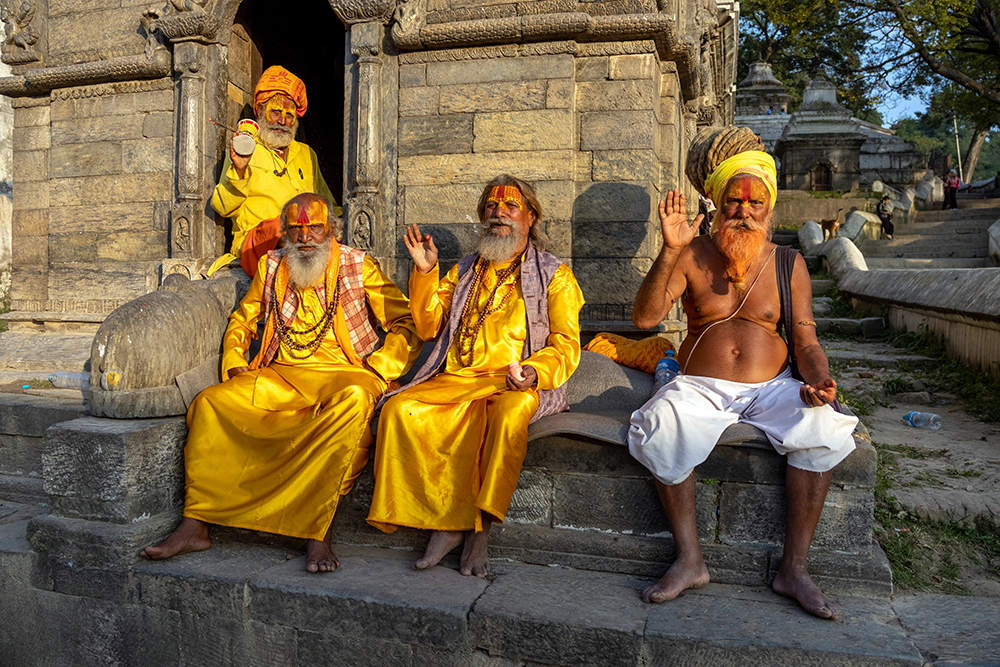
On our way back to the temple entrance, we stopped and made a donation to a group of Sadhus so I could take their picture. The Sadhus of Pashupatinath are holy men who have given up worldly pursuits in order to follow Lord Shiva. They dress in brightly colored clothing in shades of yellow, orange, and red, and paint their bodies with ash and saffron.
When the tour ended back at the entrance gate, we mentioned to our guide that we were interested in coming back for the evening Aarti ceremony after sunset. He gave us some recommendations for when to arrive, and where to go, and then we wandered the streets in the nearby neighborhood while we waited for sunset. We ended popping into a hotel and had tea at their restaurant before it was time to head back to the temple for the ceremony.
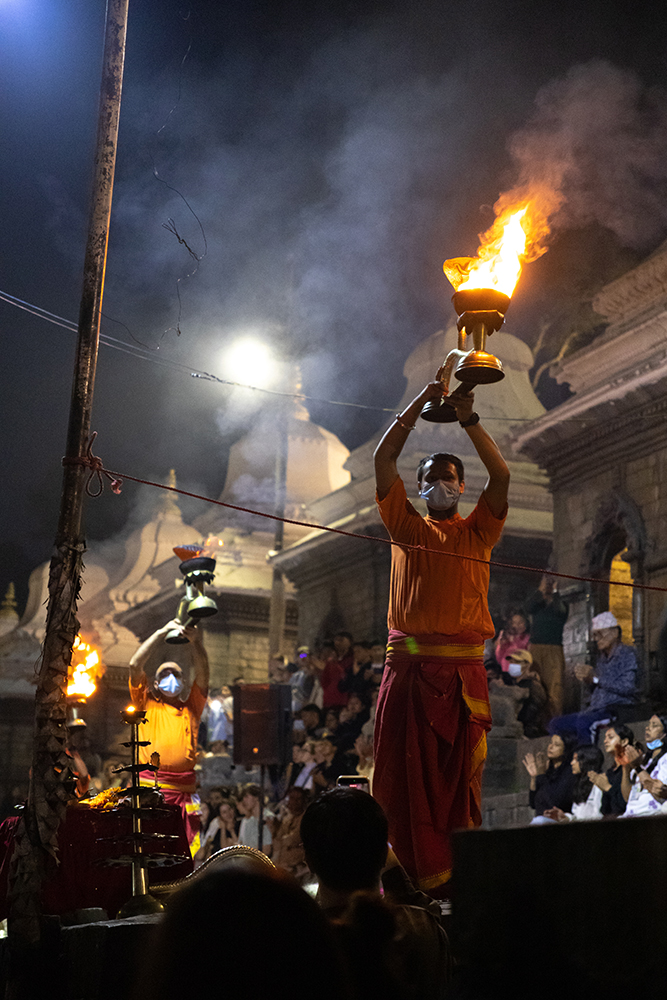
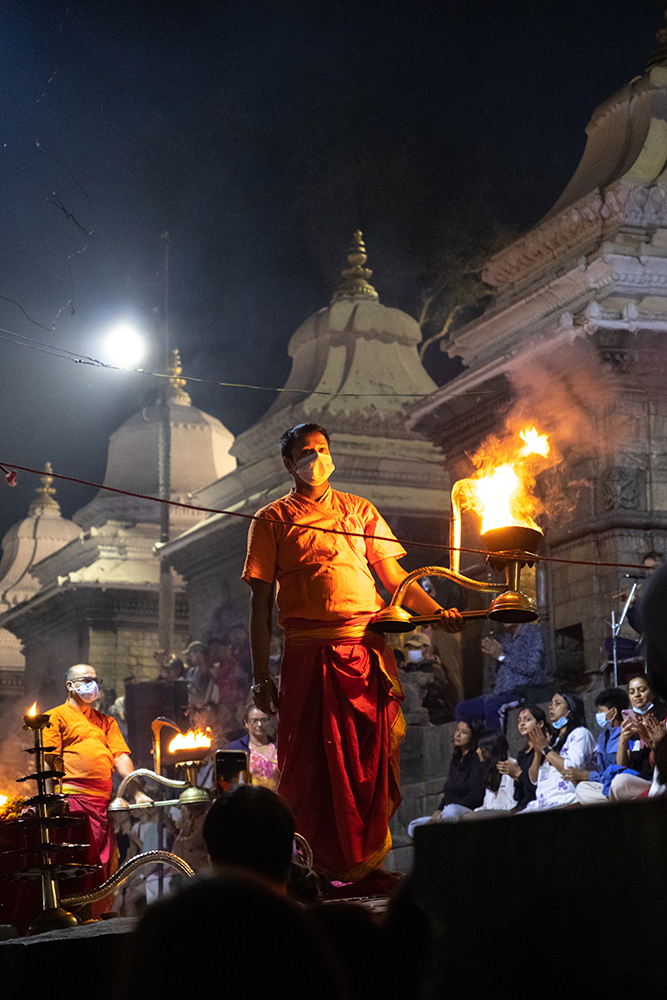
We didn’t exactly know what the Aarti ceremony would entail. Vince found out about it online, and we’d planned to stick around and check it out. It turned out there were two Aartis being held in different areas of the temple complex. We spent a few minutes at a small ceremony near the entrance gate, then headed over to the banks of the river where a huge crowd had gathered.
It turned our that and Aarti is a ceremony of light, where diyas are waved in a circular motion. There were also accompanying songs and bell ringing. We stayed for a while, and really enjoyed watching the ceremony, even though we didn’t know much about the meaning behind it.
All the while there were still funeral rites taking place on the other side of the river.
After we’d watched the ceremony for a while, we decided to head back to Thamel for the evening. We had some delicious Indian food for dinner, and then we returned to Hotel Lo Mustang, where we spent the rest of the evening at the rooftop bar From our high vantage point, we could see Tihar lights twinkling all over the city as fireworks zipped into the air and burst loudly in the distance. We stayed on the rooftop until exhaustion finally drove us to bed.
The next morning marked the beginning of our last day in Nepal, and we didn’t have any plans until the afternoon, so we took the opportunity to sleep in. When we finally did get up, Vince and I wandered into Thamel to do some last-minute shopping. I bought a couple of clean outfits to get me through our upcoming plane rides and layover in Doha. All of the clothes I’d packed for the trip were disgusting, and buying some new things was about the same price as having laundry done at the hotel.
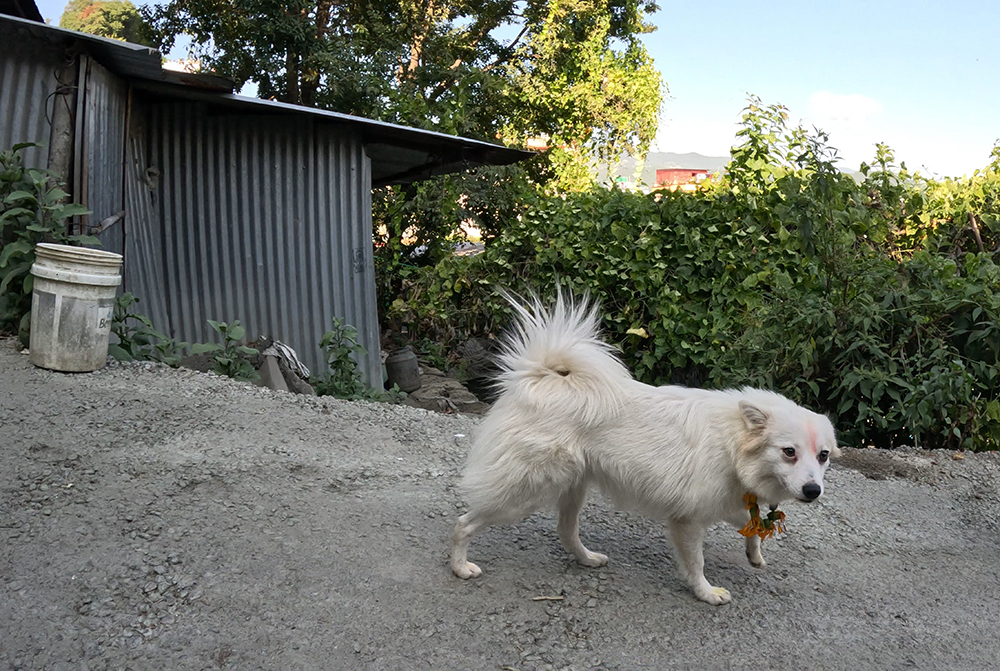
Everywhere we went, the people of Thamel were preparing for the second night of Tihar, Kukur Tihar, in which dogs are honored with treats and flower garlands. Throughout the morning, we saw a few dogs trotting down the street wearing garlands around their necks, and looking very proud of themselves. I was delighted every time we saw one, and thought that this had to be the most adorable holiday in the world.
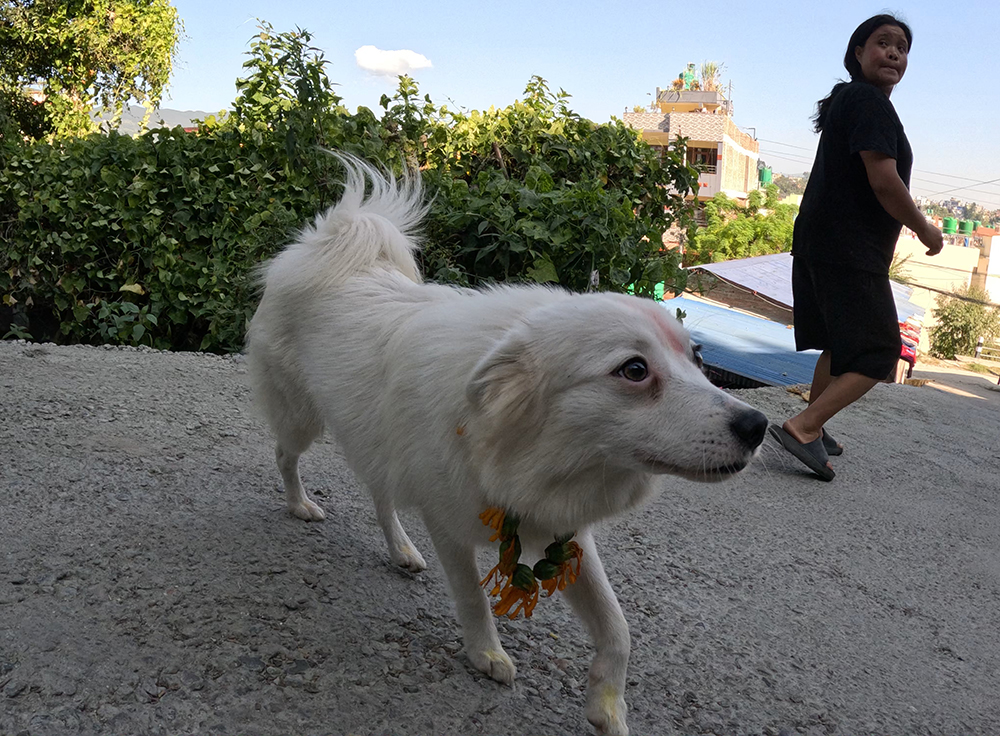
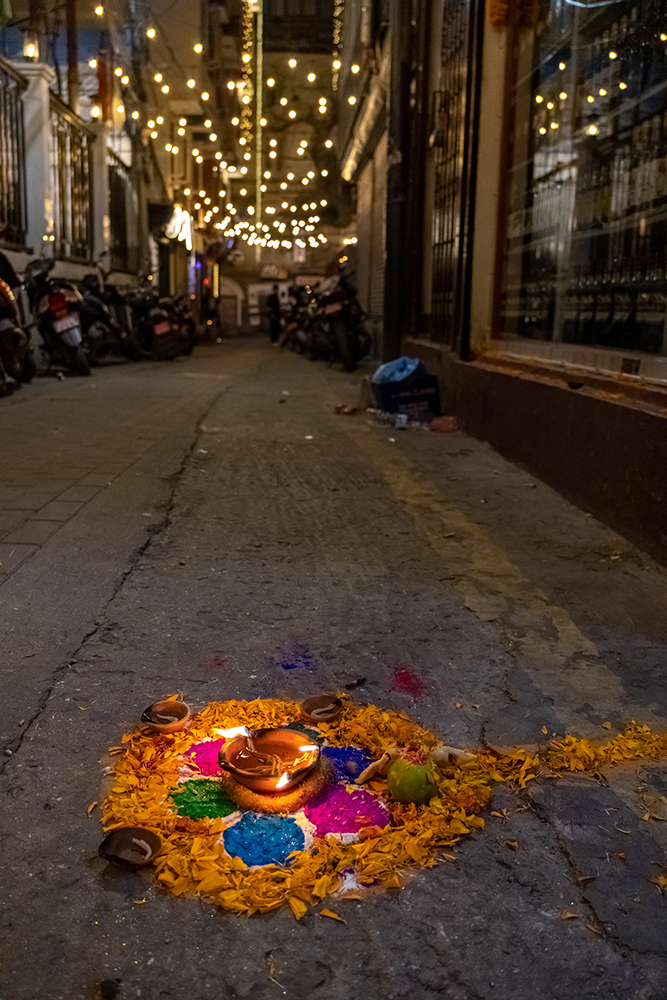
We also ran into a couple of parades of musicians, playing loud, upbeat music as they processed through the streets. As the morning turned into afternoon, more and more flower garlands appeared on shop entryways, and people started creating colorful Rangoli designs on every stoop.
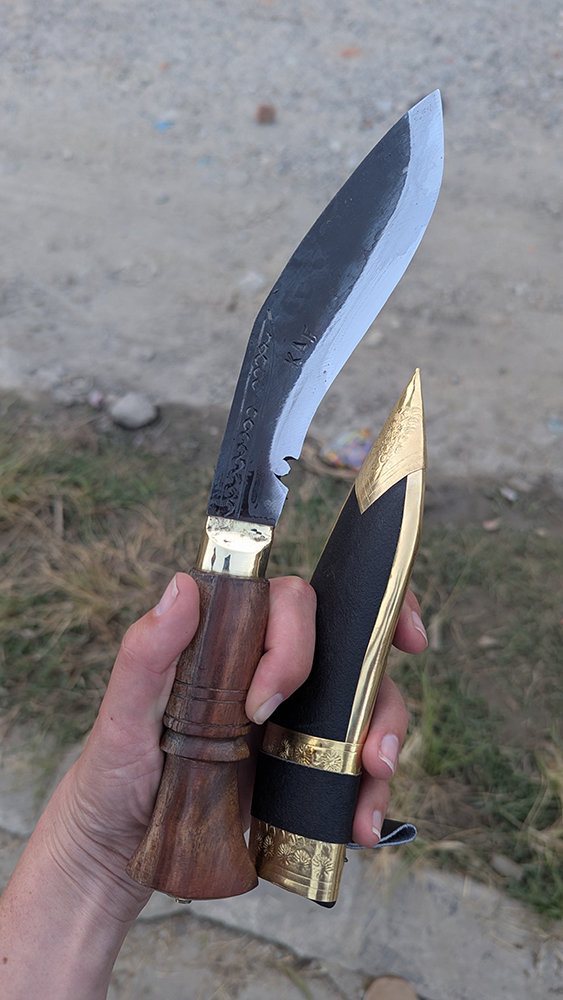
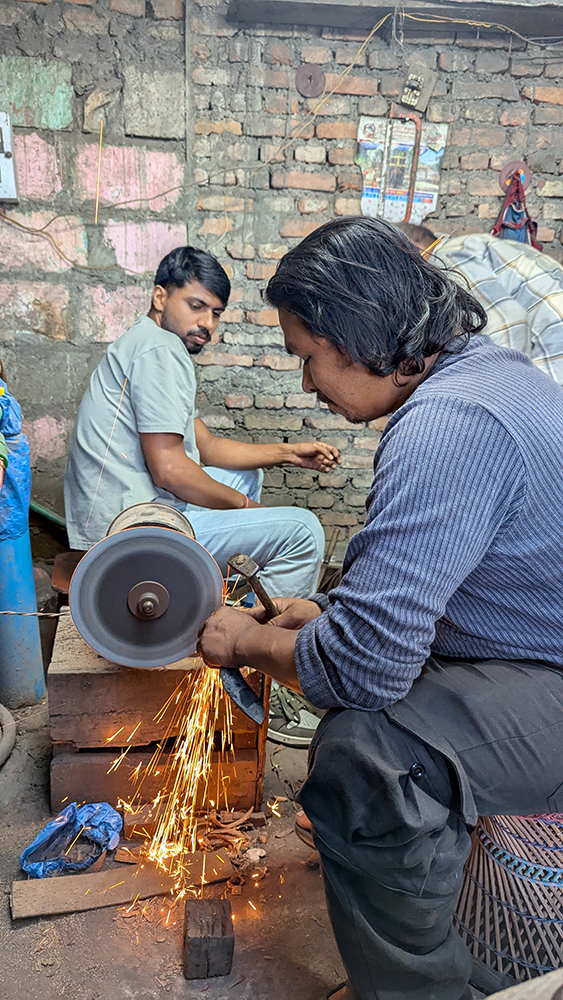
The only thing we had planned for the day was an afternoon knife making workshop. Our guide, Jivraj from I. Experience Nepal, picked us up from the hotel right on time, and we rode across the city to a quiet neighborhood that almost felt rural. The workshop was held in a small forge behind the blacksmith’s home, and when we arrived, he showed us an example of the knives we’d be making. It was a Khukuri knife, which is the national weapon of Nepal, and the signature weapon of the renowned Ghurka soldiers.
The blacksmith and his apprentice turned out to be excellent craftsmen, and they guided us through the process of heating and hammering our pieces of steel, and grinding them to polish the metal. In all honesty, they did most of the work, which was good because our knives would have turned out horribly if we’d been left to our own devices.
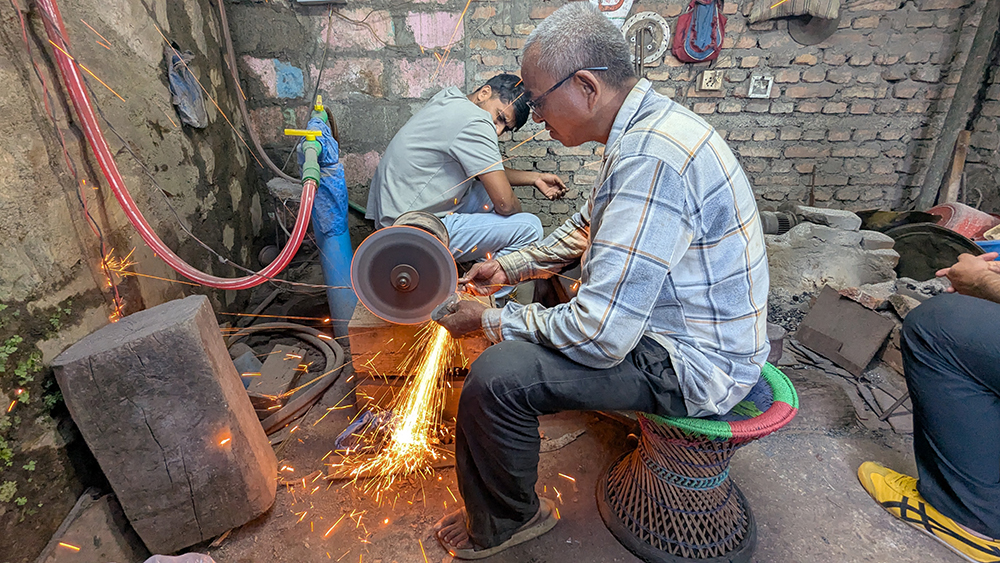
The blacksmiths made sure that the shapes of our knives came out right, and they did all the finish work, letting us each pick out our initials to stamp on our blades. I loved all of the sounds and smells of being in the metal shop because it took me back to working at my family’s tool and die shop in high school, and later studying silversmithing in undergrad.
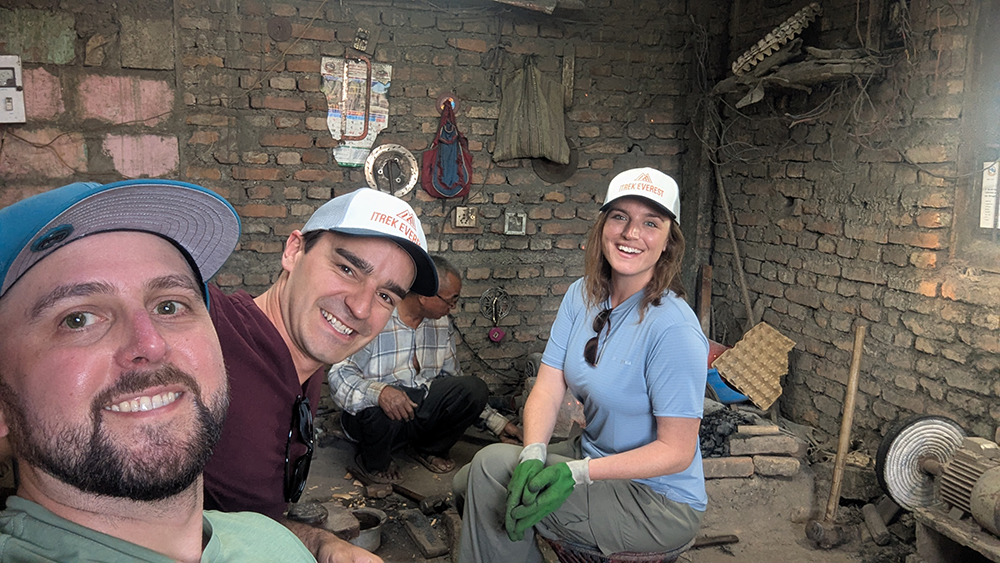
At the end of the workshop, our Khukuris were sharp enough to slice paper, and the blacksmith demonstrated how to shave with them by slicing off a patch of Vince’s arm hair. The new bald spot his arm was baby-smooth after that. The knives were also beautifully crafted, and I was happy to get to go home with such a special souvenir that I got to help make!
By the time we made it back to Thamel, the streets were coming to life with Tihar celebrations. Local kids were going around to different businesses and performing dances in hopes of getting donations. I even got an opportunity to join in a dance with a group of girls who were all dressed up in matching outfits. Of course, there were also dogs wandering the streets wearing flower garlands, and loud bangs frequently cut through the air as people lit off firecrackers. Vince, Thadd, and I wandered the neighborhood for a while, admiring all of the colorful Rangoli designs on the pavement.
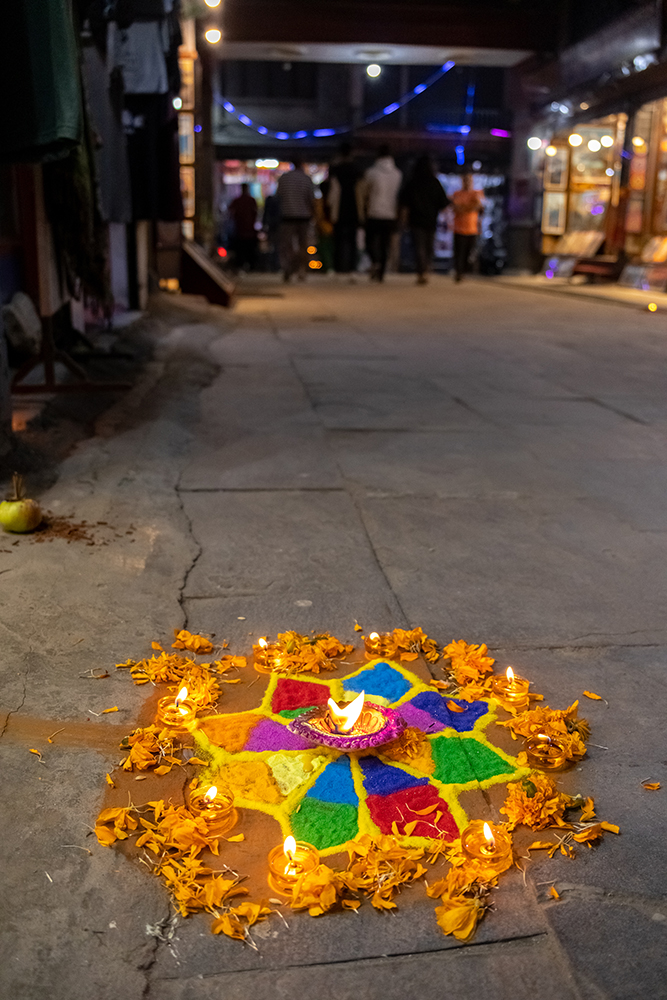
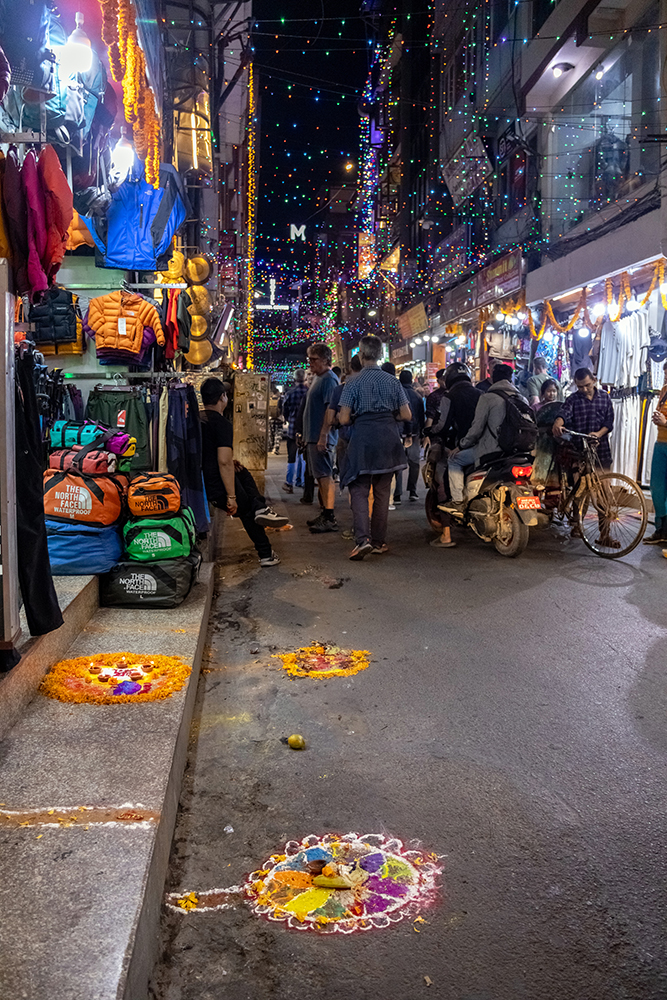
We stayed out late since it was our last night in Nepal, and we couldn’t have asked for a better sendoff than getting to experience such a fun, local holiday. The next morning, we started our journey back home. It was sad to leave, but I was so glad that we’d scheduled a couple extra days at the end of our trek. Kathmandu is such and energetic city, and I loved getting to learn about its culture and history while we were there. I’d love to return to Nepal someday to explore more regions of the country, and spend more time in Kathmandu!
You can see more details of this amazing destination on my YouTube channel!
 birdsoftheairtravel.com
Will you make physical albums of many of your images? It would be lovely to ‘read’ over your journey from start to fish that way.