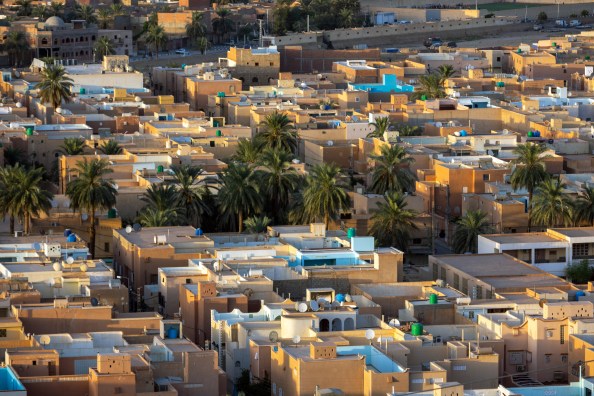
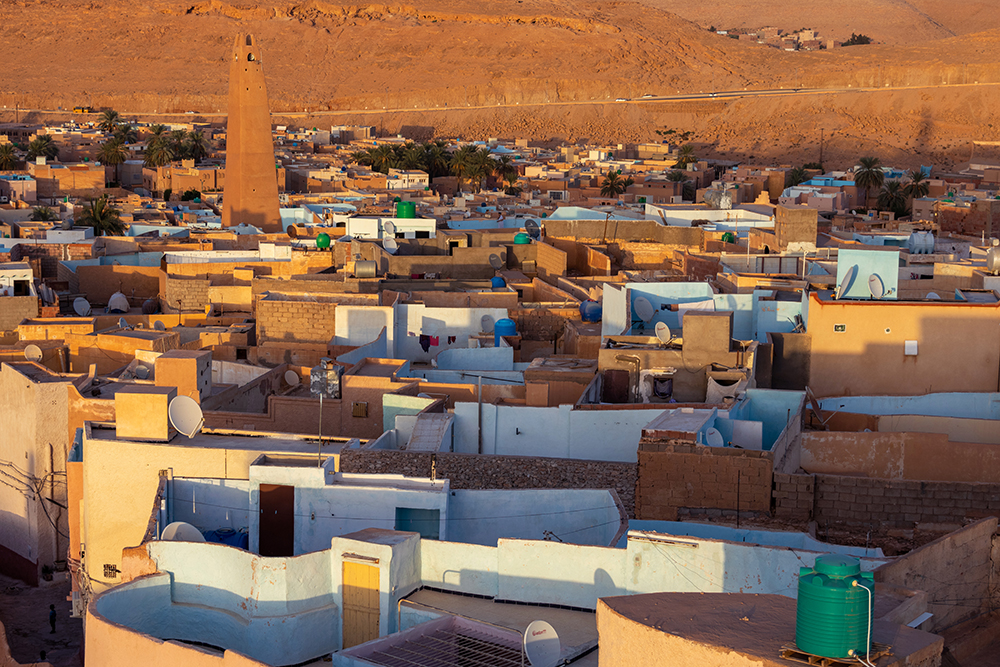
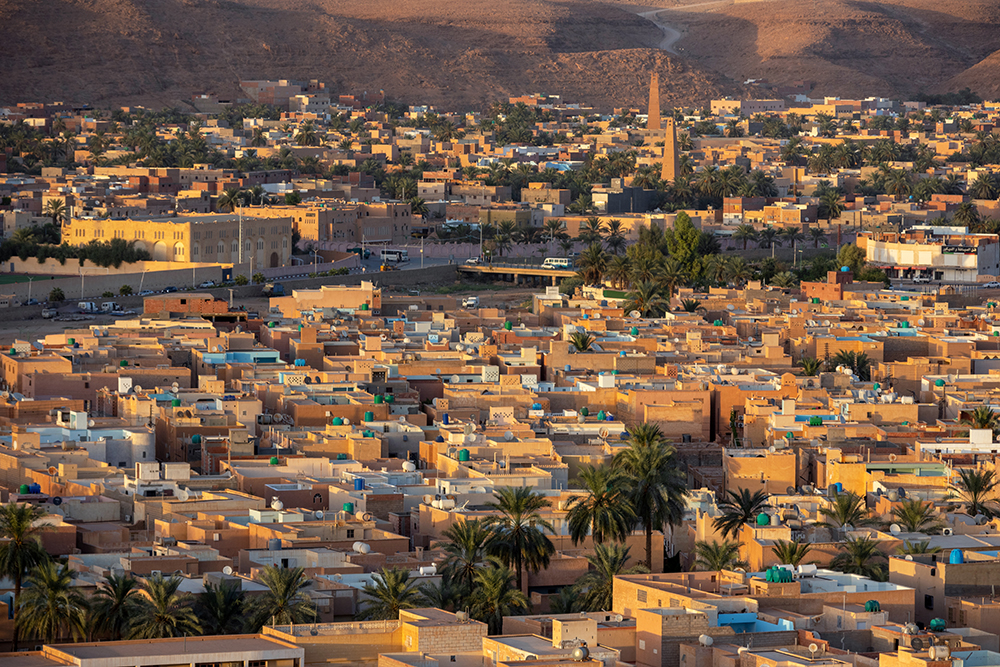
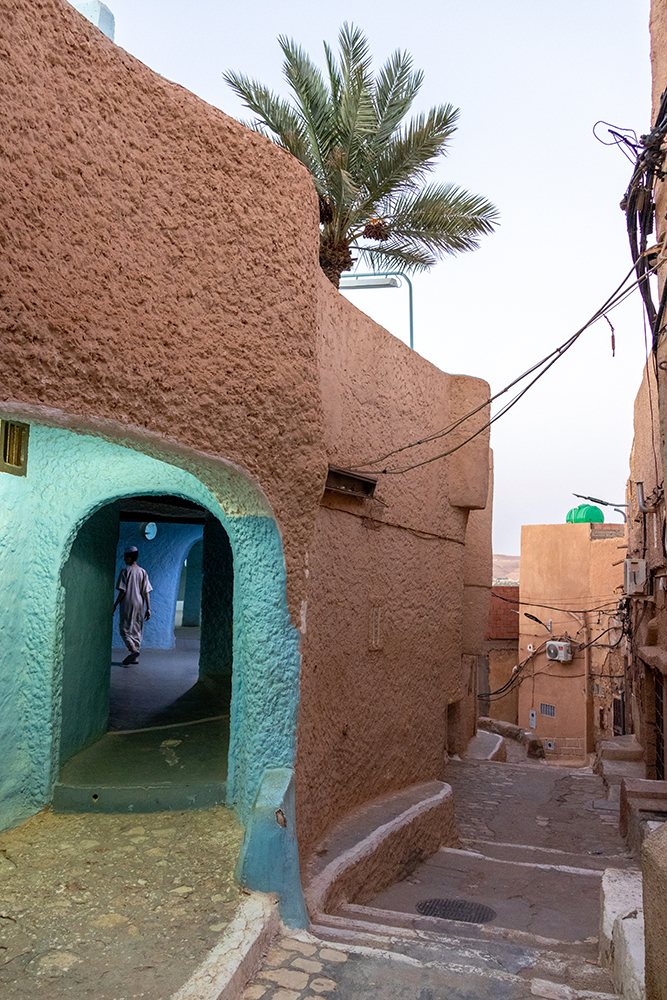
A city of rectangular buildings in various sandy shades covered a distant hillside as my friends and I absorbed the landscape with blinking eyes in the early morning light. The sea of tan was broken only by swatches of light blue paint and aqua water tanks. Beyond the hill, the city melted into an endless backdrop of rolling waves of sand. We’d arrived in the Saharan city of Ghardaïa, Algeria late the previous night, then got up early to start exploring, stopping first at this roadside vantage point that overlooked part of the sprawling city. This would be the southernmost point on our nine day tour of this fascinating country, and we only had one day to see as much of it as possible.

Ghardaïa was established almost a thousand years ago, and has been continuously inhabitated by the M’zabite people, a Berber ethnic group, ever since. The people of the M’zab valley are renowned for their handicrafts, especially hand woven rugs and textiles, and our first destination of the morning was to the local souk to shop for some of these works of art.
Our driver dropped us off in the city, and we followed our Izelwan guide, and our local guide into an open square that was bordered by market stalls. Colorful carpets were draped above from every shop entrance, and a simple minaret towered above the rest of the earthen buildings. Our local guide informed us that this would probably be a bit different from other souks we may have visited in the past. He said the shop owners wouldn’t use aggressive sales tactics, although we could still haggle. He also asked that we avoid taking pictures that were focused on people, especially women. Looking around the square, I saw mostly men filing in and out of narrow streets lined with stalls. There were occasionally women, most of whom were dressed in long, white cloths that covered them from head to toe. The robes, called haïks, only left an opening for one eye to peak through. Our guide explained that the white cloths indicate that a woman is married, and that they are a local custom, rather than an Islamic one. Married women wear them in public, but not in their homes, or on the city’s rooftops, which only women are allowed to enter.
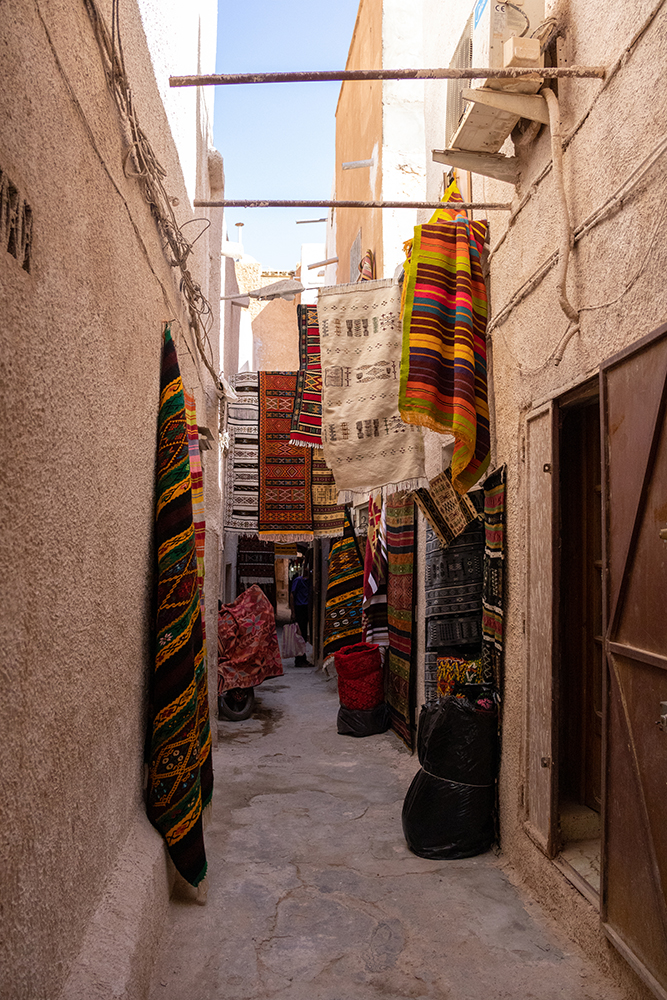
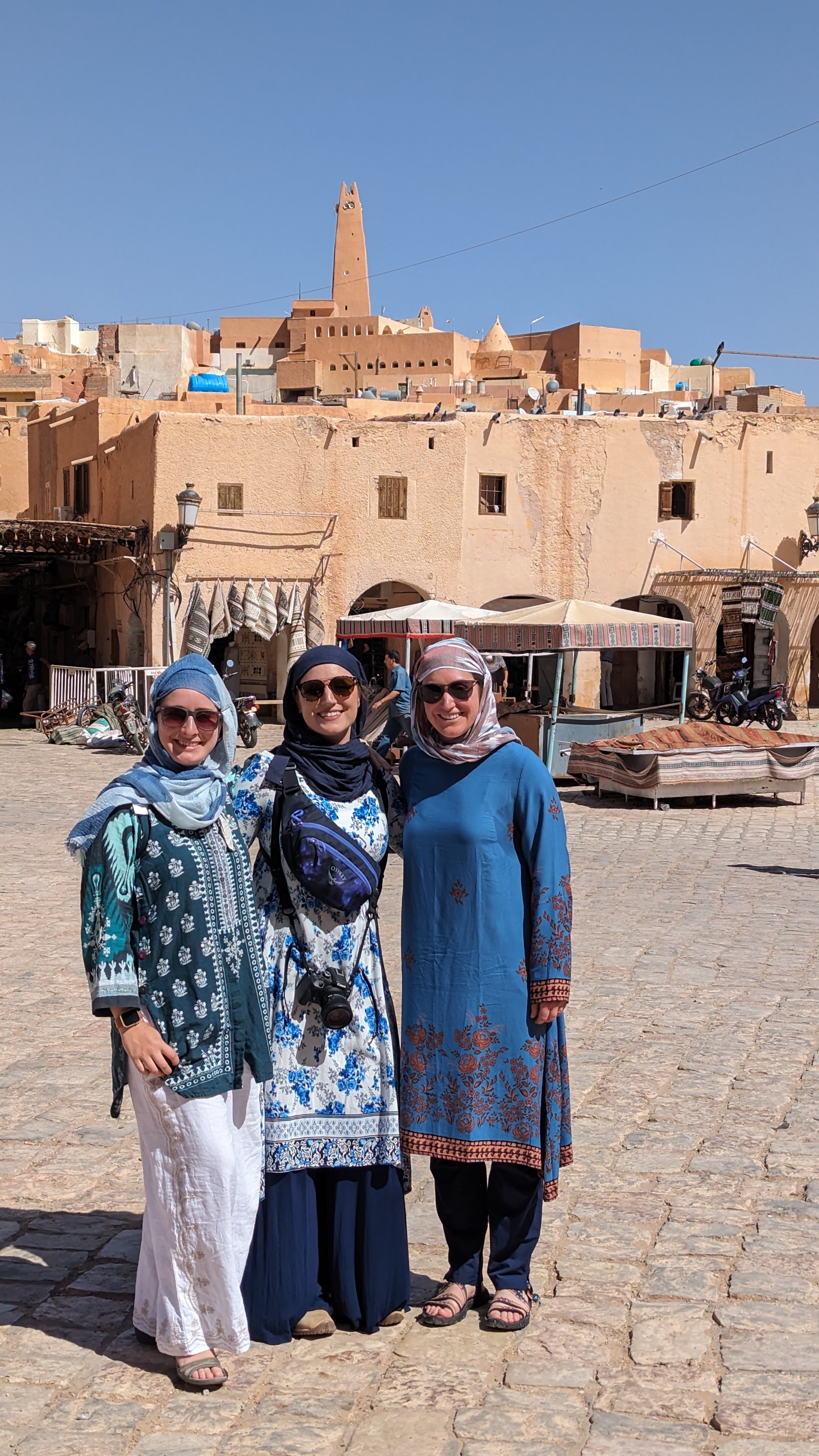
With that bit of introduction, our guide invited us to start shopping. All six of us immediately started looking at rugs. Vince and I had been specifically holding out to buy our souvenirs in Ghardaïa. We wanted a small rug to hang on a wall back home, and I was also hoping to find a necklace, which is a tradition of mine when I travel internationally. Rachel and Jared were also shopping for rugs, but needed something much bigger, and Bonnie and David decided to look for a smaller one too.
We entered a nearby store, ducking underneath some hanging carpets, and the shopkeeper, led us up to the second floor where hundreds of hand woven rugs were folded in stacks on the floor, and draped from the walls. The sheer variety of colors and patterns was overwhelming, and I struggled to pick a favorite as the shopkeeper explained the meaning behind some of the Berber patterns. Just like our guide had told us, there was no pressure for us to make a purchase. The shopkeeper allowed us to take pictures, and wasn’t offended when we said we would look around at the other stalls before making any decisions.
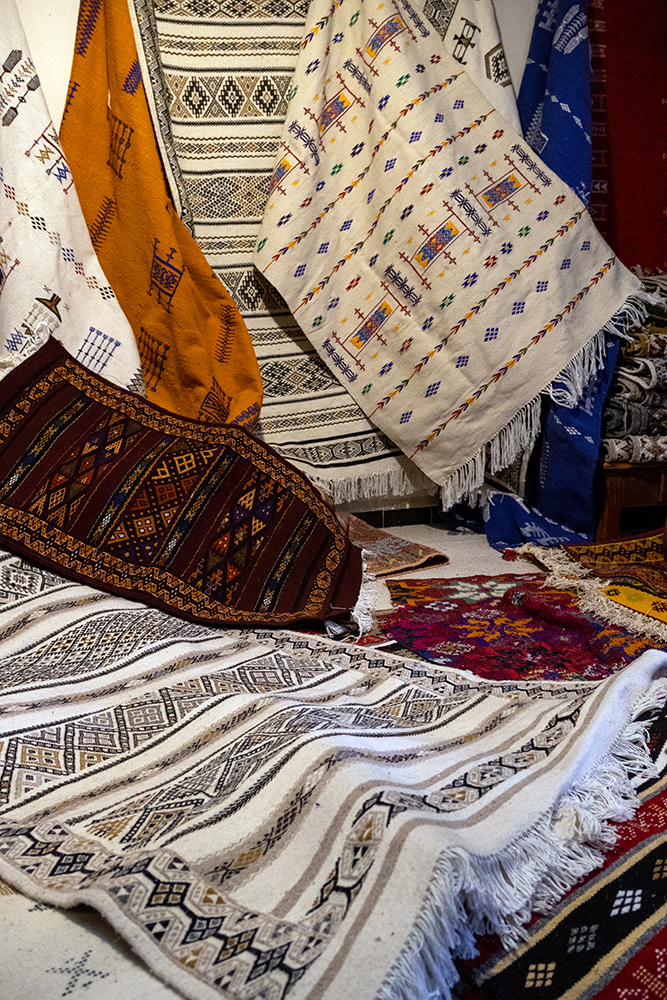
We continued on from stall to stall until I began to realize that at some point I was going to have to make a decision. Every time I saw a carpet and thought “that could be the one,” another one would catch my eye. Did I want one with bright colors and a bold pattern? Or did I want something more understated? To make matters worse, the prices in this market were the lowest I’ve ever seen for handmade goods like this, which tempted me to buy more than the one rug Vince and I had planned on. Finally I found one that was the perfect size, and had one of the Berber patterns the original shopkeeper had explained to us.
With our rug purchase secured, Vince and I returned to a few stores we’d visited already. I picked out some smaller, trivet sized weavings to give to loved ones back home, and found myself a Tuareg Berber style necklace. Then we caught back up with the rest of the group, and followed our guide into the food section of the market. We entered a narrow street that was bustling with shoppers, but somehow, the atmosphere of the market was still calm despite the crowds. This really was the least chaotic souk I’ve ever shopped at, and it felt relaxing to be able to enjoy my surroundings without feeling overwhelmed or pressured to buy too much. Don’t get me wrong, I love a good chaotic souk, but I definitely appreciated the tranquility of Ghardaïa’s market.
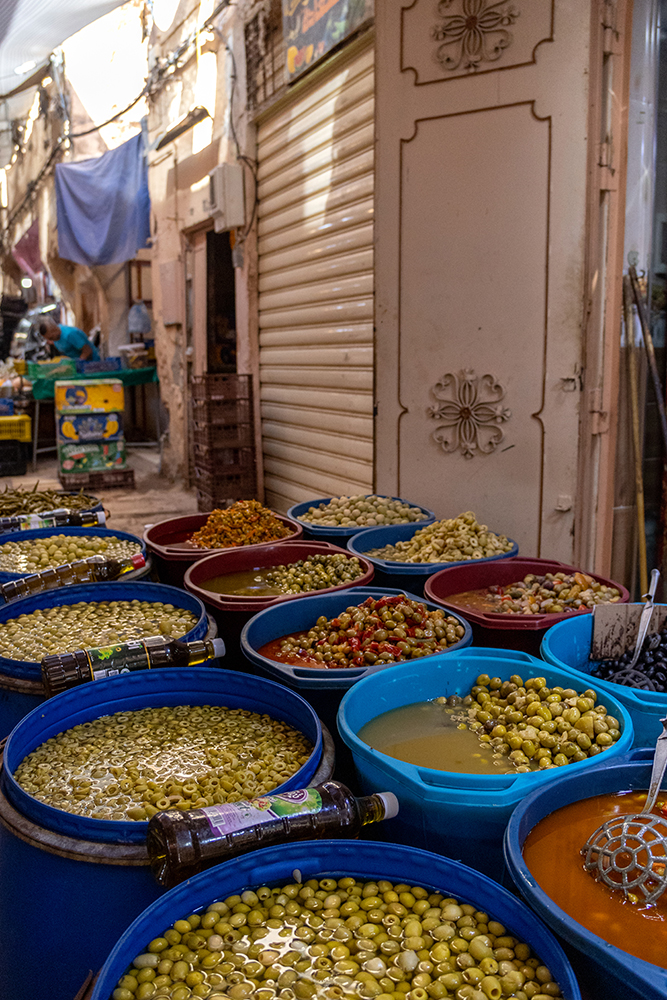
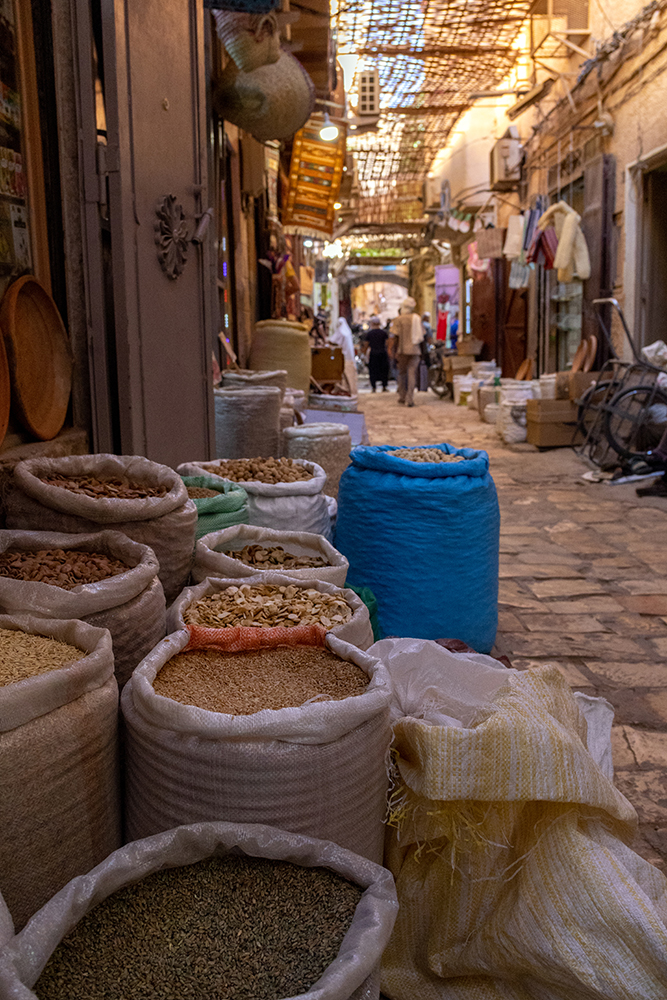
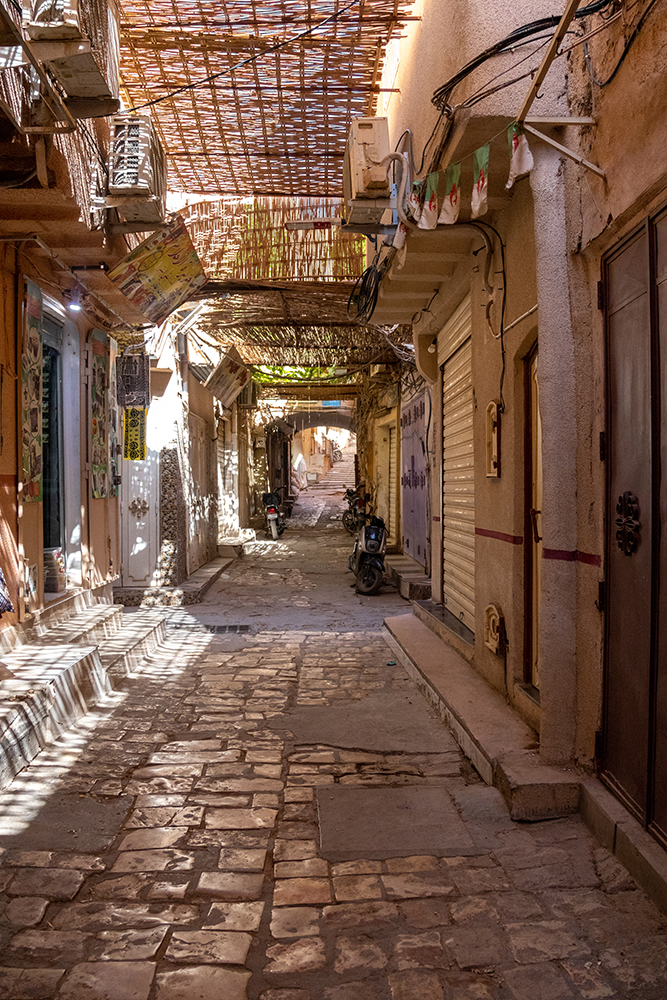
Our guide led us into a couple of tight stores to show us the back room of a very old pharmacy, and a shop full of antique items. Motorcycles puttered along the narrow street every so often, and we moved out of their way as they passed. We talked to a meat seller, who had the severed head of a camel behind his counter, and then sampled some local olive oil. Bins of herbs and olives lined the sides of the streets, creating endless interesting angles for photography.
In addition to textiles, Ghardaïa is also known for date farming, and our guide made sure that we got to stop at a store to sample a couple of the local date varieties. These were some of the sweetest, most flavorful dates that I’ve ever tried. They were so good that Bonnie and our Izelwan guide ended up buying a pound of them!
By the time we circled all the way through the food market, and back to square, everyone had packed up for the morning, and the market was totally deserted, which was a shocking difference from how busy it had been just a half hour earlier. Streets that had been bustling with activity were now completely empty, and all of the stores had shut down. With the market closed, it was time for us to move on to our next destination.
We met back up with our van, and started driving towards a rural settlement on the outskirts of the city. Along the way, we got to stop at a couple more viewpoints to see more views of Ghardaïa, a palm grove, and a hotel decorated in traditional Berber style.

The motion of the van eventually lulled me to sleep, and I woke up when we arrived at the small village to learn about Ghardaïa’s system for collecting, storing, and distributing rain water. Stepping out of the van, I was taken aback by the desert heat. Back in town, we’d managed to stay mostly in the shade of buildings, which did a lot to take the edge off of the dry heat. But out here in the blazing sun, there was nowhere to hide, and I could feel beads of sweat forming on my forehead.
Another local guide greeted us, and began explaining the broad strokes of how the M’zabite floodwater collection system has worked since it was developed in the 11th century. He led us over to a massive, sandy flat to point out a series of wells sticking up from the ground. These wells work in essentially the exact opposite way of a normal well. Instead of tapping into existing groundwater, they are used to penetrate floodwater from the surface of the desert into the earth, basically forcibly turning it into ground water.
The city can survive for ten years on the waters from one flood, and after that they have a back up plan that they can implement to buy a bit more time. The entire community cooperates in this vital operation, and all of the management and maintenance of the system of wells and shafts is done by volunteers. Each household in the community is allotted a certain amount of water, based on how many trees they grow in their palm groves. The dates harvested from the palm groves are brought into the market in Ghardaïa, and proceeds from date sales are used to maintain the water collection system.
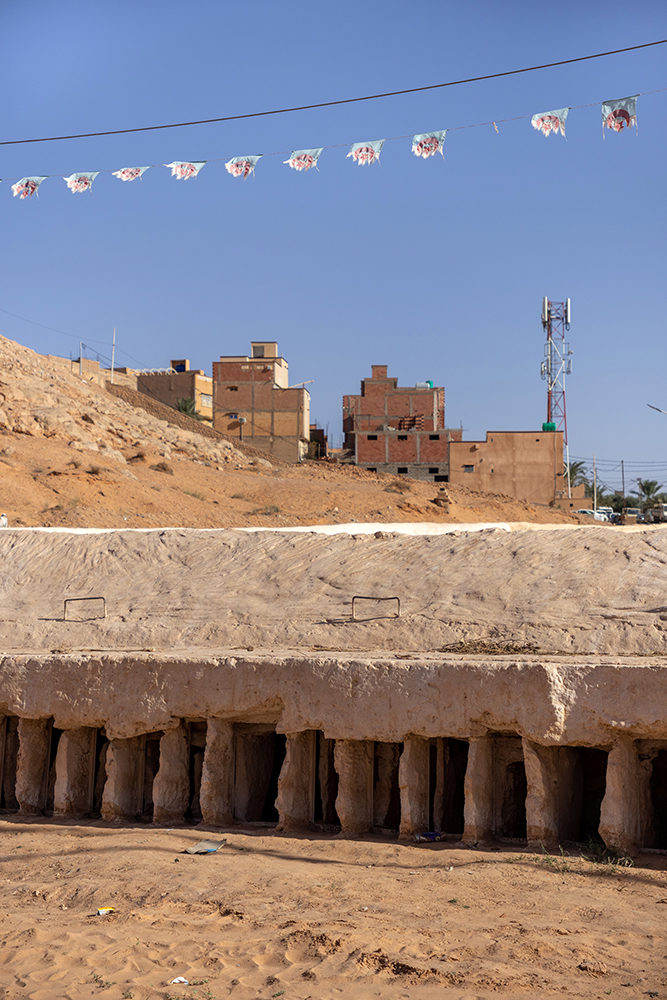
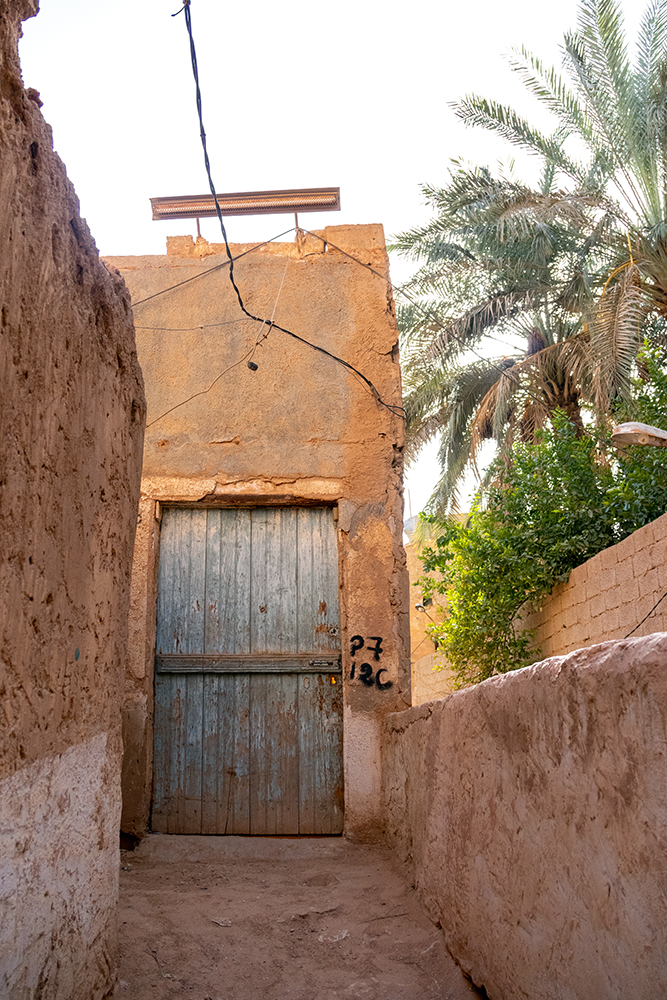
We got to poke our heads into some of the entrances to shafts, and then walk through a street of the community. There were openings in the walls of all of the buildings to allow diverted rainwater into each palm grove. These openings were larger for groves with more trees, and the size of the opening is determined by stacking a single date seed side by side for each tree that a farmer has in his grove.
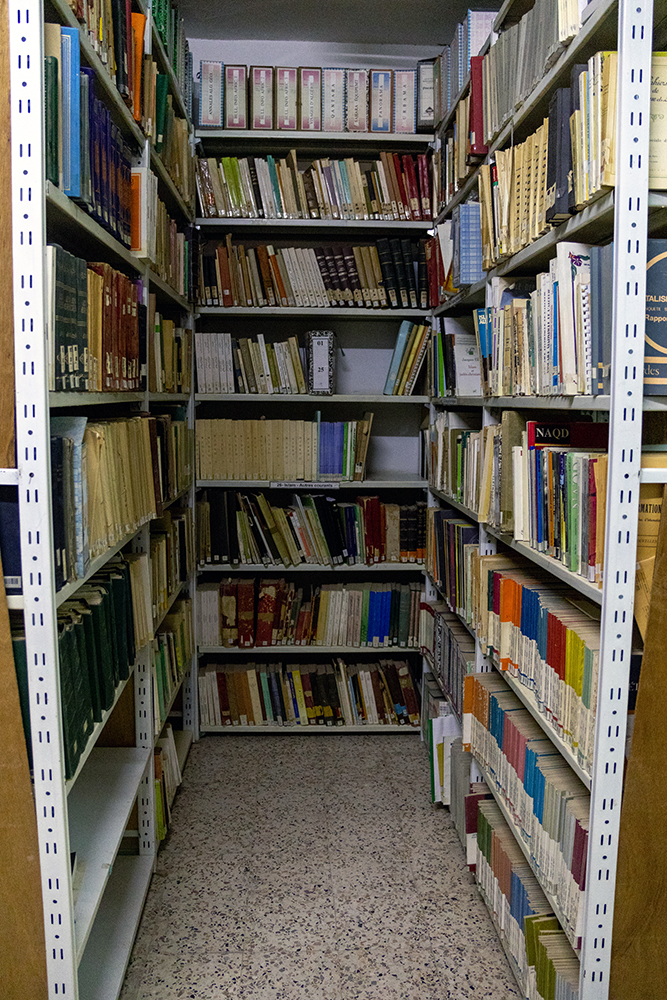
I was utterly fascinated by this part of the tour, and I would have loved to stay longer and learn more about the cooperative way of life in the community, but soon it was time for us to head back to the city. We continued our day tour with a visit to CCDS, a cultural center that is working to preserve as much information as they can about the culture and history of the Ghardaïa region. We got to look through their collection of books, photographs, and maps, and go up to the roof for a nice view of the surrounding city.

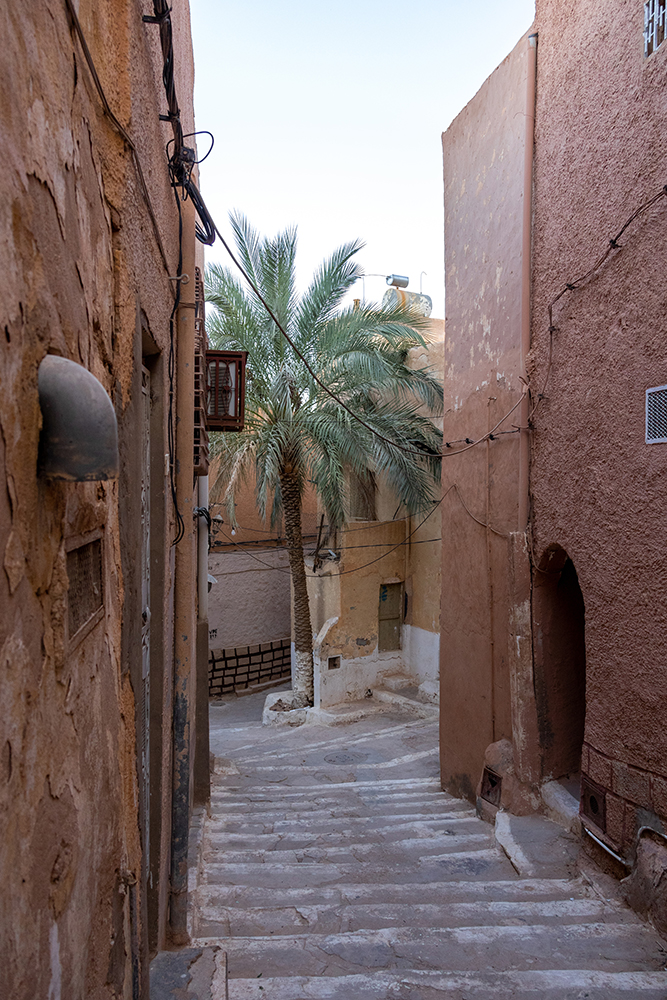
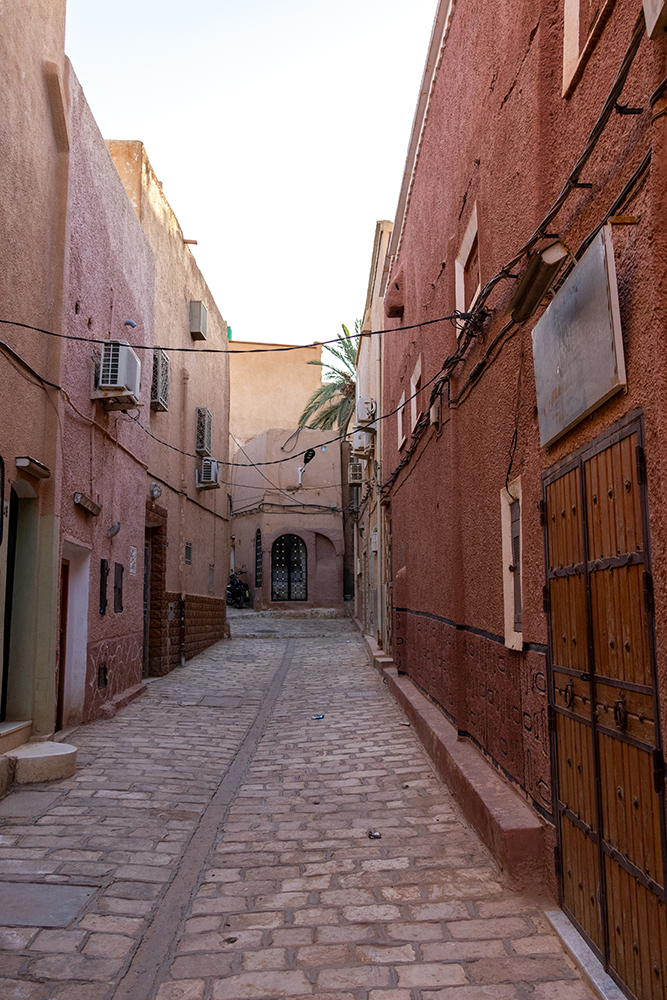
By now we were coming dangerously close to running out of daylight, and our guides had a plan for where we would watch sunset so we had to start moving faster. We rode over to Beni Isguen, a walled village with narrow, pedestrian streets. Foreigners are only allowed to enter if accompanied by a local guide, are only permitted to visit certain areas of the village, and cannot stay overnight. Our guide led us through the maze of streets, explaining how different elements of the architecture help to keep the village’s inhabitants cool, even in the intense desert heat.
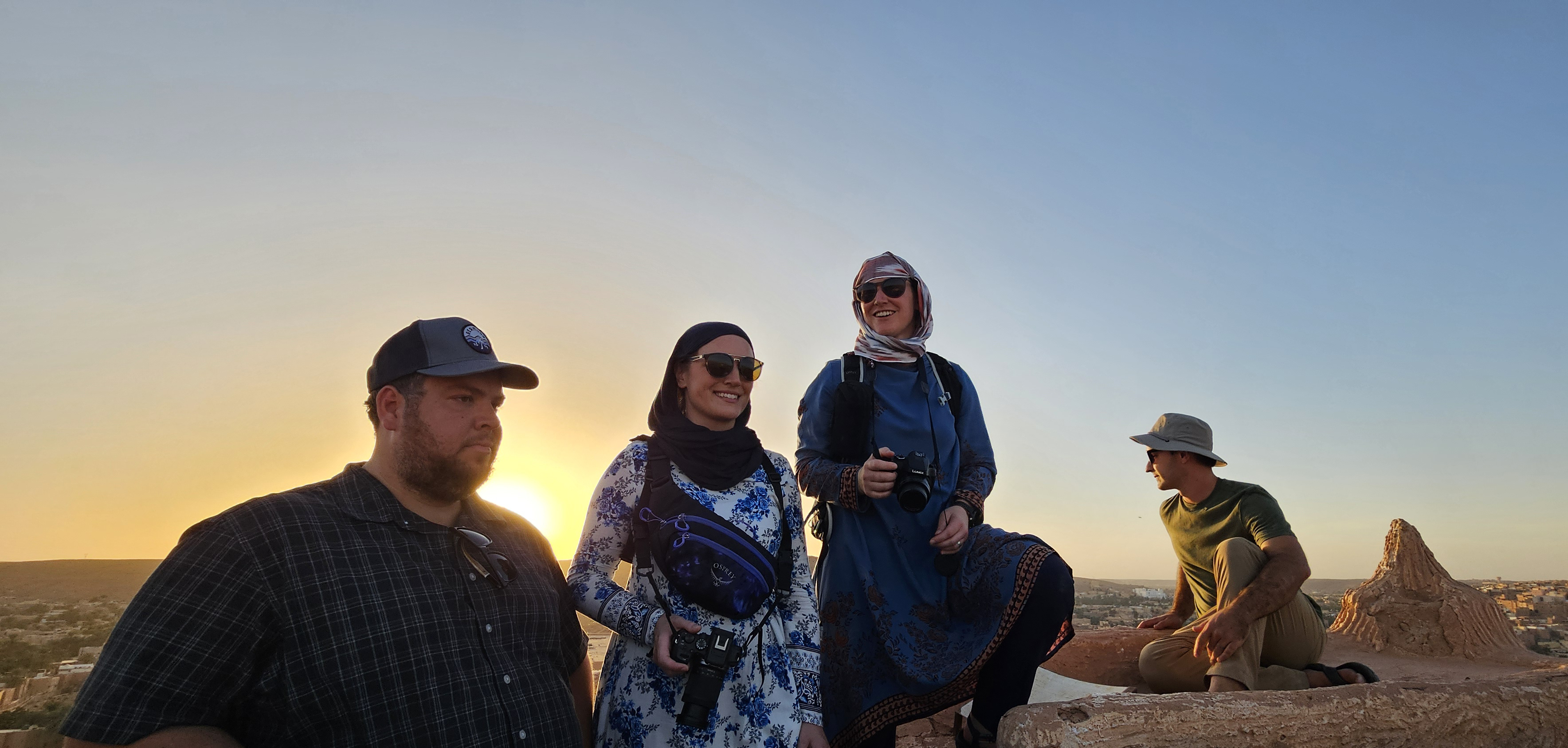
Just before sunset, we arrived at a tower on one of outer walls of Beni Isguen. We climbed up its winding staircase and emerged onto the top to find a breathtaking view of the village, illuminated in golden light. The sun sank behind a nearby mountain as we gazed over the view of square buildings with date palms growing between them.

Once the sun had vanished, we followed our guide back out of the village, taking a different route so we could see some different sights along the way. The haze of twilight stayed with us until we finally exited Beni Isguen.
Now the only thing left on our agenda for the evening was to eat dinner, which we were all very excited about. Izelwan Travel is based in Ghardaïa, and its owner, Abdou, is from there. Abdou had arranged for us to have a fantastic dinner experience with local food and live music. We went to a restaurant that was decorated in Berber style with woven carpets on the floors and walls. A waiter led us to our table, where we sat on floor cushions to enjoy a three course meal of delicious local, dishes. After dinner, there was a lively musical performance while we enjoyed tea and pastries for dessert. By the end of the evening, Vince, Jared, and David were all up and dancing along with the musicians and restaurant employees, and my face was beginning to get sore from smiling and laughing as I clapped along.
It was another late night by the time we finally returned to Hotel Belvedere. We would have to be up before sunrise the next morning for our flight back to Algiers, and I secretly wished that we could stay in Ghardaïa longer. I’ve never been anywhere quite like this Saharan city before, and I would have loved to stay and learn more about the region’s unique culture, or even continue on to other Saharan villages. But our trip was officially approaching its end at this point, and it was time to make our way back to the north of Algeria. In three more days, we’d be on our way back to the US, but there was still a lot to see before then!







 birdsoftheairtravel.com