A jellyfish, if you watch it long enough, begins to look like a heart beating … a heart you can see right through, right into some other world where everything you ever lost has gone to hide.
-Ali Benjamin, The Thing About Jellyfish
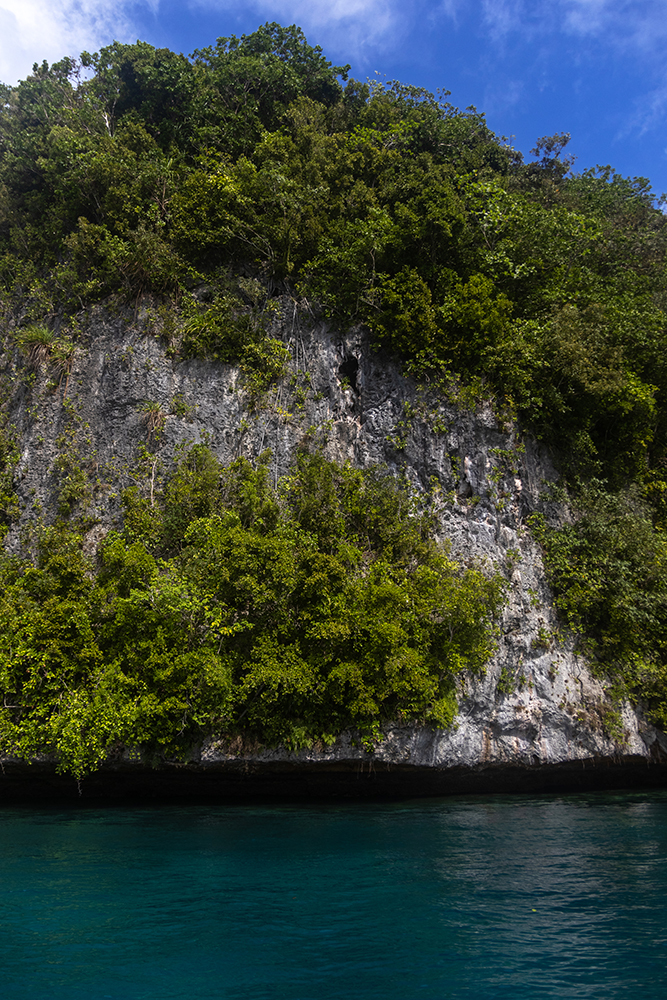
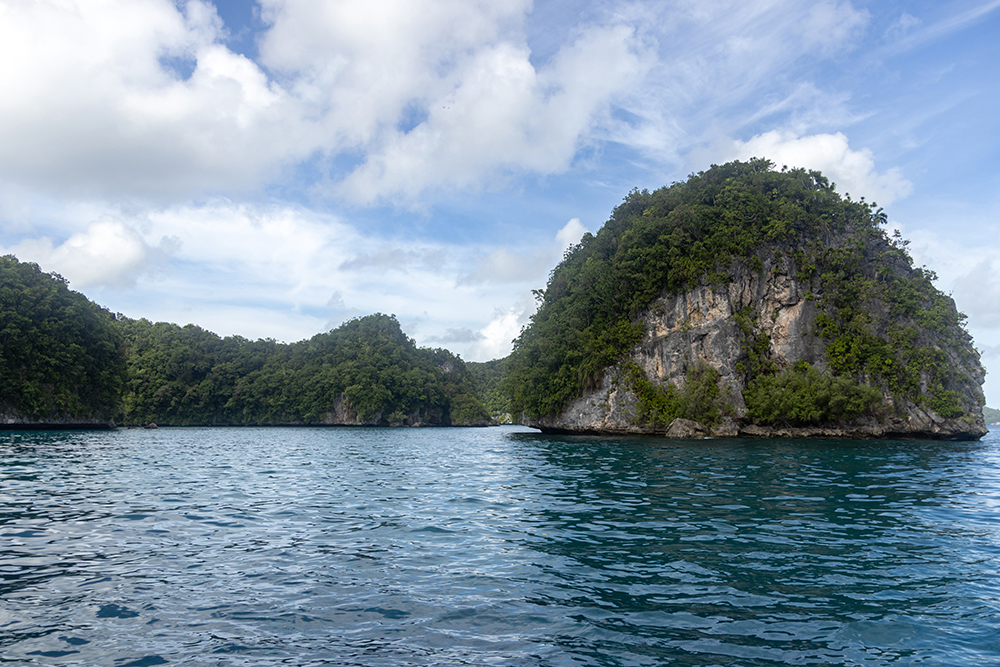
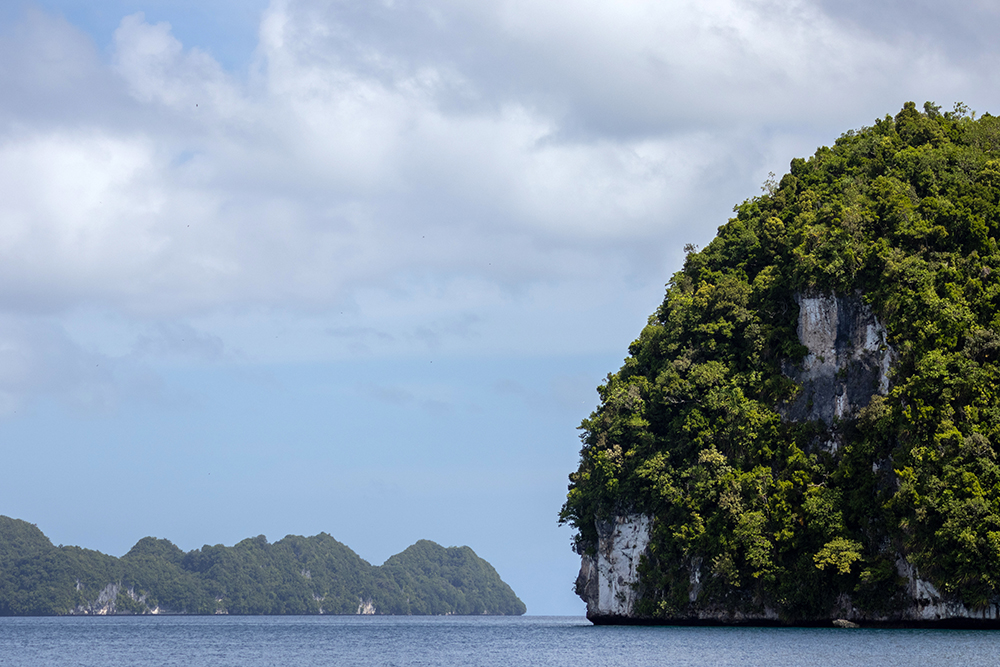
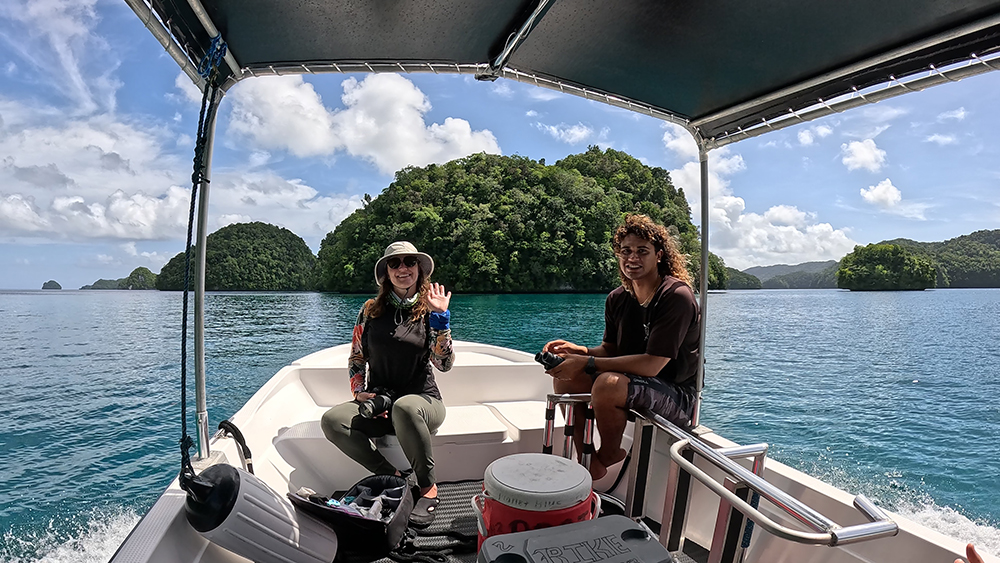
Our little boat listed dramatically to the side as captain RD took a sharp turn around a little island at breakneck speed. I leaned into the turn and craned my neck upward to get a good look at the island as we zoomed passed it. I grabbed for my hat as the wind tried to take it, and RD expertly threaded the boat through a tight gap between two more islands. We were just starting our last day in Palau, and it had already been an exciting morning.
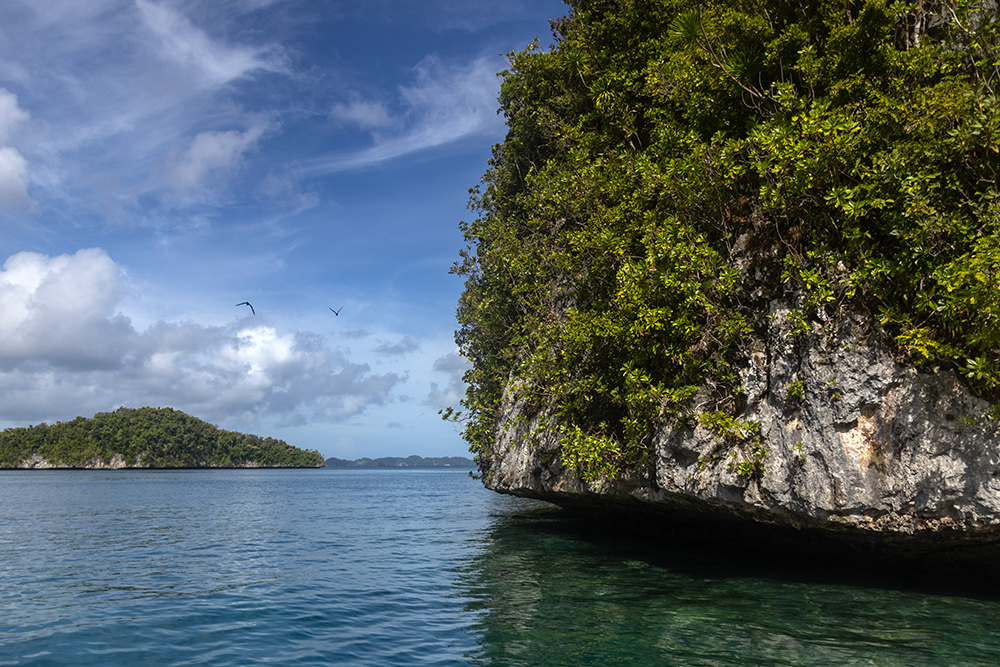
Earlier that morning, our guide, Finn had picked us up from our Koror hotel for one last time. We were headed out to some of Palau’s more distant Rock Islands today on another full day tour with Paddling Palau. The previous day, we’d had an amazing time kayaking and snorkeling in Risong Bay. We’d left the kayaks behind this time because we had a lot of distance to cover.
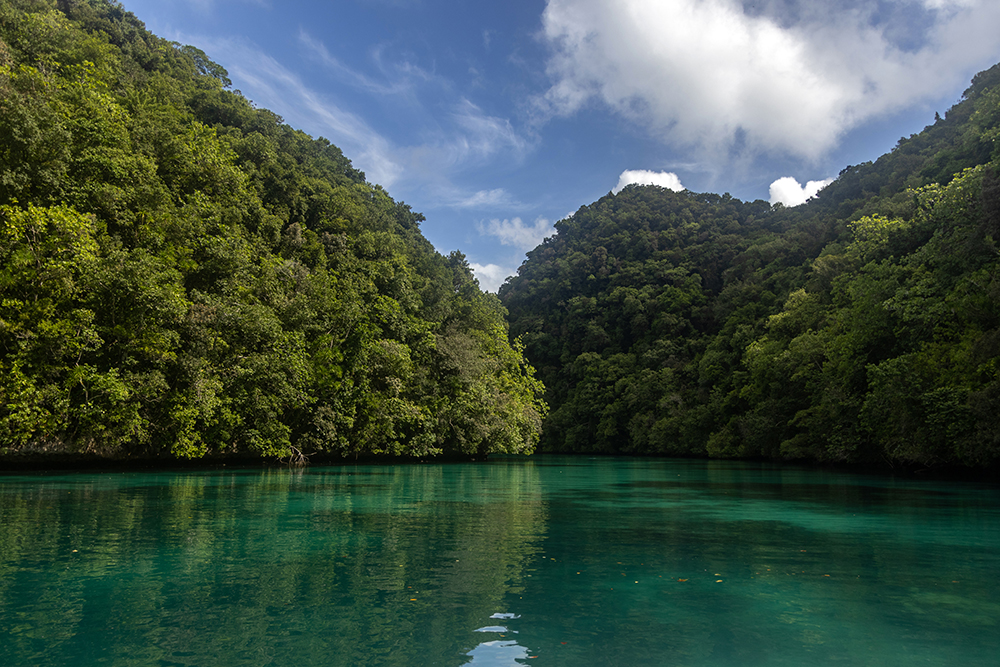
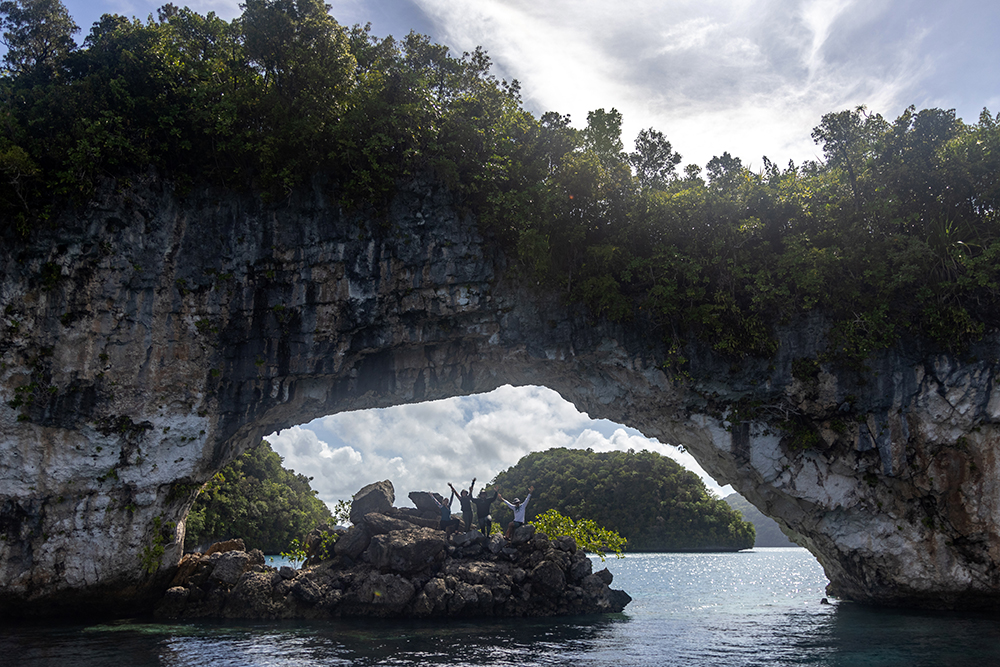
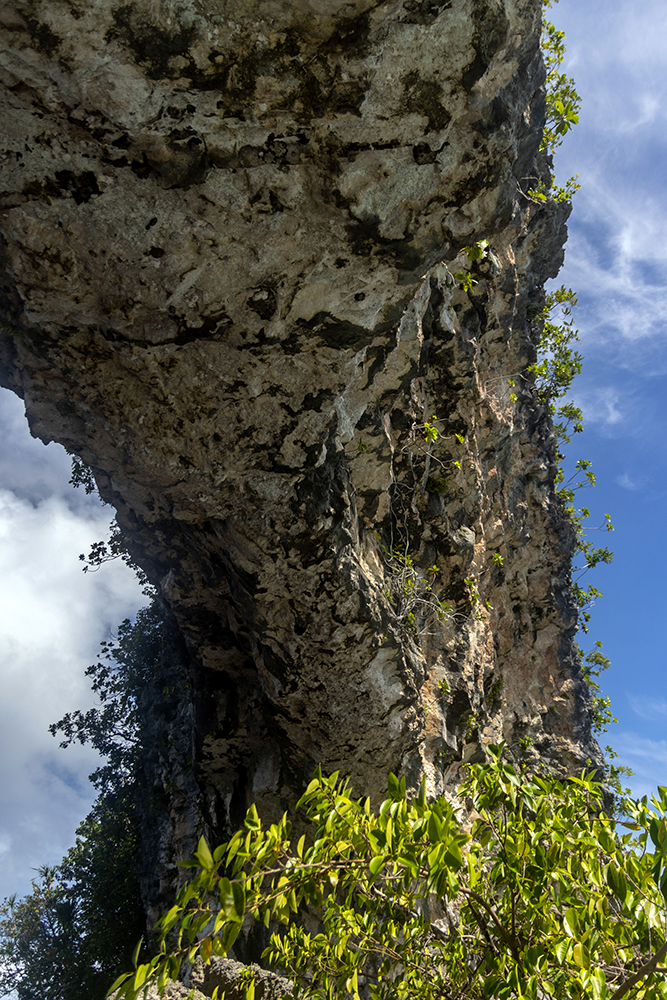
Presently, captain RD was taking us on a very scenic route through the Rock Islands as we wove our way ever closer to Mecherchar, a large island that is home to Palau’s most famous attraction, Jellyfish Lake. RD steered our little boat between a couple more small islands, and we entered an emerald green lagoon where we were completely surrounded by limestone islands. I swiveled my head around to take in the panorama as RD slowed the boat to a near stop. We were approaching a large, free standing arch that bowed up from the water in the middle of the lagoon.
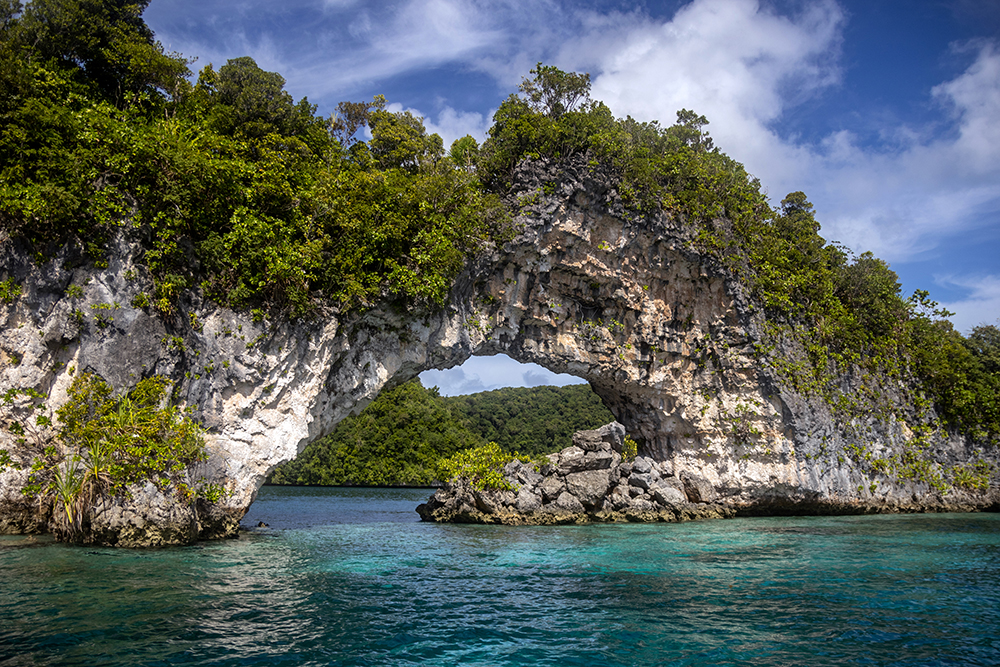
When we floated into the shadow of the arch and up to its base, Finn let us all carefully climb out of the boat and onto a pile of rocks underneath the arch. I handed Finn my camera so he could snap a group photo of us, and RD backed the boat up a ways until the entire arch was in frame. Finn snapped a few photos and then jokingly yelled “Ok, bye guys!” and waved as though he were planning to leaving us stranded under the arch.
Of course, he was joking. He and RD returned to pick us up, and soon we were speeding in and out of more islands. Any time Finn spotted something notable, like a local bird species, we would slow down to look at it. At one such juncture, Finn pointed up to a bare patch of rock about seventy feet above us on a cliff face. I had to squint to see it, but the rock was streaked with simple shapes done in red paint. These were what still remain of a set of ancient Palauan pictographs.

As Finn explained some of the Rock Island’s ancient history, he mentioned offhand that there was a Yap coin not far from the Jellyfish Lake, and he could take us there later if we were interested in seeing it. We all eagerly agreed that we would love to make a stop to see it, and then we finished off the short remaining boat ride to our first snorkeling spot of the day.
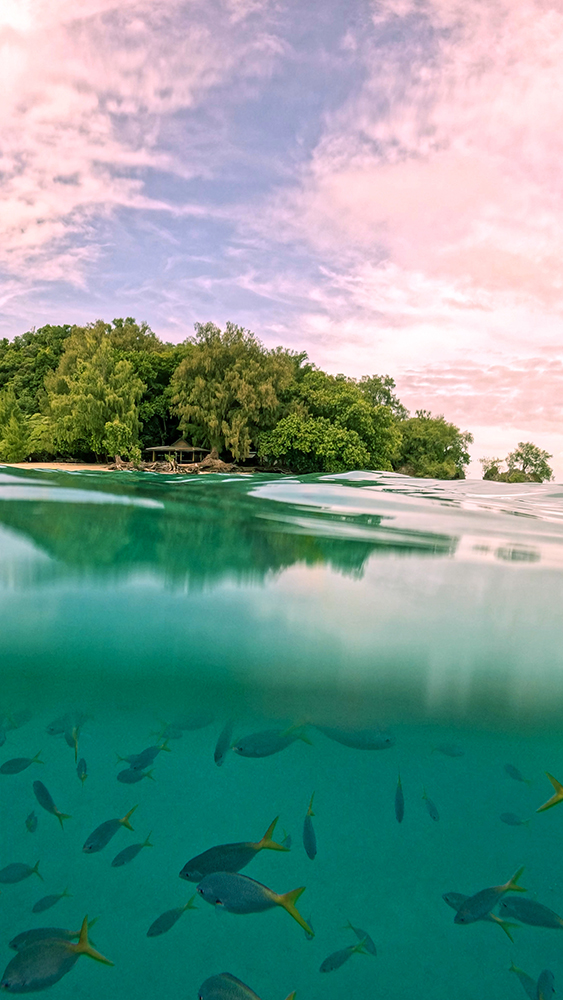
Nestled in a semi-protected bay, we found a shallow reef cordoned off by a line of swim buoys. Finn called it the Fishbowl, and told us to be on the look out for “teenage” fish. Lots of fish species in Palau begin their lives in insulated bays deep within the rock islands, then move outward to slightly more exposed areas as they grow, until they are finally big enough to move out to the open ocean. The Fishbowl was in the intermediary zone where we might find young fish that haven’t quite matured enough to head out to sea yet.
I peered into the water below us as I pulled on my fins and mask. Already, there were hundreds of fish swarming around the boat. Finn identified them as yellowtail fusiliers. Vince, Rachel, Jared and I all jumped into the water together, straight into the chaos of the school of fusiliers. There were also sergeant majors in the mix, and flashes of shining scales dazzled me as the fish surrounded us in every direction.
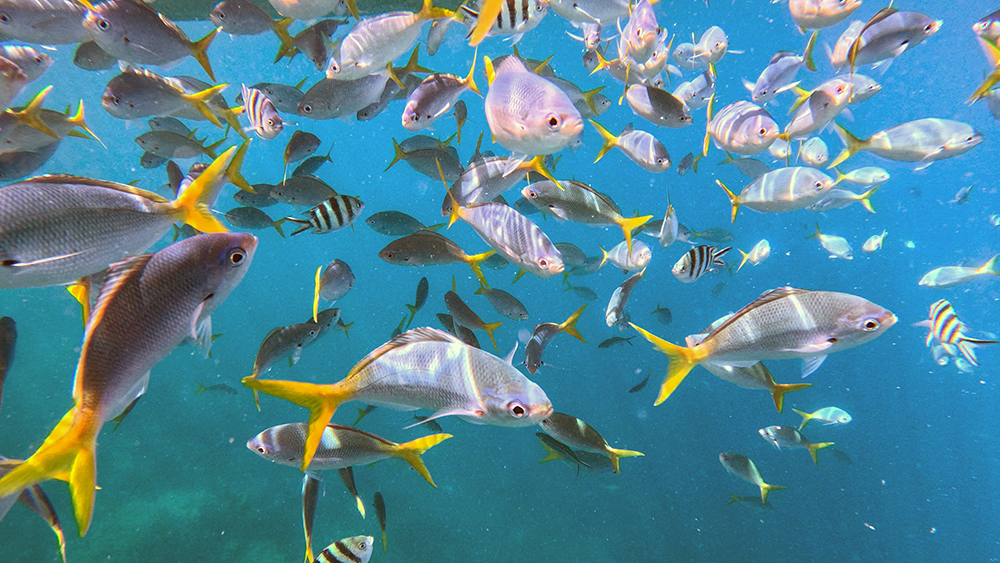
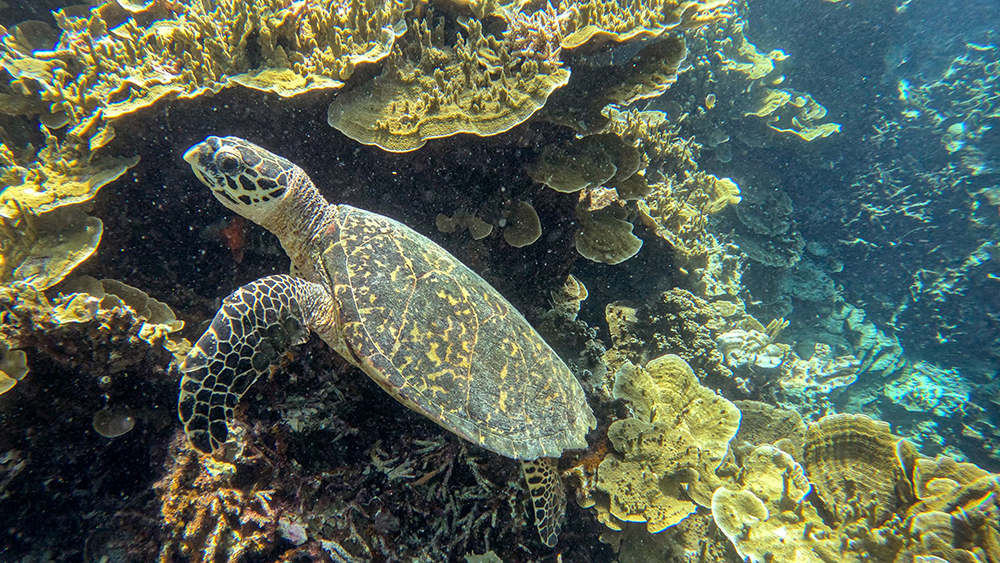
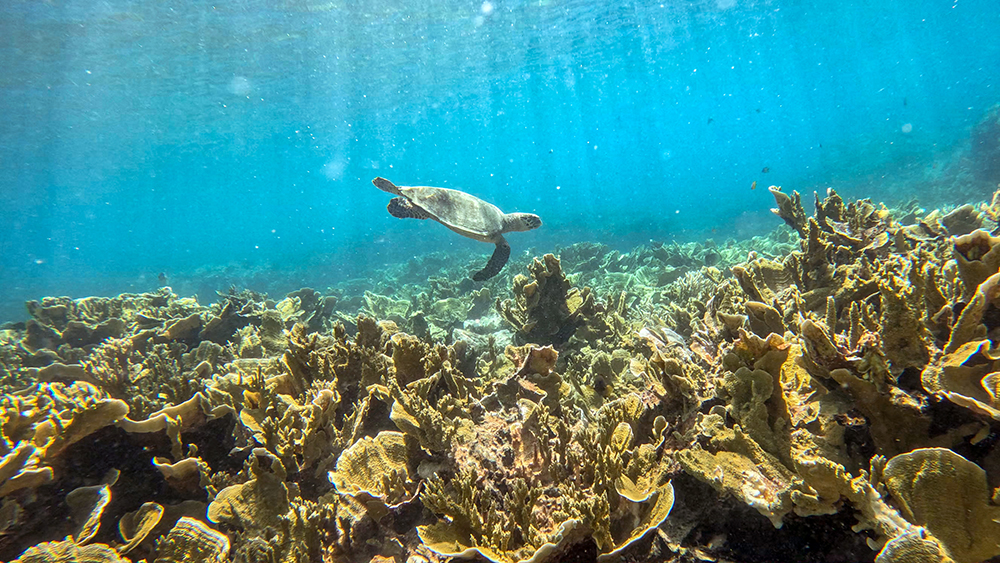
We were so engrossed with watching the fusiliers, that we didn’t notice when Rachel swam off in search of more fish. Suddenly we heard her yelling and we pulled our masks out of the water and looked up to see her waving for us to swim over to her. Vince, Jared and I started swimming as fast as we could, and when we reached Rachel, we saw what had her so excited. She’d spotted a hawksbill sea turtle!
Hawksbills are critically endangered, so this was a really cool find. At this point I couldn’t tell you how many green sea turtles I’ve seen (not that I could ever tire of them), but this was only my third hawksbill sighting ever, so it was extra exciting. We watched as the turtle chewed on some coral, and then gracefully glided away over the golden reef.
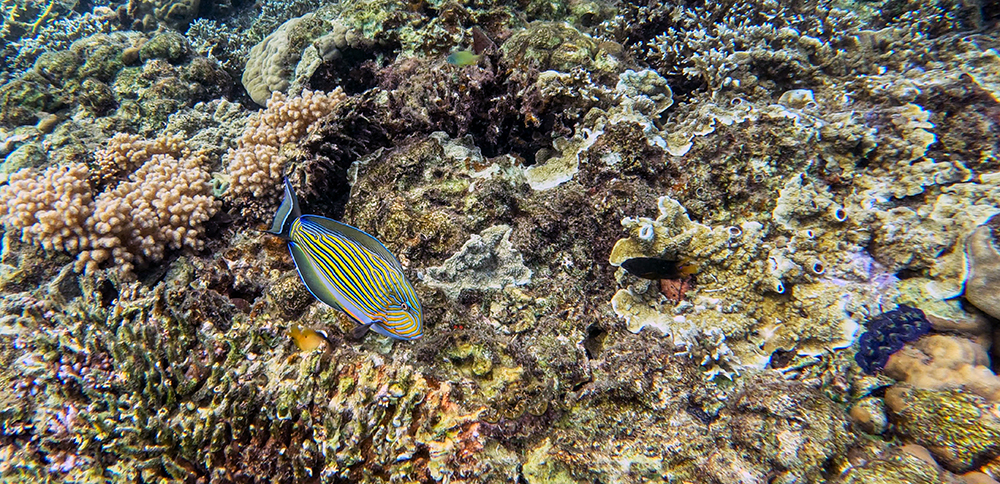
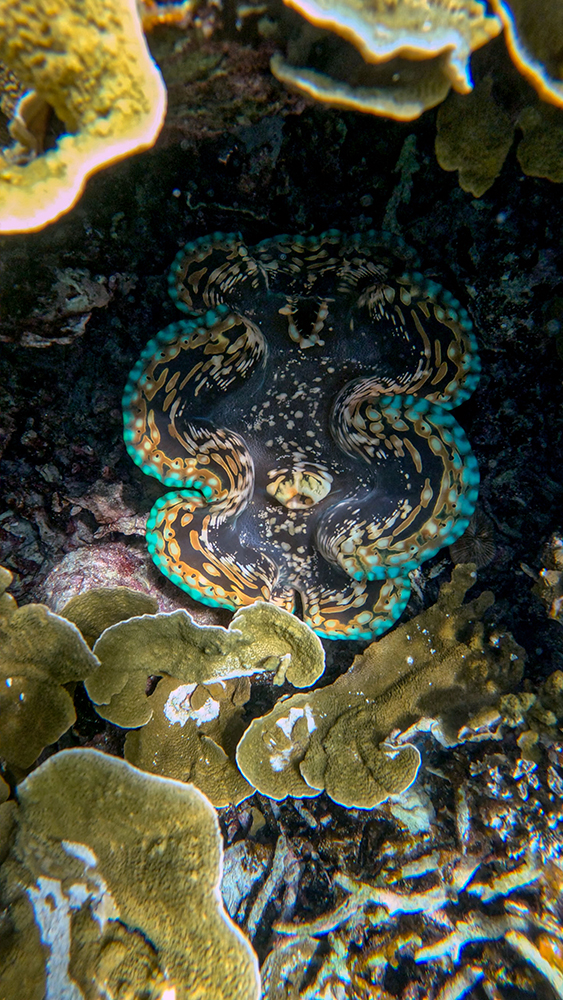
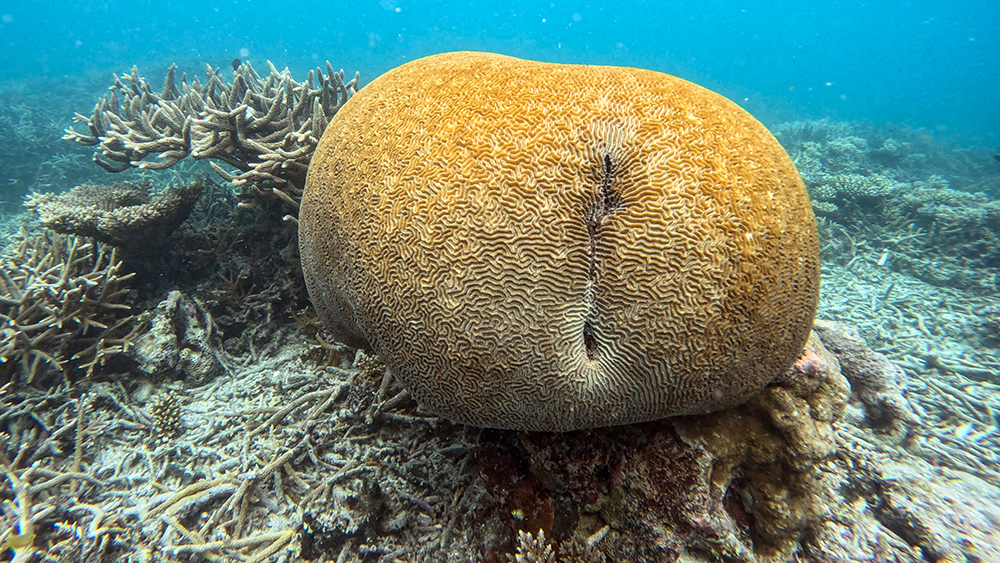
We explored the Fishbowl for a long time because there were beautiful corals and fantastic fish species to see everywhere we looked. I found a large rock that was covered in dozens of small giant clams, each with distinct, colorful patterns. I also found a school of juvenile bumphead parrotfish. They were much smaller than the mature adults we’d seen while SCUBA diving a few days earlier. Throughout the reef, we kept finding pearlescent balls, about the size of golf balls. Jared asked Finn what they were and he explained that they are bubble algae, and are one of the largest single-celled organisms in the world.
Finn located an area that was covered in waving anemones and lots of reddish orange clownfish were swimming around, guarding their anemones fiercely. When we inspected the anemones more closely, we could see tiny, baby clownfish darting in and out of their tentacles. The babies were so small that they were nearly invisible, but once we knew they were there, they became easier to find.

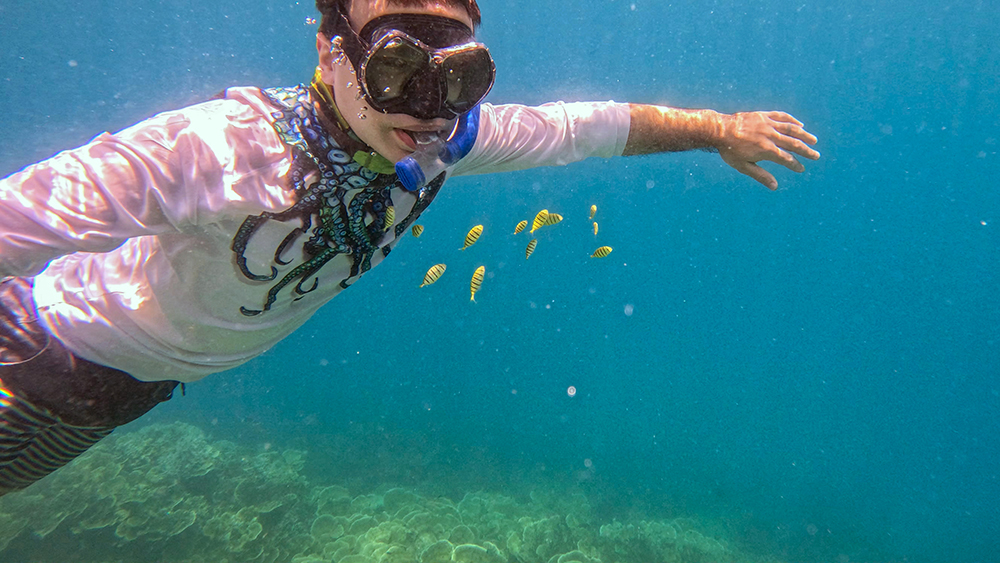
But the hands-down funniest and most amazing thing that we encountered at the Fishbowl happened by random chance to Vince. He had swum off on his own, following the turtle until it swam beyond the buoys and over a drop-off. As he swam back he noticed that about a dozen or so little, yellow fish were swarming around him. He kept swimming, and they continued to stick close to him, mostly preferring to swim under his chest. Vince came over to show me what was going on, and the fish all darted behind him, trying to hide whenever they sensed that I was looking at them.

We swam over to Finn to ask him what on Earth was going on, and the little fish accompanied us. Finn immediately identified them as juvenile golden trevally, and said that when they are small like this, they take up residence beneath larger animals like turtles or sharks. This lends them protection from would-be predators. Apparently they had decided that Vince looked like a good option, and had taken the opportunity to cling onto him as their new protector.
No matter how long we kept snorkeling around, the trevally never strayed far from Vince, and we started to call them his “Fish Posse.” Any time I got close, they darted behind Vince to hide. This went on for so long that we all eventually had to pull our heads out of the water because we were laughing too hard. I loudly complained, “Vince I can’t even hang out with you because your fish don’t like me,” which sent me and Rachel into a giggle fit that ended with me choking on salt water.
When it was finally time move on from the Fishbowl, I stayed underwater as Vince removed his fins and climbed up the boat’s ladder. I wanted to see how the Fish Posse would react, and sure enough, they panicked. They swam around in a confused pattern, desperately trying to find anything to be beneath. Vince was understandably distraught to hear this as he’d formed an emotional bond with the fish, and felt very protective of them. We all felt a little sad to be abandoning them, but it had to be done. Vince isn’t in fact a sea creature, and there was no way he could protect them forever.
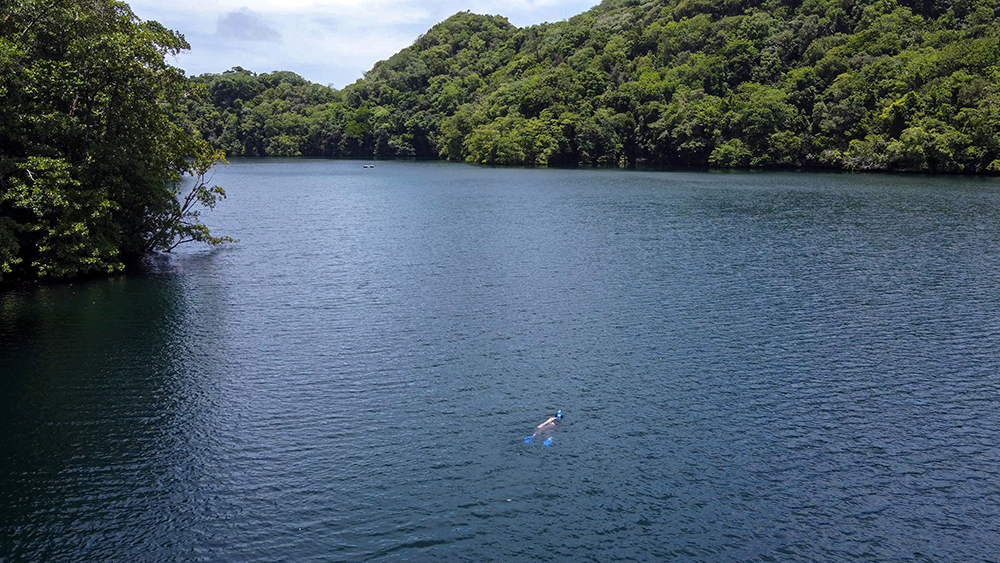
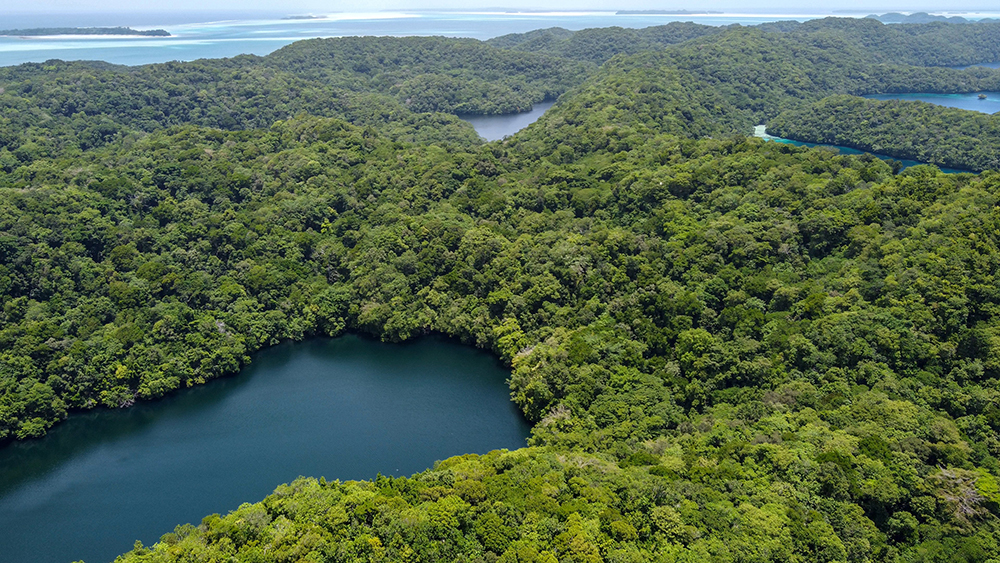
After we were all back on board the boat, we went directly to a dock on Mecherchar. There was an official ranger station at the dock, and Finn went up to it to arrange permission for us to visit Jellyfish Lake. From there, we took a ten minute hike up a steep hill, carrying our snorkeling gear with us. The hiking path ended at a large, marine lake that glistened in the midday sun.
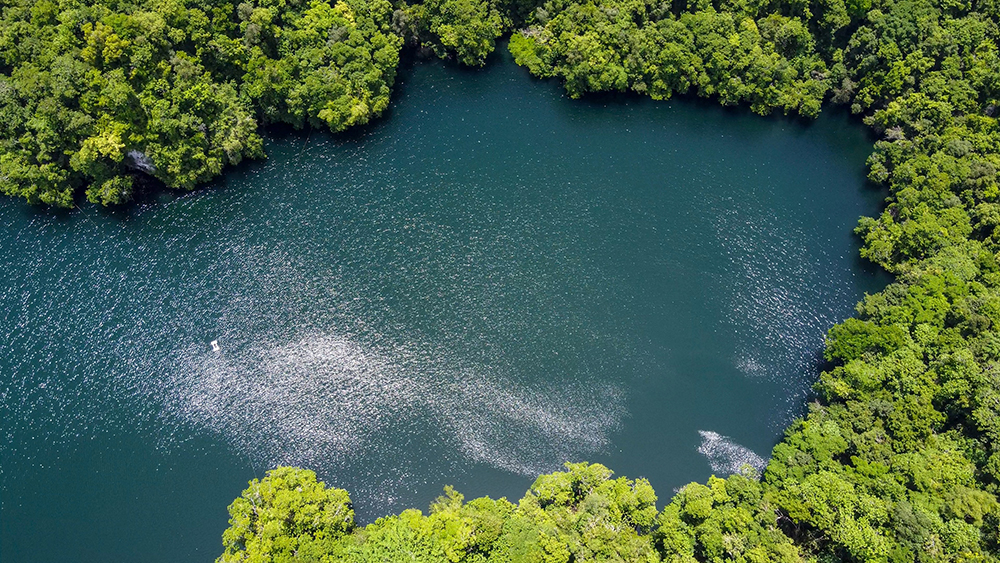
Just a few years ago, the swim dock and the waters of the lake would have been crowded with hundreds of tourists, but today we were the only humans in sight. It should be unthinkable to have a truly private tour of Jellyfish Lake, the most popular destination in Palau, but since 2019 visitors to the lake have been as scarce as the once booming golden jellyfish population that attracted them.
Before 2019, Jellyfish Lake was filled to the brim with millions of golden jellies, a subspecies of Mastigias Papua that lives only in the marine lakes of Palau. But Golden jellies prefer cooler water than many other jellyfish species, so when a La Niña hit Palau in 2019, the jellies didn’t reproduce, resulting in a dramatic drop in their numbers. Golden jellies reproduce by two means. Either Asexually by budding off of polyps that are affixed to the lake’s walls, or sexually when mature medusas produce larvae. These larvae swim to the edge of the lake, where they attach and become polyps. When the water gets too warm, the polyps don’t produce more medusas, although they remain dormant, attached to the lake edges. Recently temperatures have come back down, and the jellies have started to make a slow comeback, but a full recovery will take some more time. For now the lake has a lot more moon jellies, which thrive in warmer water.
Most tourists choose to skip Jellyfish Lake these days because of the small golden jelly population, but we chose to go and check it out anyway since none of know if we’ll ever make it back to Palau to try again. We all agreed that it would be worth it to see even a handful of golden jellies since they are such a unique and interesting species, and Finn directed on where to swim to have our best chance at finding some.
When we entered the lake, we were greeted by a school of orbiculate cardinalfish, relatives of the pajama cardinalfish we’d seen the day prior. These fish have no natural predators in the lake, so they haven’t developed fear of humans, and they swam right up to us.
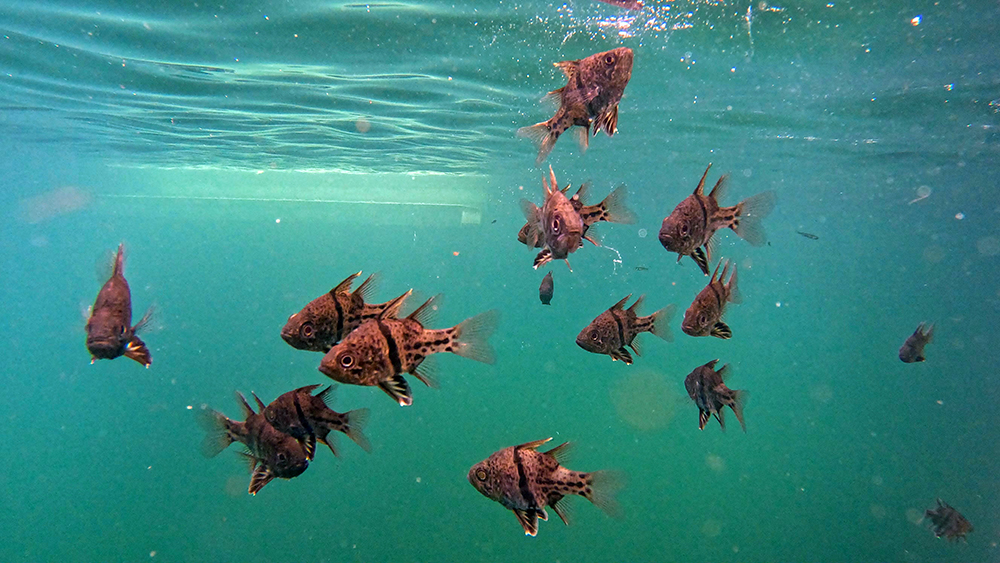
We swam passed the cardinalfish, and headed toward the sunniest spot in the middle of the lake. Golden jellies are in a symbiotic relationship with a single celled alga called zooxanthellae. The jellies provide a home for the zooxanthellae, and the zooxanthellae provide nutrition for the jellies. Zooxanthellae photosynthesize, which is why the jellyfish can be found in the sunniest part of the lake at any given time of the day.
At first, all I could see was beams of sunlight shooting through the milky, green lake water. The bottom was completely invisible, but I knew that about fifty feet below the green abyss was a lake bottom blanketed by a highly poisonous layer of hydrogen sulfide gas. Finn had already warned not to free dive too deep in the lake because of this (not that I can free dive that deep anyway).
Eventually though, I started to find crystal clear moon jellies floating lackadaisically through the green water. They moved lazily, and with no apparent goal or purpose, their thousands of hair-thin tentacles dancing around them in a hypnotic rhythm.
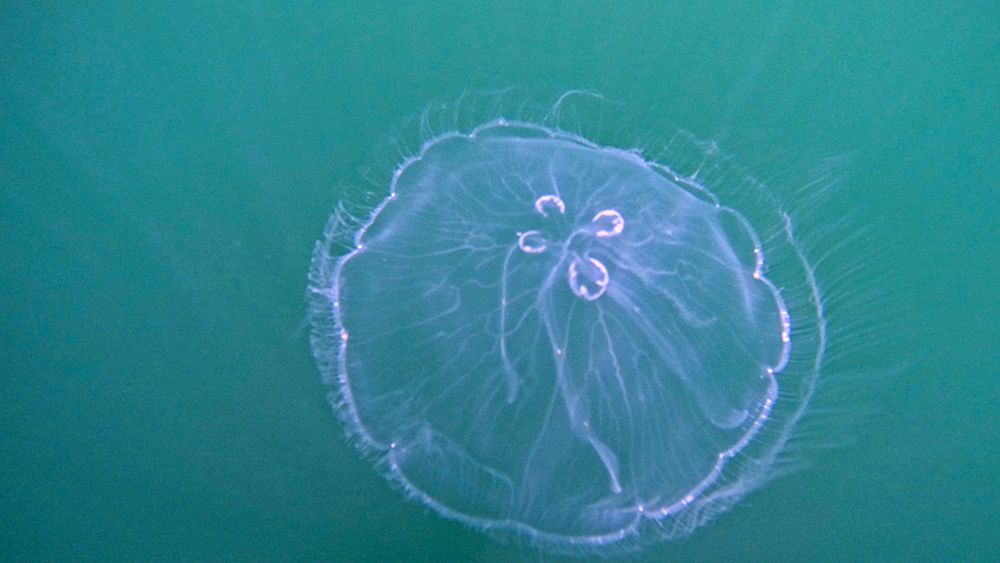
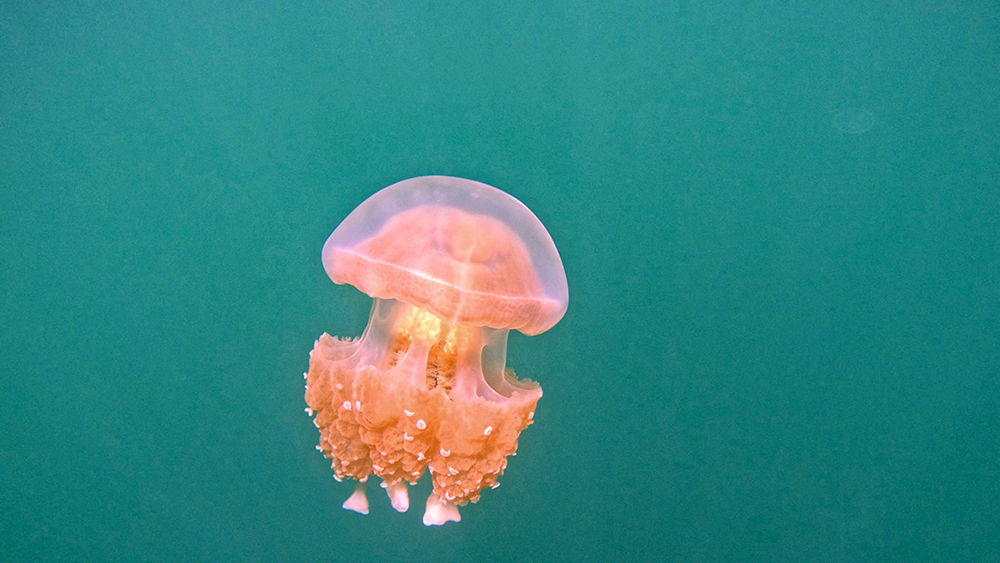
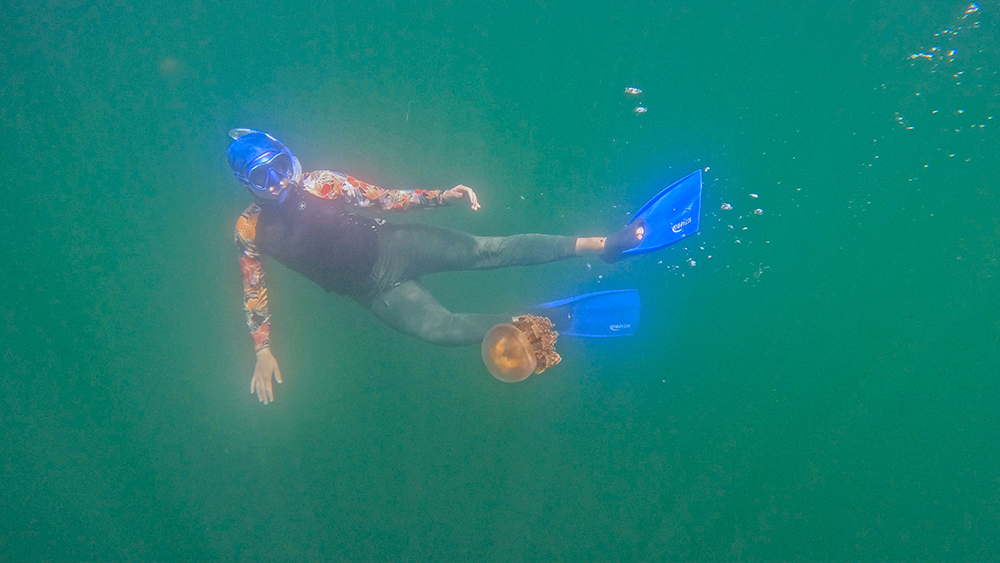
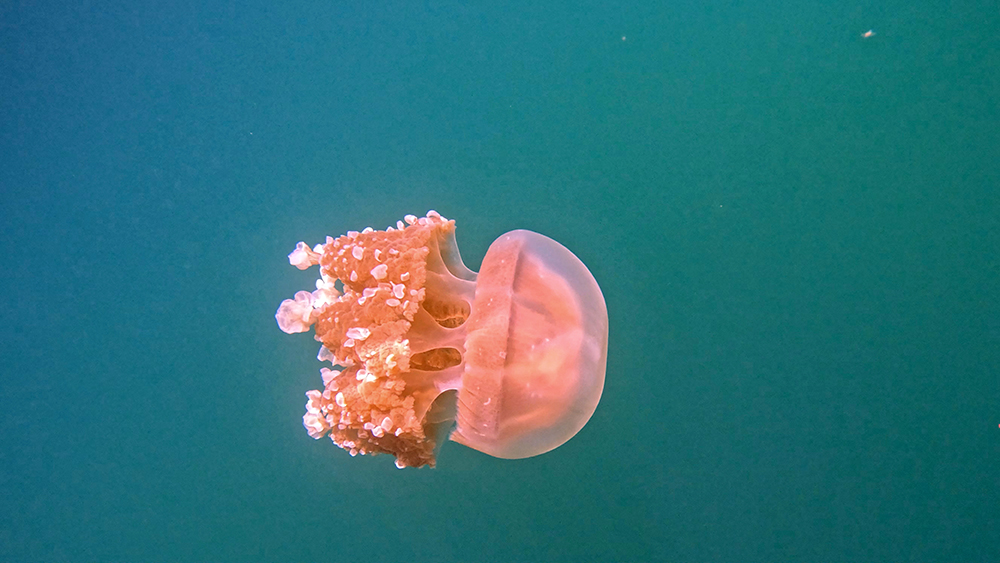
After a while, I found my first golden jelly. Gradually more and more of them came into view, although certainly not by the millions. The golden jellies were more beautiful to me than the moon jellies, and they seemed to glow from within whenever a beam of light hit them just right. They also moved much faster and with seemingly more purpose. Whichever direction they happened to be traveling in, they seemed on a mission to keep moving, and they simply wouldn’t be stopped.
I could also see that they were similar, yet different from the Mastigias Papuas we’d swam with yesterday. They were deeper orange in color, and their tentacles were shorter than the Mastigias Papua.
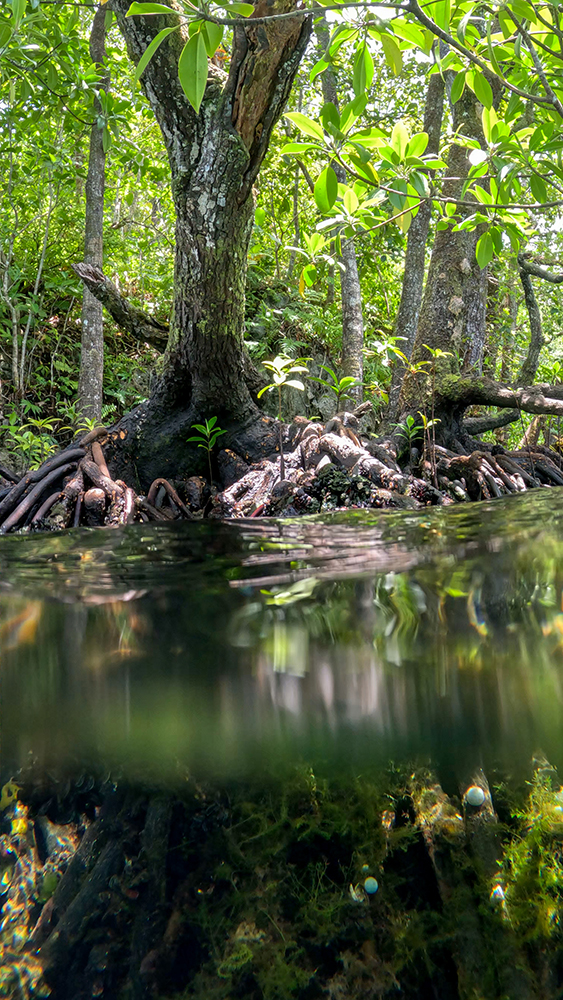
Surprisingly, jellyfish weren’t the only interesting creatures to see in Jellyfish Lake. Finn led us over to the edge of the lake where tangled mangrove roots dipped into the water. He pointed out a wispy, white anemone affixed to a root and explained that these anemones prey on the golden jellies.

Finn allowed us a generous amount of time to swim in the lake, and even though we mostly saw moon jellies, I was still very glad we’d come to check it out. Palau’s marine lakes are a fascinating environment to learn about I was very happy to have seen some golden jellies, even if we didn’t get to see them in full force.
After we dried off and hiked back down to the boat, we took a very short ride over to see the Yap coin Finn had told us about earlier. Vince and I were extremely excited for this because we thought we wouldn’t get to see one during our trip. Jared and Rachel had already visited a Yap coin on a tour they took while Vince and I were SCUBA diving, and we had just resigned ourselves to missing out on that in favor of diving. Now it turned out we would get to see one after all!
During a short walk through a wet forest, Finn told us about the Yap coins history and how they were made. These giant coins were harvested by the Yapese, who didn’t have crystalline limestone on their own island in the present day Federated States of Micronesia. So they travelled 300 miles by outrigger canoe to carve these stones from quarries they dug in Palau, and then brought them by canoe back to Yap to be used as currency.
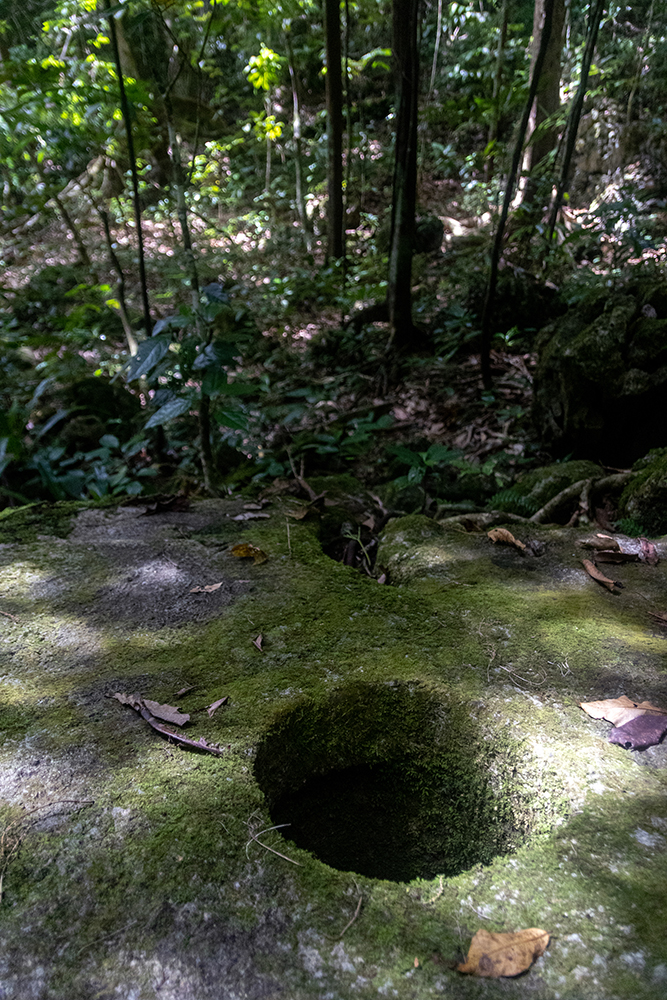
When we arrived at a gargantuan circular stone on the forest floor, Finn pointed to a large crack in it’s moss-covered form. He said that the stone was probably damaged when workers were attempting to move it from the quarry to a canoe. Damaged Yap coins were worthless, so they abandoned it where it still sits to this day.
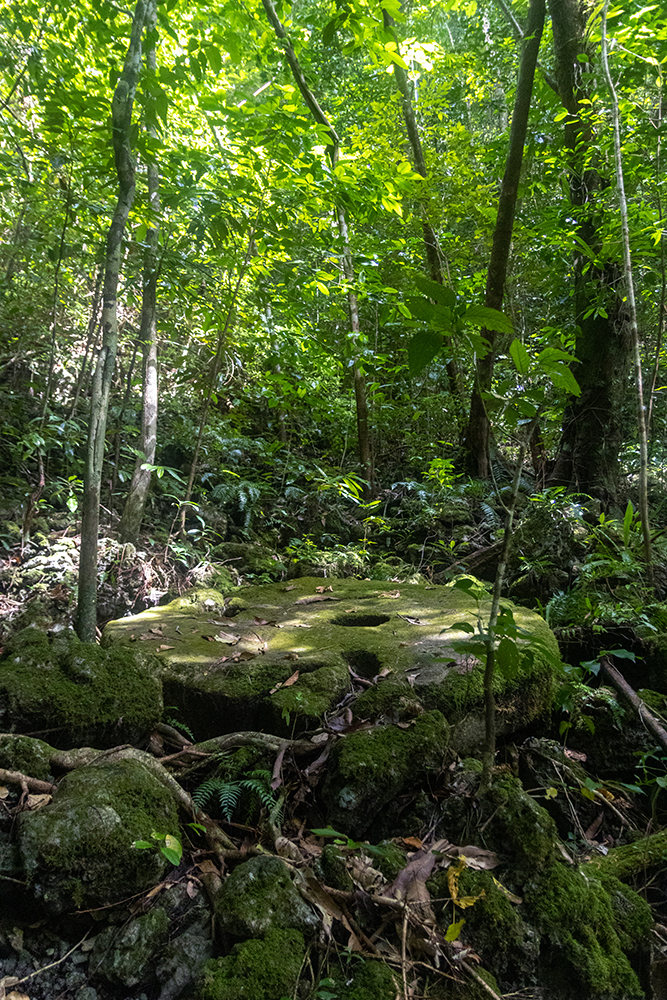
Just to demonstrate how big the coin really was, Finn had us all sit on its surface together for a photo. We all easily fit with plenty of room to spare.

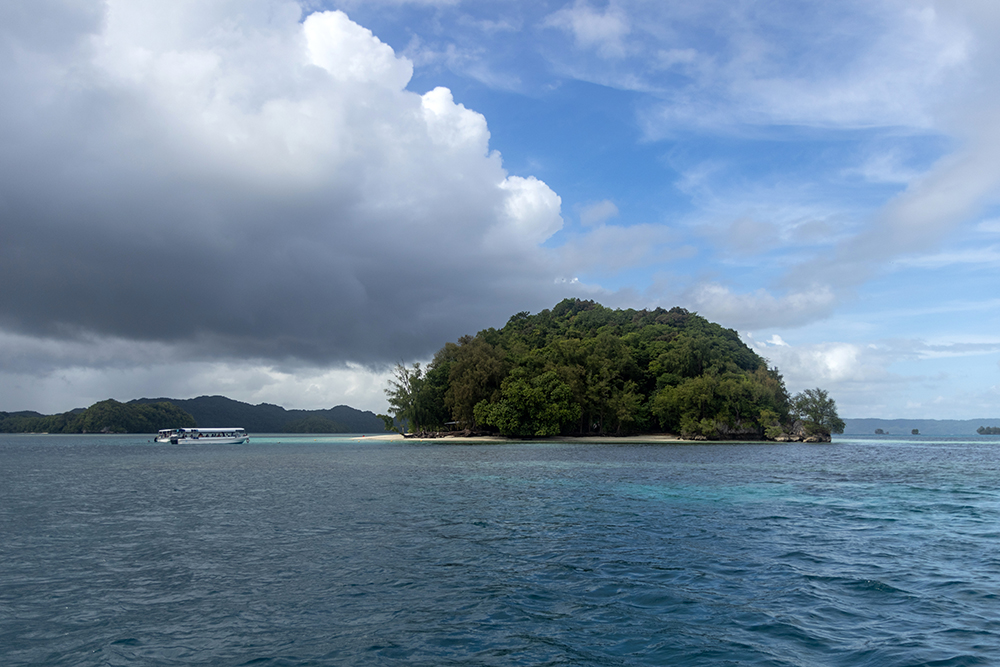
By the time we made it back to the waiting boat after visiting the Yap coin, everyone had worked up a major appetite. It was already after one pm and the day was flying by. RD drove us over to a nearby island that is rumored to have been a filming location for Survivor. I really geeked out over this because all four of us are big Survivor fans, and the two seasons that were filmed in Palau are among my absolute favorites.
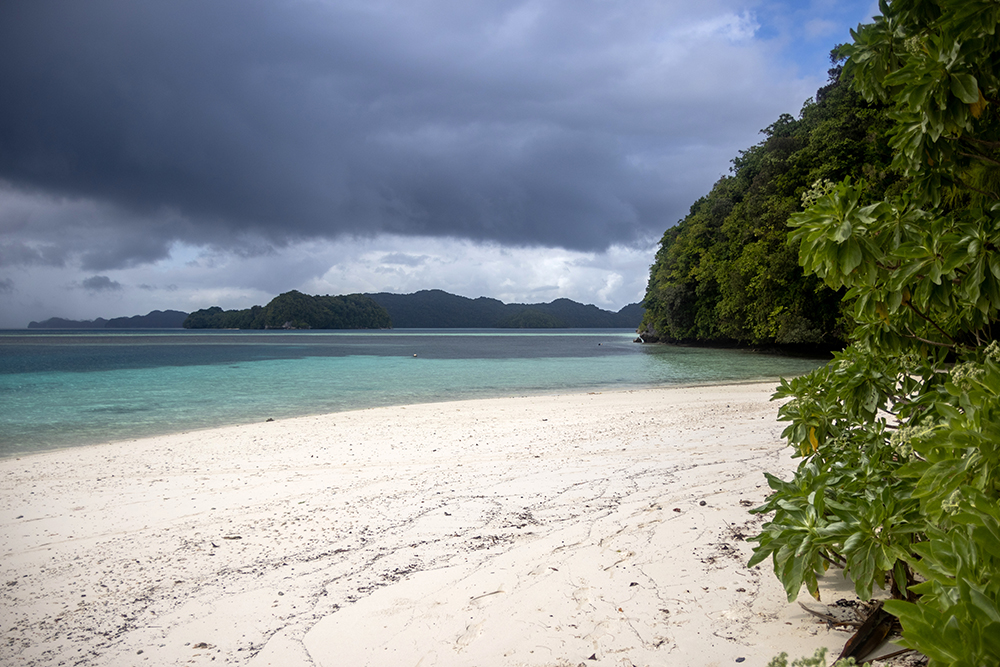
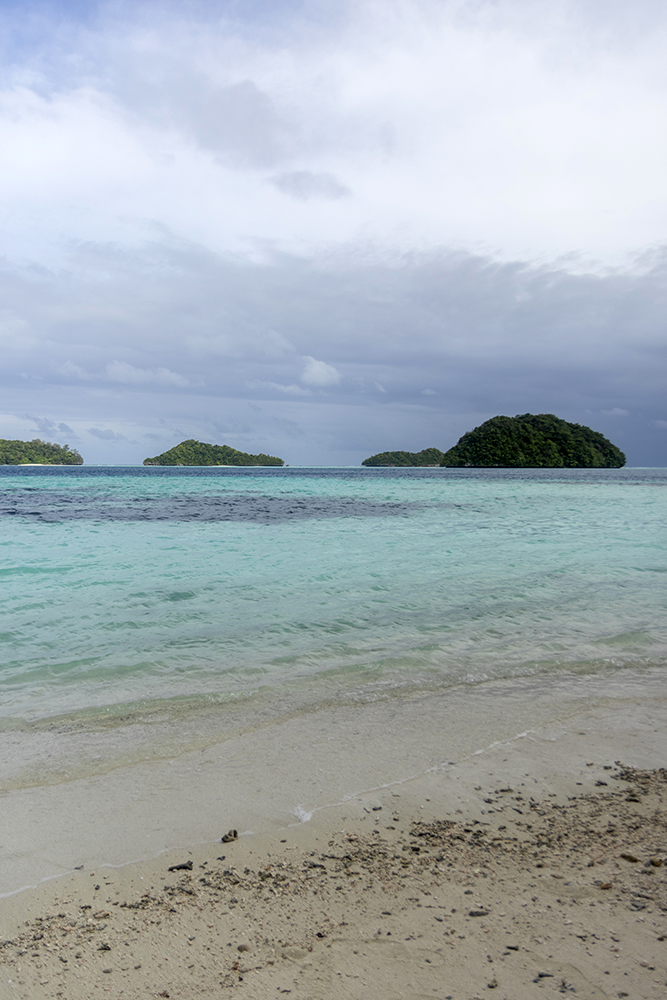
RD pulled the boat up to a sandy beach and we jumped into the shallow surf, carrying our bento boxes along with us as we waded to the island. We sat in the shade at a nearby picnic area, looking out over a paradisiacal seascape as we opened up our lunches and dug in. We also sang happy birthday to Jared, who would get to celebrate two days in a row since we’d be going back in time to his birthday again when we crossed the international date line on our way home.

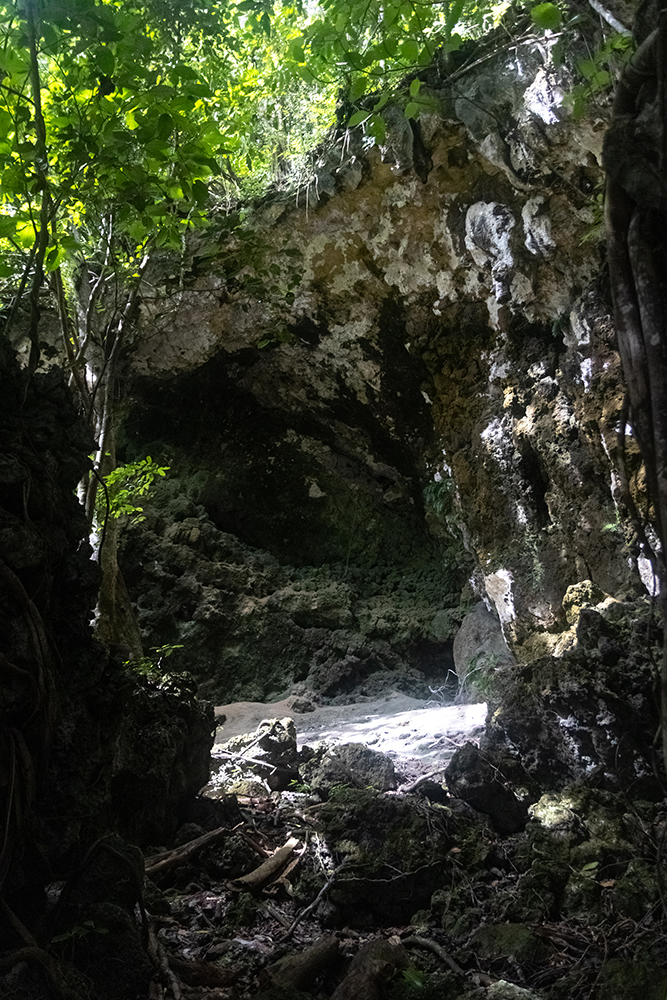
I scarfed down my bento box, then went to explore the shores of the island while everyone else still ate. What had been a sunny day was now darkening, and a dramatic looking cloud front hung in the sky above. Eventually Vince, Rachel, and Jared finished their meals and joined up with me, and found some beautiful sandy beaches, and a small cave.
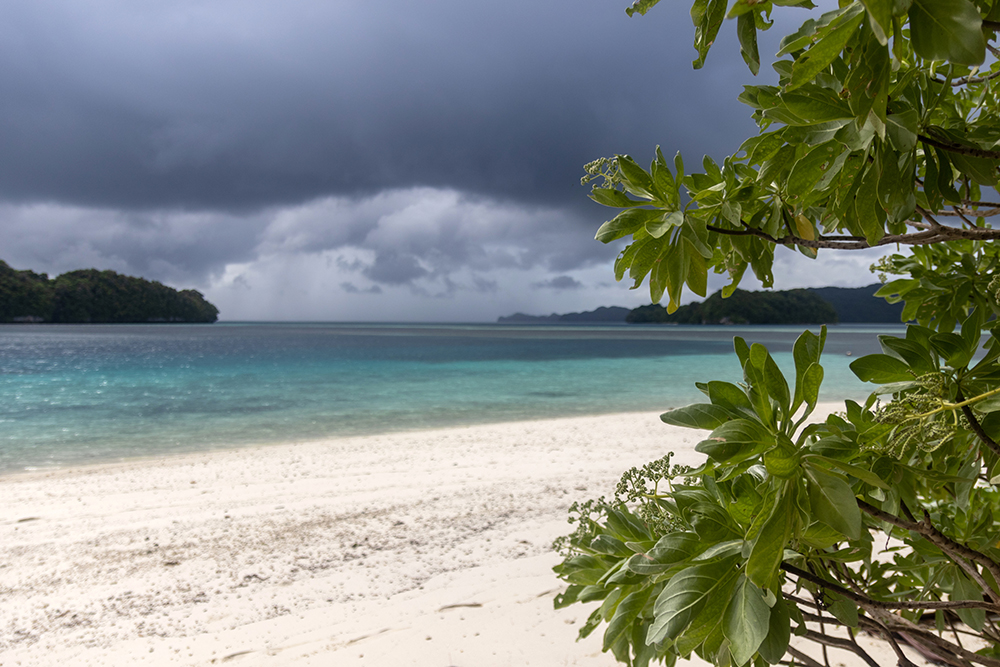
But we didn’t have much time to explore the island because we still had two more snorkel spots to get to before the end of the day. We gathered up all of our lunch boxes and trash, and waded back out to the boat. Technically we were already at the next snorkel spot, we just had to boat out a bit deeper before we could jump in.
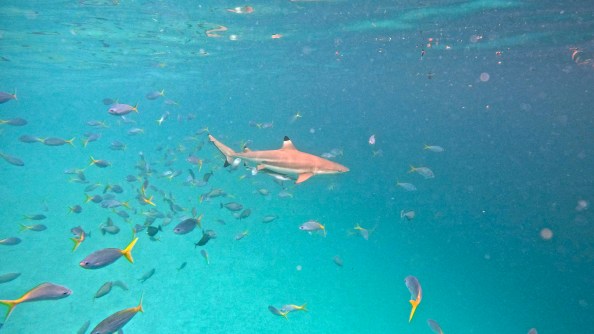
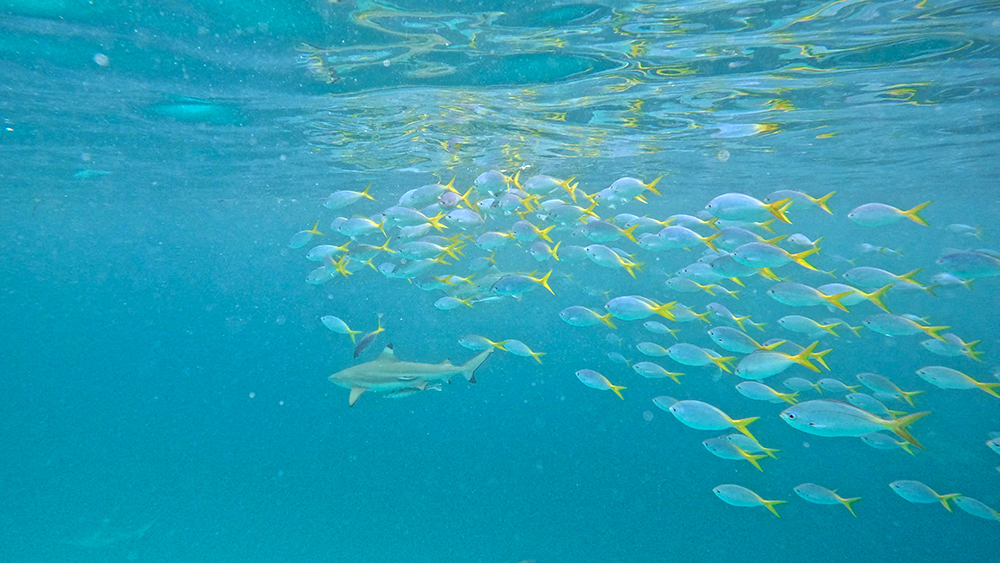
This spot was known as Blacktip Beach because the blacktip reef sharks in the area have become habituated to boats, and will swim right up when they hear one approaching. So when we jumped into the water amidst another school of yellowtail fusiliers, nobody was surprised to see a few sharks circling the area.
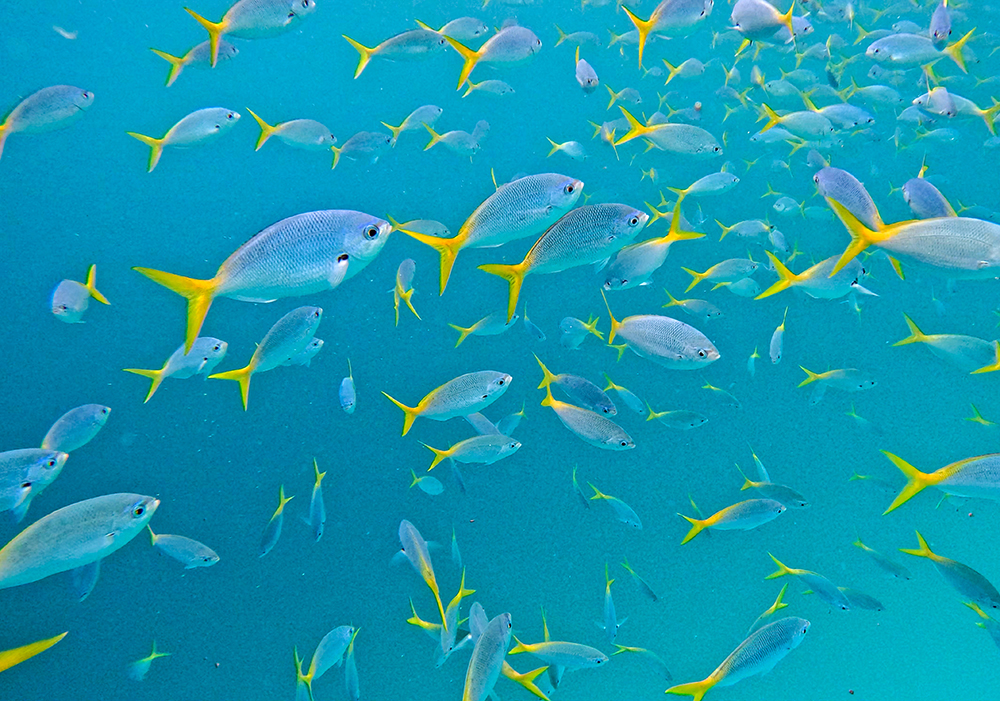
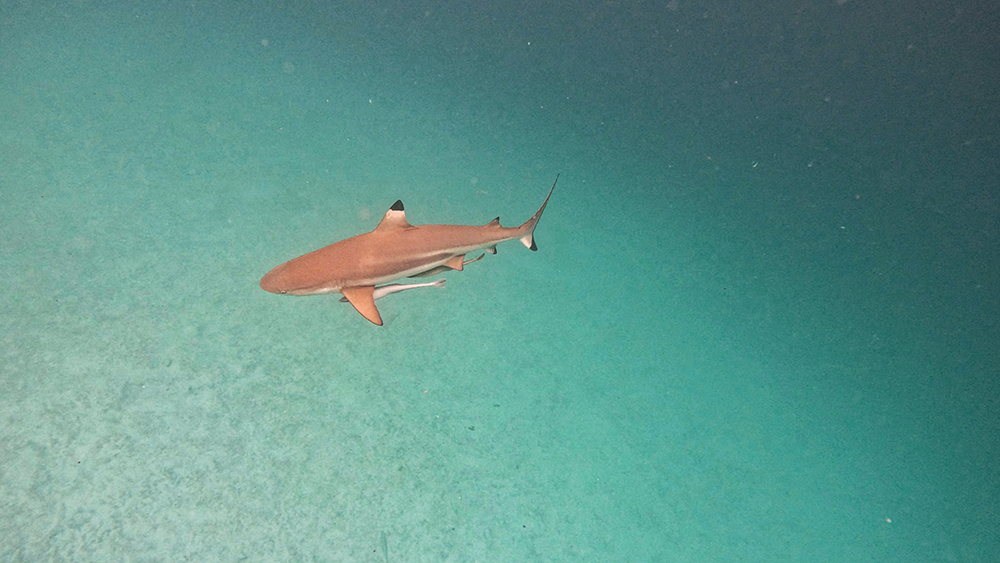
At first the sharks were curious and interested in the commotion caused by the boat and the fusiliers. They swam around us, sometimes coming in quite close. But eventually they lost interest in the situation and returned to deeper waters, leaving us to float with the fusiliers for a bit before climbing back onto the boat.
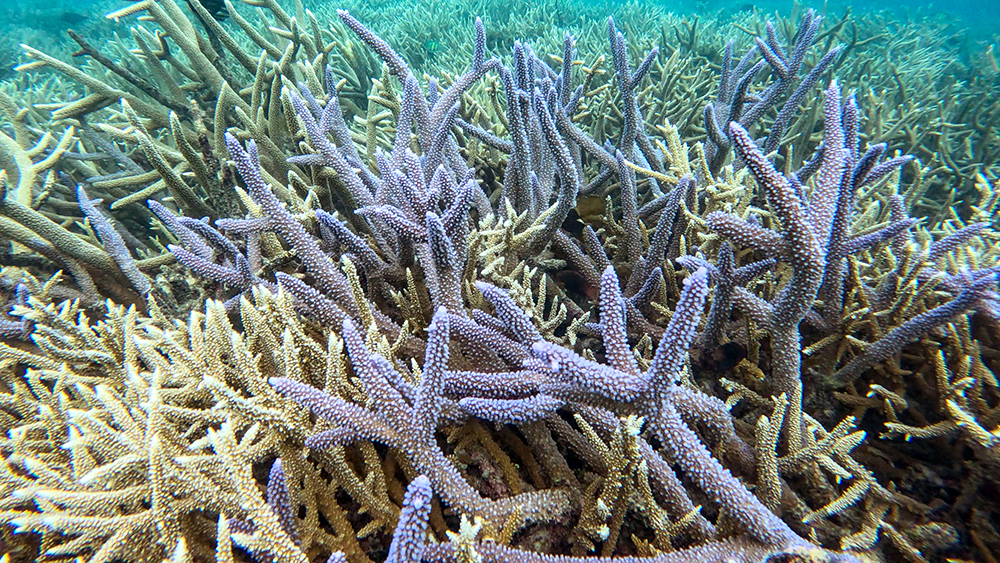
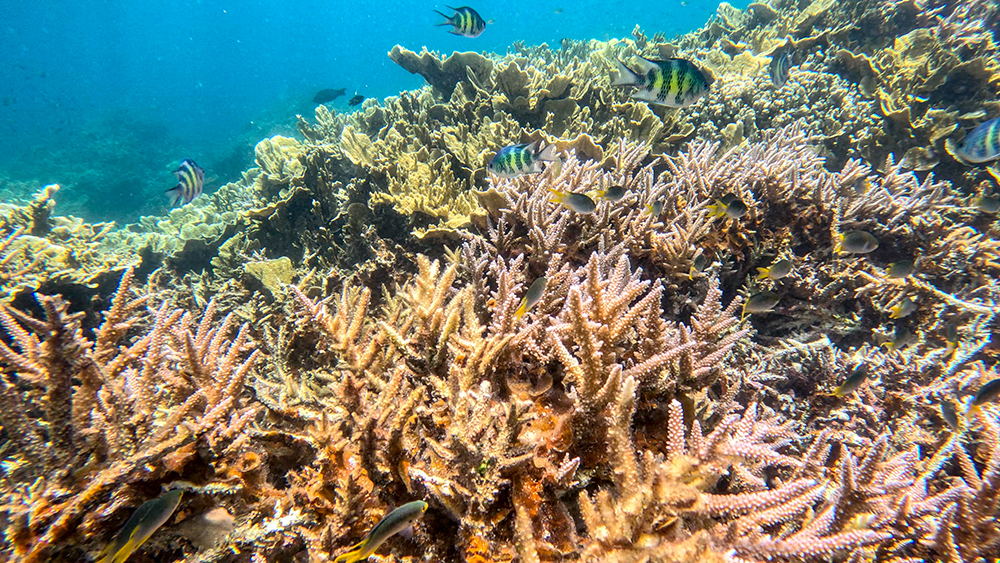
Now we only had one stop left to make, and this would be our last activity in Palau, and of our entire Micronesian vacation. We boated over to a nearby area with a strong current. This would be a drift snorkel over a patch reef that beautiful patches of purple staghorn coral mixed in with the more common orange staghorn coral.
We jumped into the ocean one last time and followed Finn’s lead, cruising over the reef effortlessly. The purple corals were very vibrant and were a great punctuation to the much more abundant orange ones.
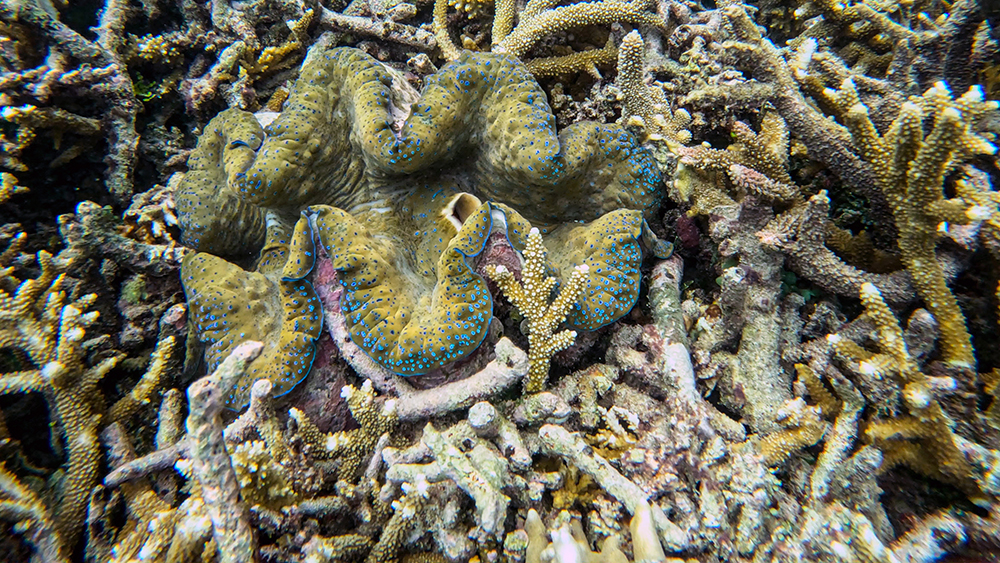
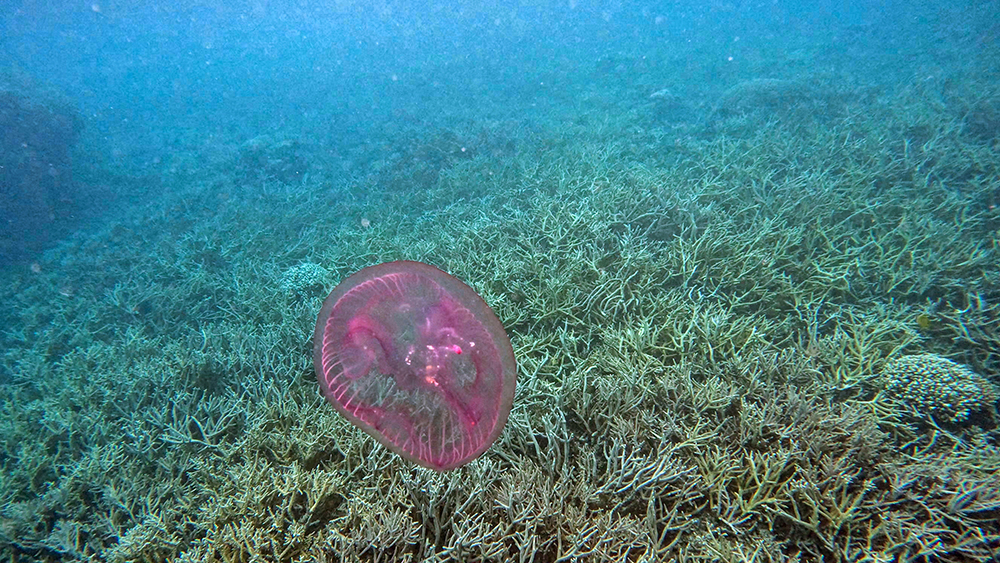
As we glided along the reef, we found a bright pink jellyfish, a lot of really neat corals, and a final giant clam. RD met us down current to pick us up, and clamored back into the boat for the long (and very wavy) ride back to Koror.
When we arrived back at Paddling Palau headquarters, it was time to say our goodbyes. Both of our tours with them had been totally fantastic. RD was an excellent captain, and Finn was a knowledgeable and very fun guide. I really wished we could have stayed longer and gone on a few more tours with them, but by now we’d been away from home for over two weeks, and reality was calling.
That evening we went out for dinner at and Indian restaurant for Jared’s birthday, and reflected on all of the amazing experiences we’d had on our island hopping adventure. From marooning ourselves on an uninhabited island in Majuro, to diving through WWII shipwrecks in Chuuk, to discovering the unparalleled natural beauty of Palau, every step on our journey had been unique and memorable in its own way. Everyone agreed that another highlight of the trip had been meeting so many friendly people along the way, both the locals on all of the islands we visited, and other travelers. Micronesia had lived up to all my wildest expectations and more, and while I was very sad to have to leave, I was also deeply grateful for the chance to visit so many of its wonderful island destinations!




 birdsoftheairtravel.com
What amazing adventures you and your friends have. It was great to learn how the young fish stay protected and move out to deeper waters when bigger. The cave art. The coloured jellyfish. But I was thrilled to see the hawksbill turtle, what a treat for you to see this creature. I have only ever drawn them (I am an illustrator).
That’s so cool! You couldn’t pick a more beautiful subject than a hawksbill, such an amazing animal!