The reason I love the sea I cannot explain – it’s physical. When you dive you begin to feel like an angel. It’s a liberation of your weight.
~Jacques Cousteau
A day after we missed our flight out of Guam, Vince, Rachel, Jared, and I finally arrived in Koror, Palau. This was the leg of our Micronesian island hopping tour that we were all looking forward to the most, but the weather upon our arrival vacillated between a light drizzle and a torrential downpour, making it difficult to imagine doing much of anything that didn’t already involve being underwater. Luckily for me and Vince, we had two days of SCUBA diving on our itinerary, which would hopefully give the weather plenty of time to clear up before our more land-based excursions later in the week.
after catching a cab from the airport, we checked into the Palau Hotel and went straight to bed, even though it was only nine pm. Everyone was exhausted from only getting a few hours of sleep the previous night, and we also all had early morning excursions and we wanted to be well rested. While Vince and I were on our three tank dive, Jared and Rachel would be exploring some of the islands around Koror on a half-day kayak tour.
We rose early the next morning, gathered all of our gear, and had a quick breakfast before going outside to meet the shuttle van from our dive shop, Blue Marlin. There was already a Japanese couple aboard when the shuttle arrived, and we learned that they would be achieving their one thousandth dive that day! Next, we picked up Lars, who we’d met back on Eneko in the Marshall Islands, and then Sebastian, who we’d met in the Majuro Airport. Finally we stopped for a British couple (Will & Ellie) who were about to reach 300 and 100 dives respectively.
The scenery on the way to Blue Marlin, although somewhat gloomy underneath a blanket of lingering rain clouds, gave us a preview of what we would experience over the next four days. We drove along a coastline dotted with views of bubble-like limestone islands rising from the sea. The trees growing from the limestone gave them a chia pet-like appearance, and they made me excited to explore Palau’s islands later in the week.
We arrived at the dive shop just as another downpour started, and walked to a covered deck to collect all of our rental gear. Tomi, our divemaster and the person I’d communicated with to book our dives, directed us each to a numbered bag that contained out BCD’s, fins, wetsuits, boots, octopuses, and weight belts. We’d sent our heights, weights, and shoe sizes in advance, so everything fit perfectly. Also in our bags were neoprene hoodies, which were sure to keep us warm out on the boat on such a rainy day.
Once everyone had done a gear check, our bags were loaded onto our dive boat, and we followed behind them, taking our seats aboard the boat. Each diver had a row seats to themselves, with plenty of room for gear, and all three of the tanks of air we’d be using that day. When we were all situated, the boat’s motors roared to life, and our captain steered us away from the dock, passing between some of the rock islands until were out on the open sea.
Our dives that day would all be out near Ulong Island, which coincidentally is where the Koror Tribe camp was located during the tenth season of Survivor (one of my all-time favorite seasons (yes I have watched every season of Survivor, some more than once)). It took about an hour to get there, and we all hid underneath our neoprene hoodies from the chilly air during the ride.
We were all somewhat soggy when we finally arrived at our first dive site, Grassland. The waters around Palau are known for some pretty serious currents. Because of this, local law requires every diver to carry an SMB and whistle. That way if anyone gets separated from their group, the boat will still be able to find them and pick them up. Our first dive however, would be an easy one, as Grassland is well protected from the strong currents on the outer reefs. It’s fairly standard for a dive shop to feel you out on an easier dive if you’ve never been out with them before, so after Tomi conducted our briefing, I was looking forward to a low-pressure, relaxing hour underwater.
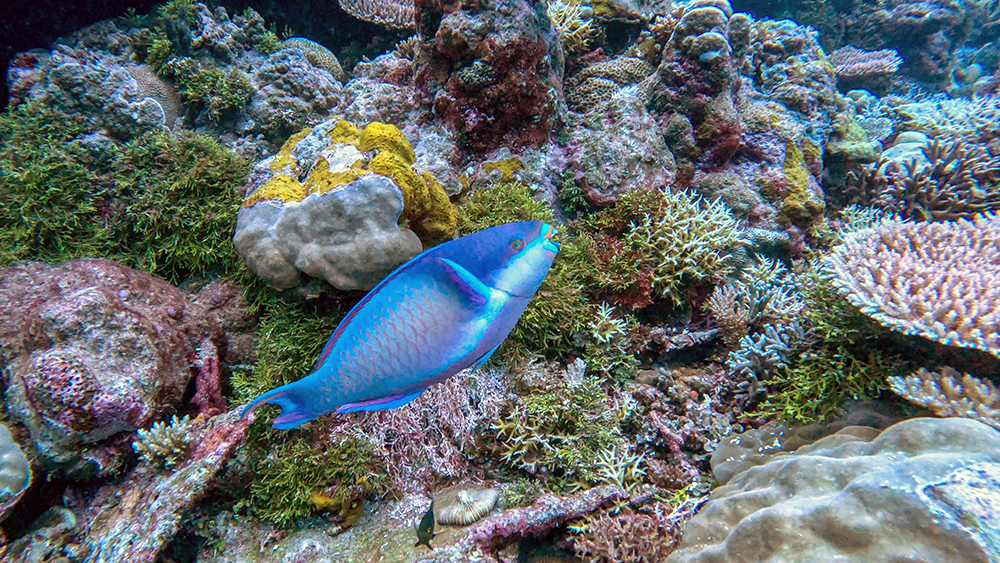
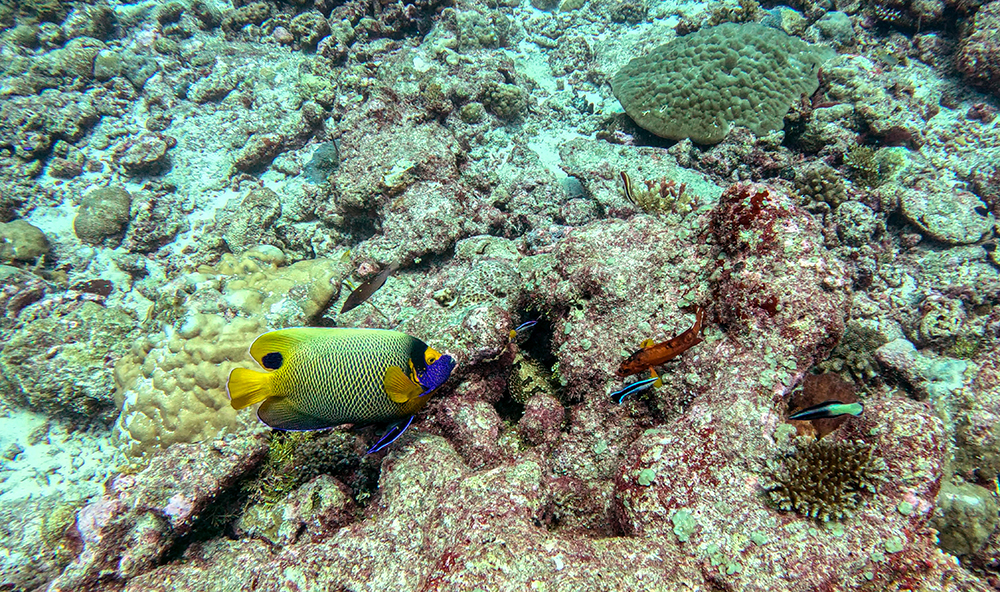
We rolled into the water in two groups divided by language (English and Japanese). Vince, Lars, Seb, Ellie, Will and I were in one group with Tomi leading, and another divemaster led three more pairs of divers. Once in the water, our group gathered at the surface and descended together to a sandy bottom alongside a colorful reef. I saw a couple of cool fish, including a colorful parrotfish, while everyone was grouping up at the bottom.
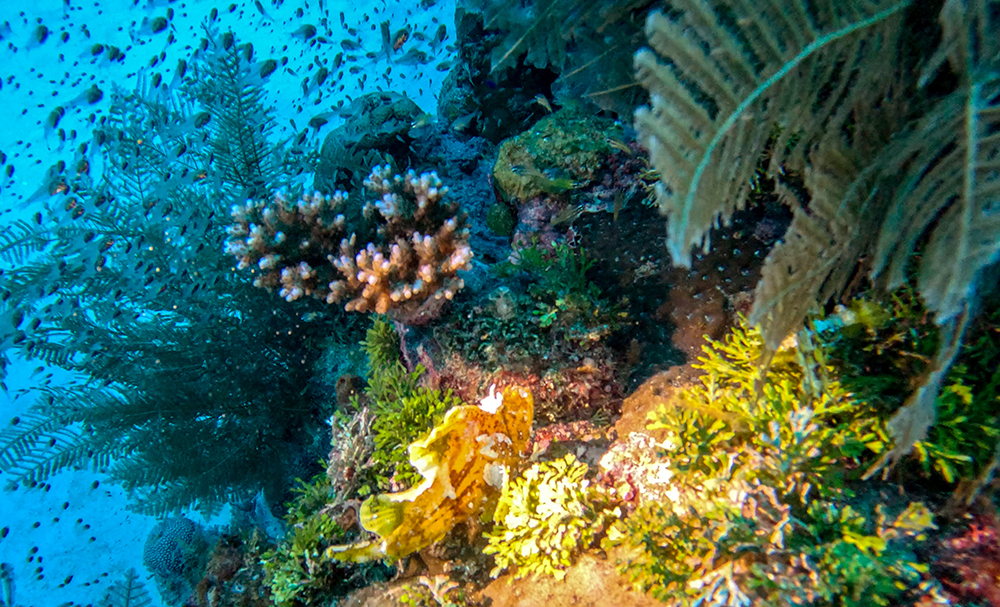
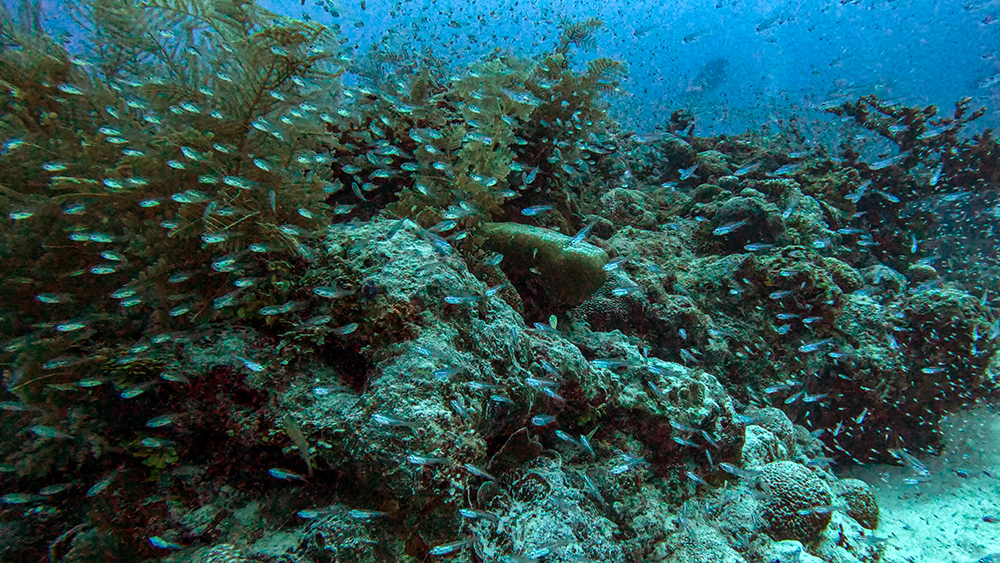
Tomi led us over the sandy bottom, letting us stop to check out any notable fish along the way. We encountered a small whitetip reef shark and a school of barracuda gliding over the sand. Back at the reef, we were treated to a show of hundreds of tiny, translucent fish swarming together. Tomi also spotted a leaf fish blending into the coral as the school of tiny fish flowed around it.
But the best part of the site was a field full of garden eels. This was impossible to capture on my GoPro because we couldn’t get close enough, so I’ll have to do a good job of describing the scene. We came upon a large, flat area of sand, and Tomi motioned for us to get flat on our bellies on the bottom. As I shifted downward, my perspective of the sand shifted until I could see hundreds of sand-colored eels poking their heads out of tiny holes they’d burrowed in the sea floor. The effect of so many of them all in one place was that they looked like a swaying field of amber grass. I’ve never seen anything like this outside of nature documentaries, and it was an amazing scene to witness in person.
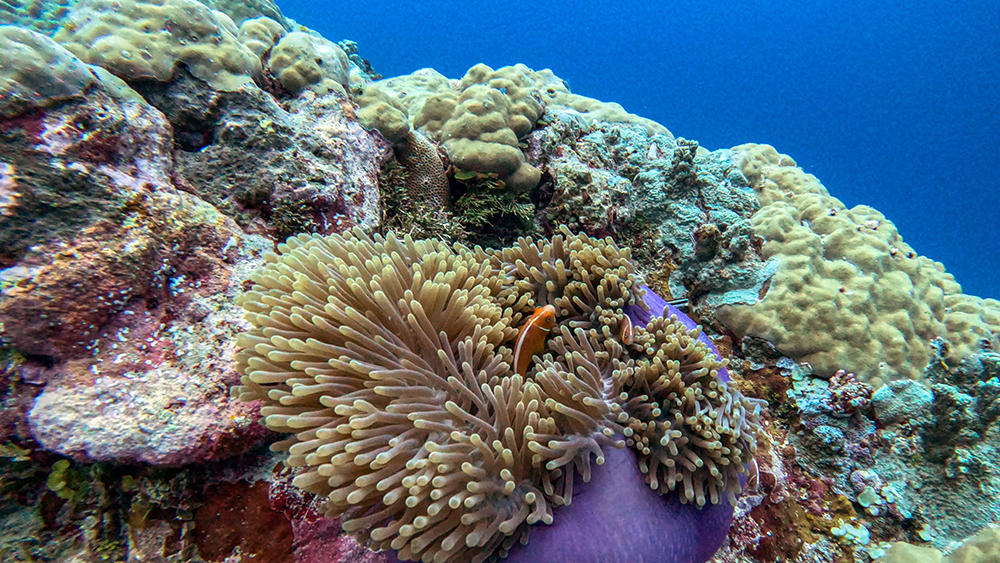
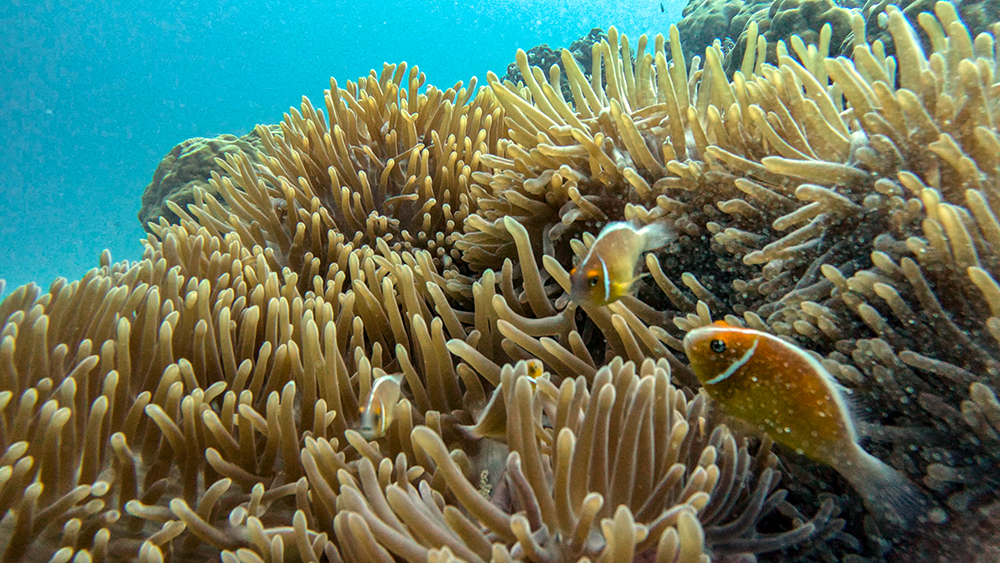
The eel garden was the turning point for the dive, and after watching them for a few minutes, we started to fin back in the direction of the boat. On the return trip we spotted a perfect anemone with a pair of clownfish living in it, and I found a large moray eel hiding in a rock. I tried to show everyone else, but couldn’t get their attention.
After the first dive, we spent a chilly surface interval on the boat, drinking water to stay hydrated. About an hour passed before Tomi announced our next dive site would be Shark City. The objective of this dive would be to find a school of red snappers while staying mindful of the strong current. Now this was the kind of Palauan diving I’d really been waiting for!
The current was ripping when we rolled into the water. We descended to a bottom that was covered in lace-like, yellow coral, and then followed Tomi, swimming with the current until we found the snappers.
This didn’t take long-they would have been quite hard to miss since there were so many of them. A couple of fish species in Palau have spawning events that are closely linked to the lunar cycle. We had arrived at Shark City just a few days before the snappers’ monthly spawn at the full moon, but it seemed that the fish had already started aggregating. These spawns involve up to ten thousand snappers gathering together at once, and there were indeed thousands of fish in the school we found. At first I only noticed the snappers that were closer to me. Visibility was poor that day due to the weather, and it took me a minute to see a gargantuan shadow heaving through the waters behind a deep blue veil of murky water. The shadow streamed up and over the reef from a massive drop off, its tendrils trailing towards us until the shapes of individual fish were apparent.

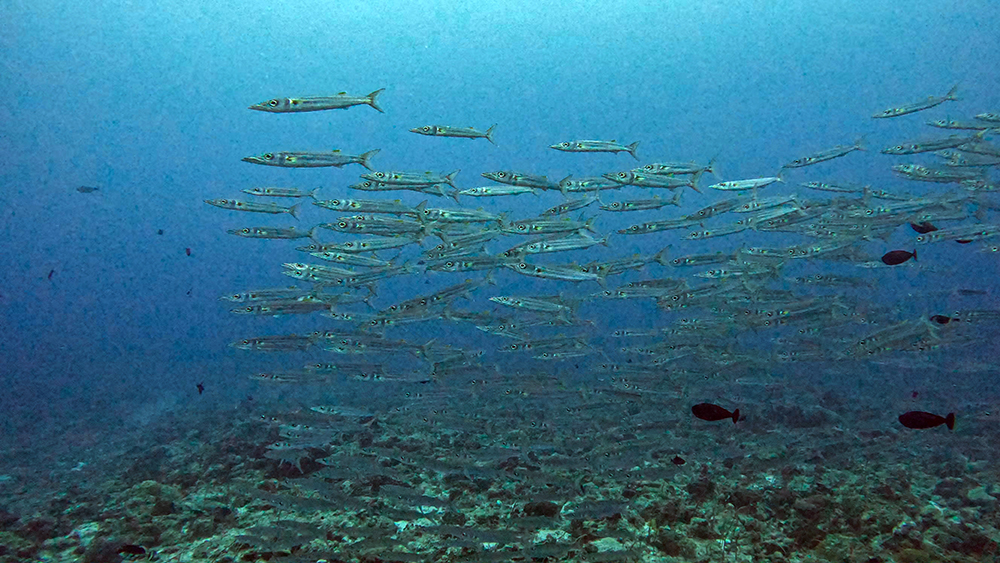
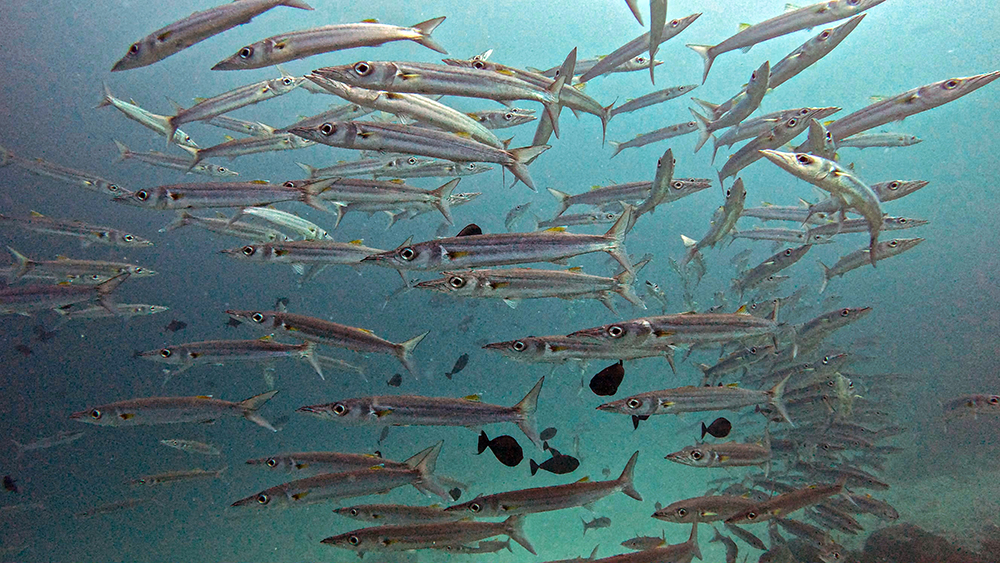
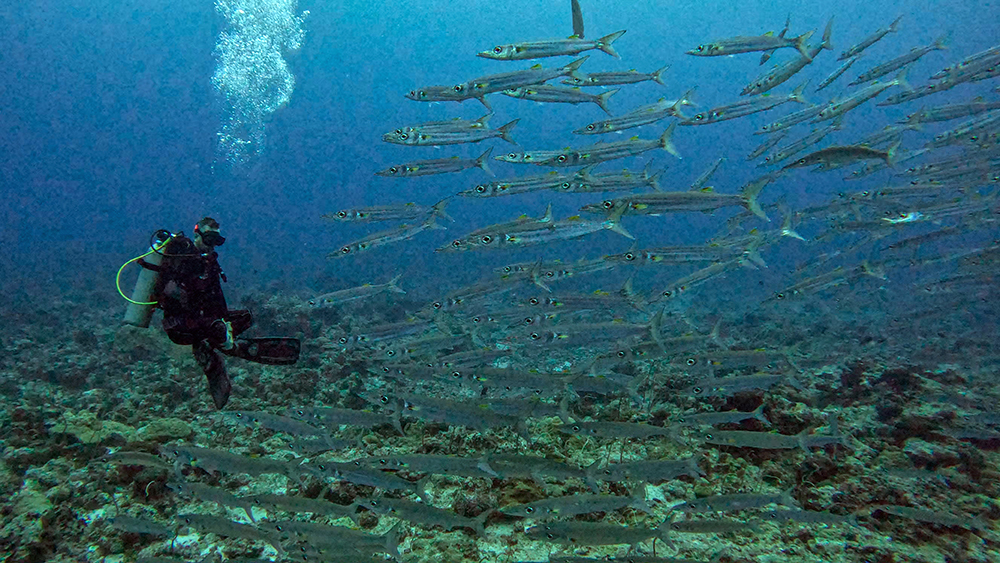
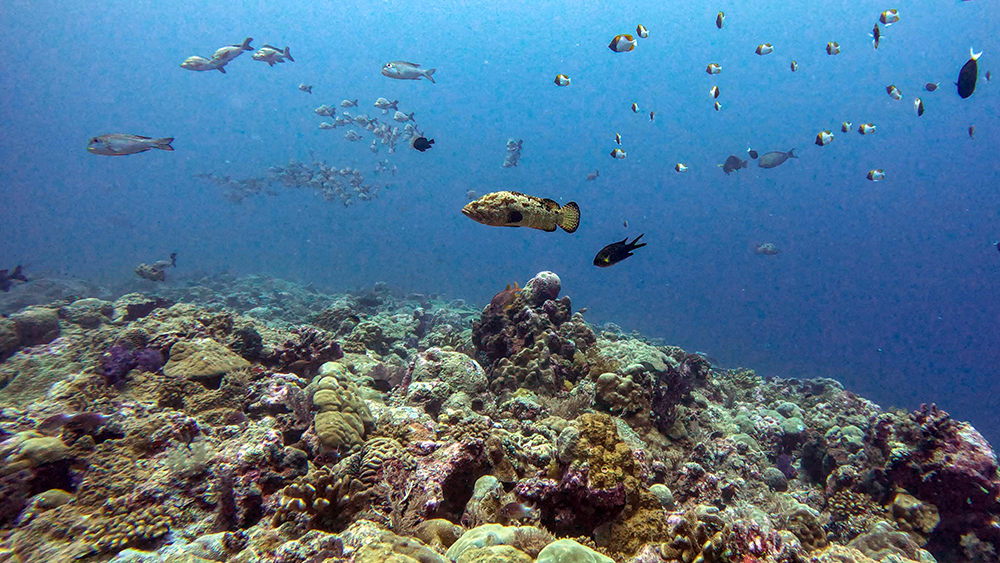
It was a challenge to stay near the school. The current, which seemed to pose the fish no problems, was quite strong, and we had to alternate between floating with it and swimming against it to watch the snappers. After doing this for a while, we eventually broke away to follow a large school of barracudas and a handful of bumphead parrotfish.
I love the way barracudas catch the light and look like they are shimmering when they gather in large groups, so I was happy when we got to spend the rest of the dive swimming along with the school.
After the dive, we returned to the boat for a longer surface interval and a bento box lunch. Then we motored over the the last dive site of the day, Siaes Corner. While not the absolute most famous dive site in Palau, Siaes Corner is well-known for having large schools of fish, and lots of sharks. I’ve talked to divers who found it better than the Blue Corner, which is the most sought-after dive in Palau. It remained to be seen whether Siaes would best the Blue Corner for us, but I was eager to find out.
Before we jumped in, Tomi told us to be ready to use our reef hooks if we found anything we wanted to stop to watch. My pulse raced as I plunged into the water. A mixture of excitement about what we might find, and apprehension about possibly having to reef hook (a skill I’d never practiced) had my adrenaline pumping. As it turned out, the current wasn’t particularly strong that day. It was just fast enough to make for a comfortable drift dive along a wall that was covered in brightly colored corals.
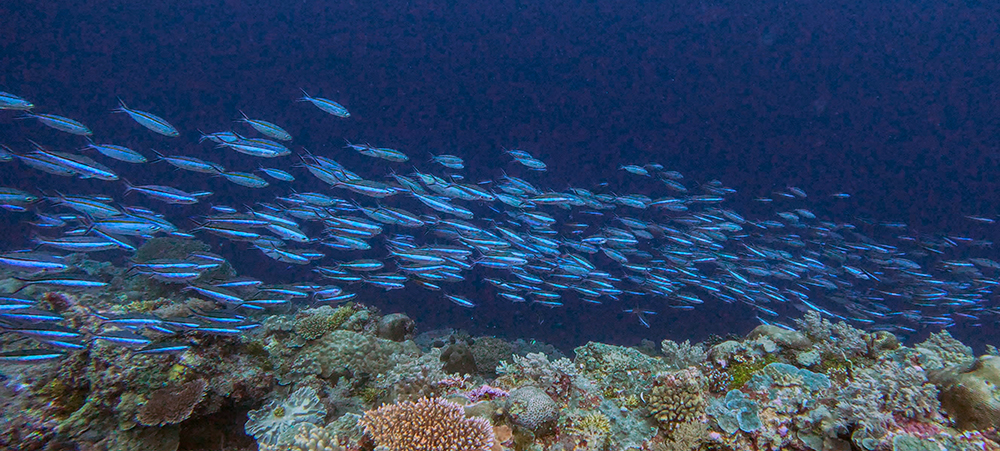
The first thing I noticed besides the water condition was the fish. Thousands upon thousands of shiny fusiliers flowed around us as we drifted along the reef. Tomi partially inflated his SMB and dragged it through the water in erratic patterns to make the schools of fish dart around together in reaction to it. The result was a dazzling display of twinkling bodies, moving in tandem in every direction I looked.


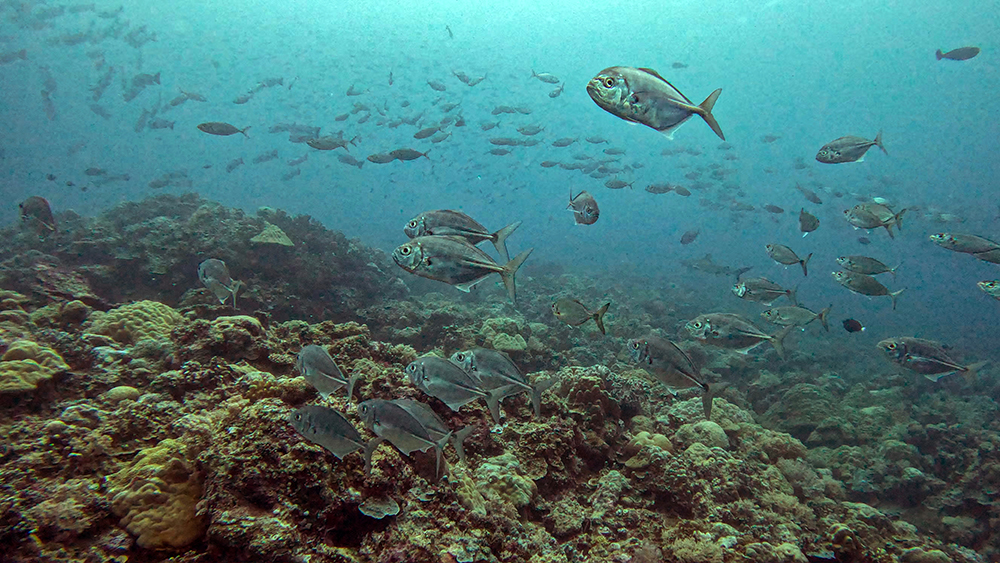
And the fusiliers weren’t the only interesting fish we saw. There were more barracudas and snappers, another bumphead parrotfish, and a school of jacks. I was momentarily stunned when a whitetip reef shark sped toward us from the blue haze, attacked a snapper, and vanished back into the depths as quickly as it had appeared. It was somewhat sobering to see how fast the shark could move when it was on the attack. I’ve seen a fair number of sharks underwater at this point. All of them have been either laid-back, cruising through the water and minding their own business, or harmlessly curious, checking out our group of divers, but never making any sudden movements to rush towards us. This shark came out of nowhere and was so fast I could have completely missed it if I didn’t happen to be looking in the right direction at the time. It was my first time watching a shark hunting, and the animal’s speed and power was breathtaking.
When the dive was over, we returned to the boat one last time, and chatted excitedly with Seb and Lars as we sped back towards Koror. Everyone agreed that it had been an amazing day, and we couldn’t wait to do it again the next morning. We just hoped the weather would improve for us so we would have better visibility.
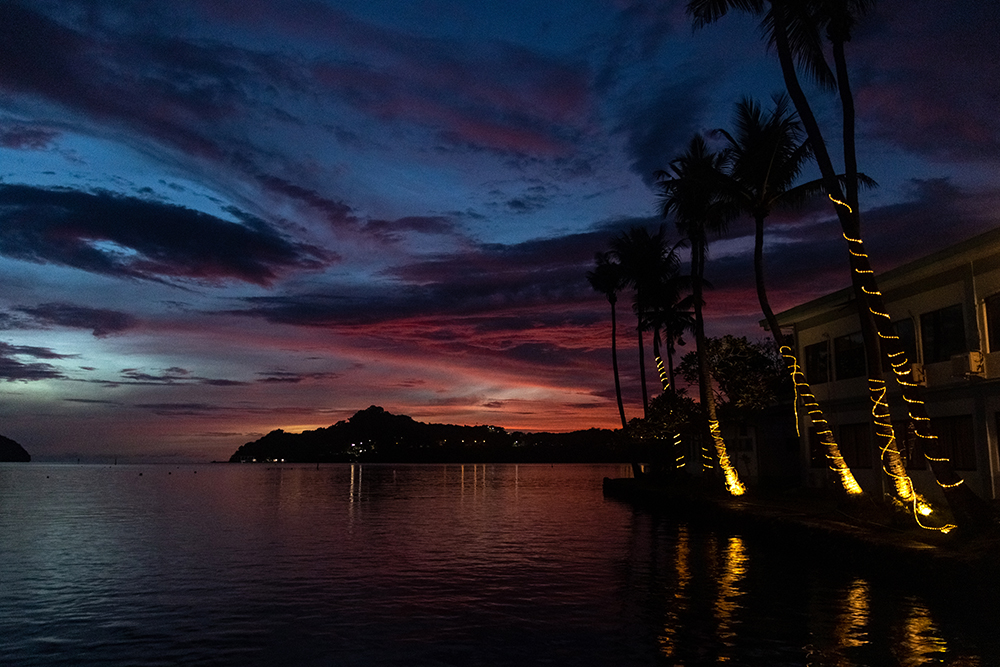
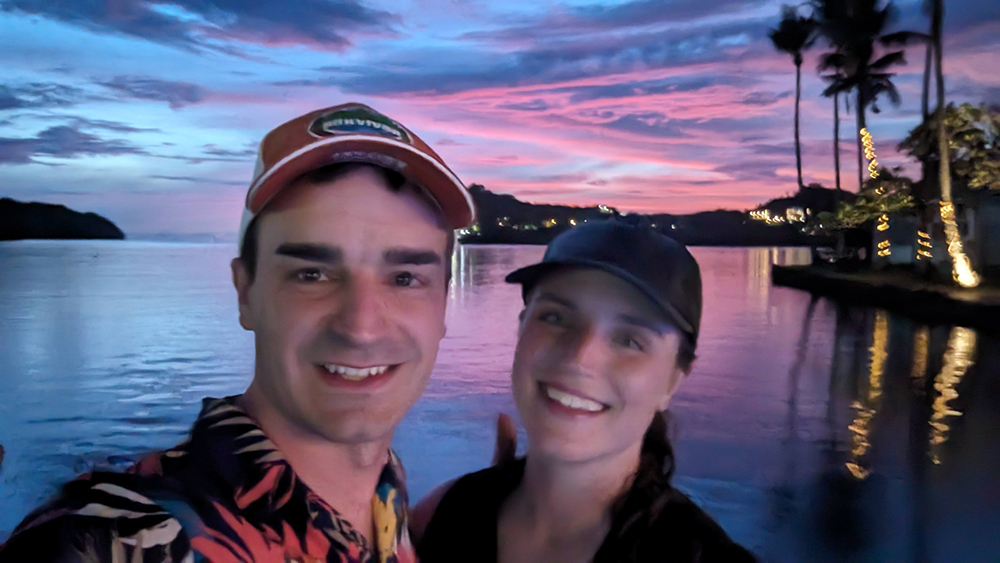
Back in Koror, Vince and I grabbed dinner with Lars, Seb, and Seb’s husband, George at Elilai Seaside Dining. We had drinks and a delicious meal, all while watching a truly stunning sunset melt the western sky. After we finished our dinner, we returned to the hotel to get some rest before another big day of diving.
I knew the day would be a good one when I woke up to sunlight pouring into our hotel room the next morning. Sebastian was even more enthusiastic than I was (a difficult feat when it comes to diving) when he joined me and Vince in the Blue Marlin shuttle van. The consensus on the shuttle ride was that we were sure to have a day of unforgettable dives.
By now we knew the routine at Blue Marlin, so it didn’t take us long to check all of our gear, and board the boat. I can’t even begin to explain how good it felt to see the sunshine as we rode out into the Rock Islands again. No more shivering in our neoprene hoodies. Instead we basked in the sunlight and beautiful views, passing by the rounded-top islands that rose from a sea that now shone bright turquoise under the gleaming sun.
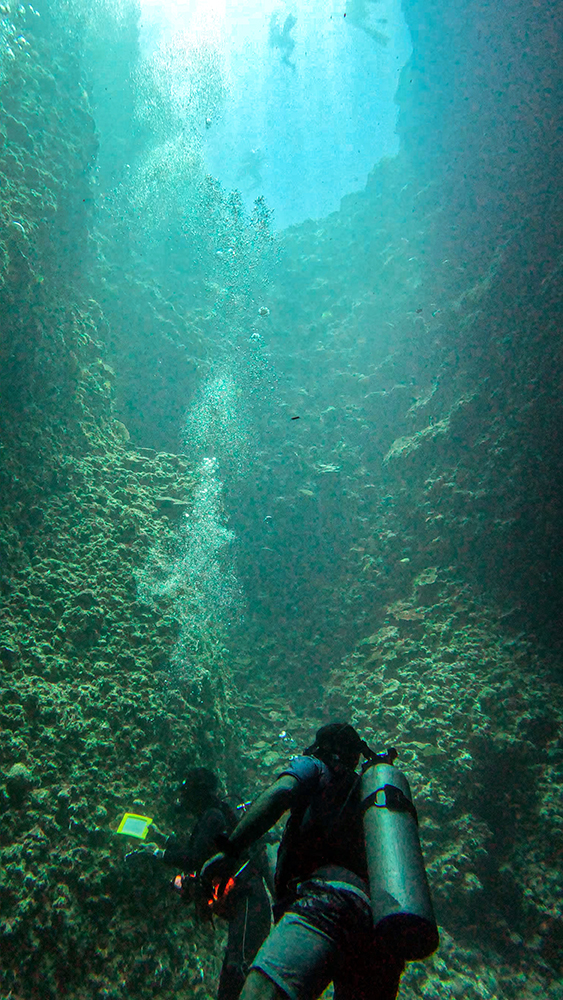
Sunny skies also meant that the visibility underwater should be better that day, and I was so excited when we finally rolled into the sea at one of Palau’s most famous dive sites, the Blue Holes. This was me and Vince’s 50th dive, and it was a wonderful spot to mark the occasion. The Blue Holes gets its name because the main attraction of the dive is to swim through giant holes in the seabed, and into and underwater cavern. Once we reached depth, we entered one of the eponymous holes, and swam into another world where ethereal beams of light pierced the darkness to illuminate patches of the rocky cavern.
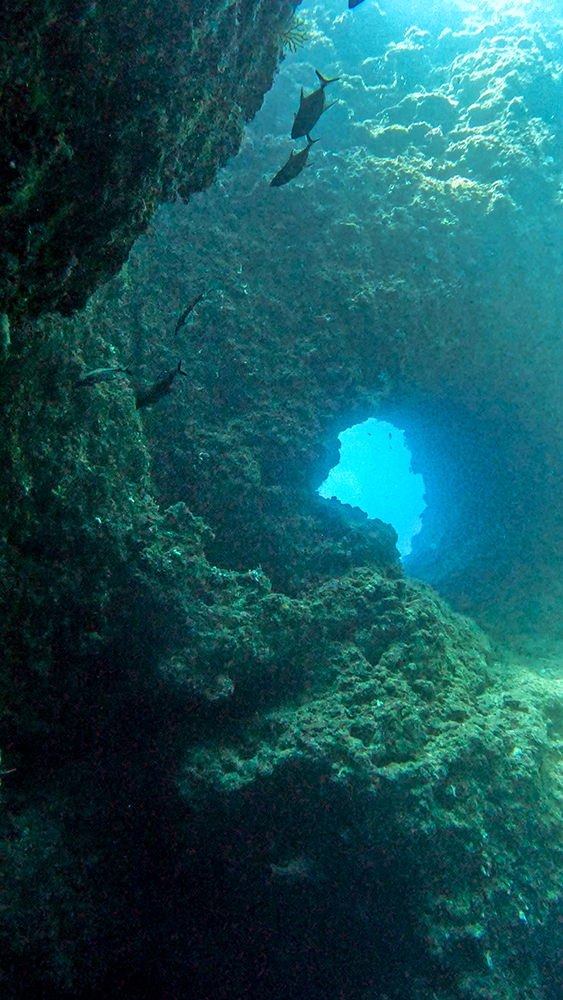
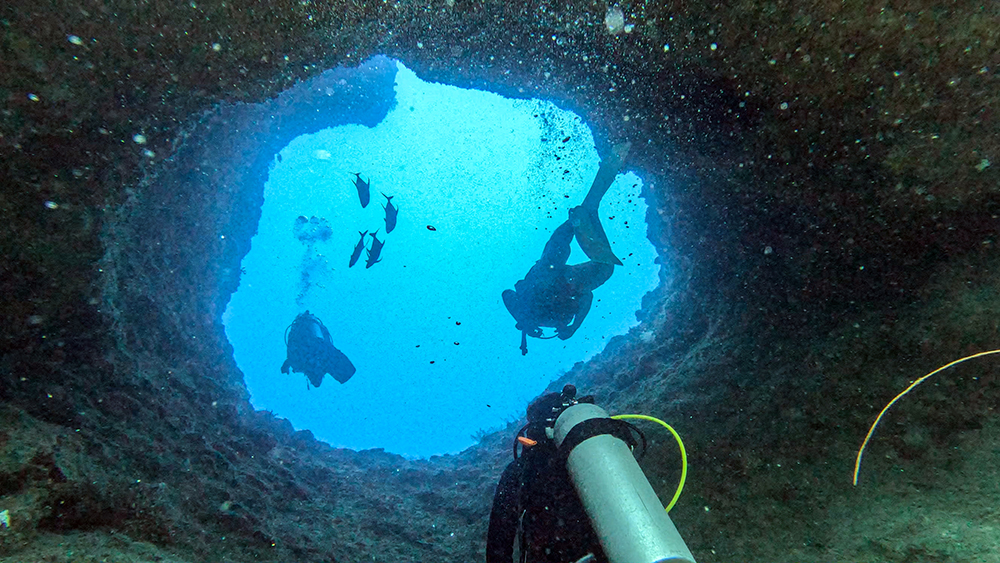
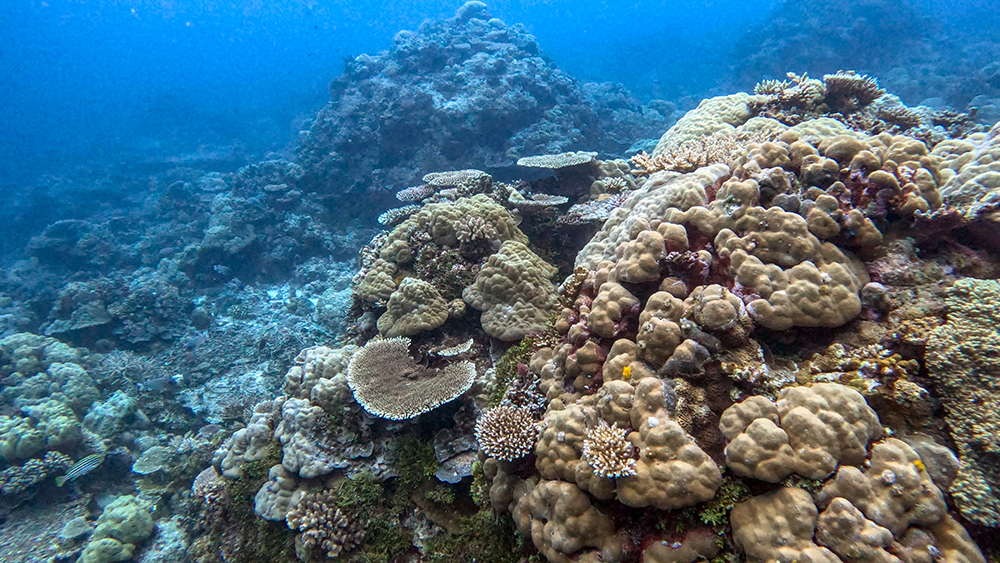
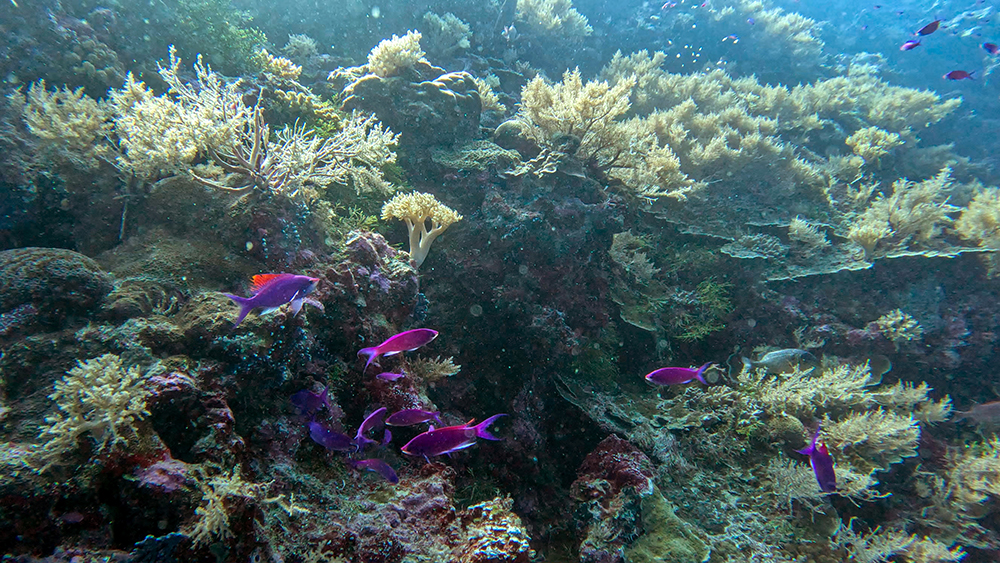
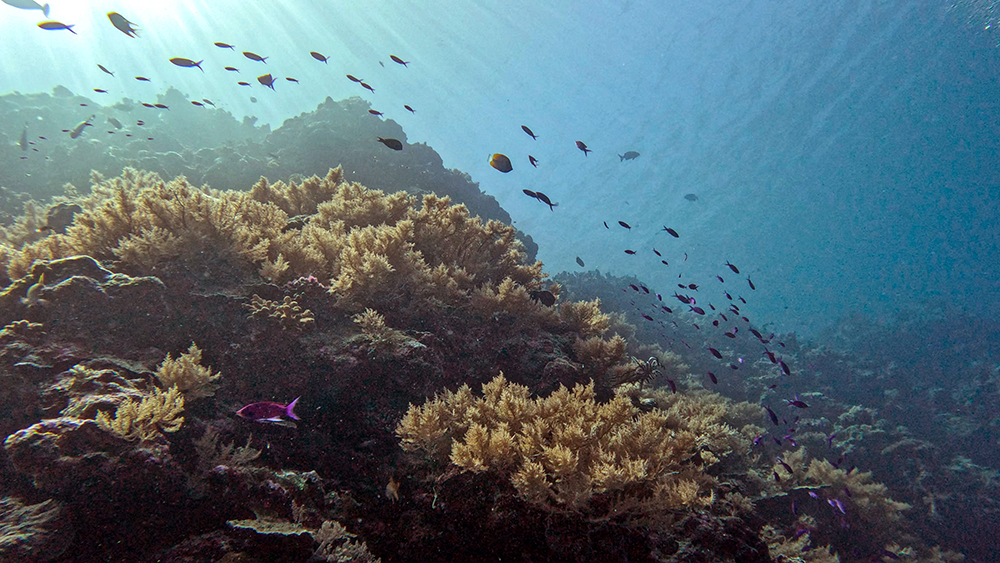
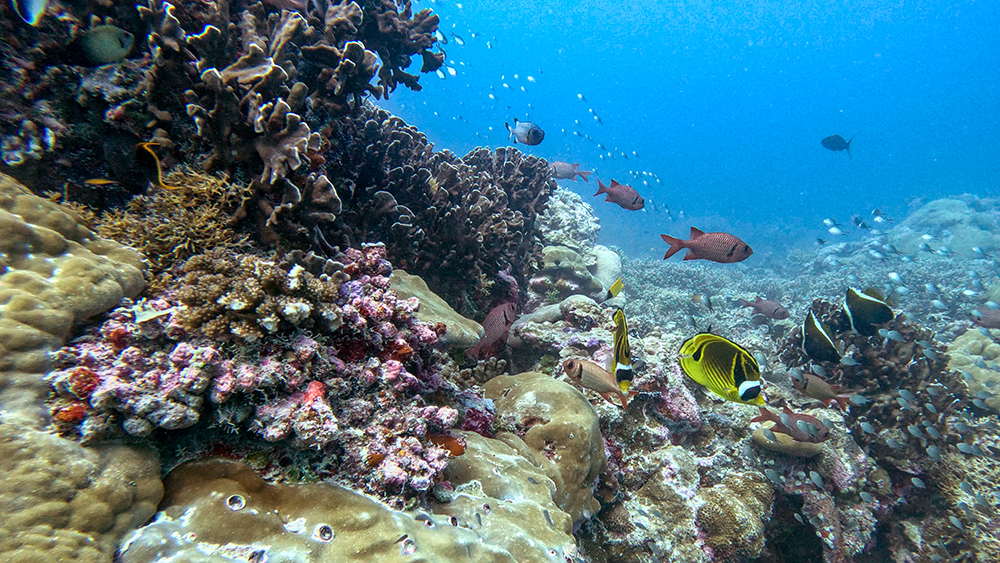
We explored the cavern for about half of the dive, then reemerged onto the reef. Visibility was indeed greatly improved from the previous day. The reef itself looked vibrant, and the colors of the reef fish seemed much brighter as well. We swam along a wall that was covered in lush coral that glowed from the backlight of the sun filtering through the water.
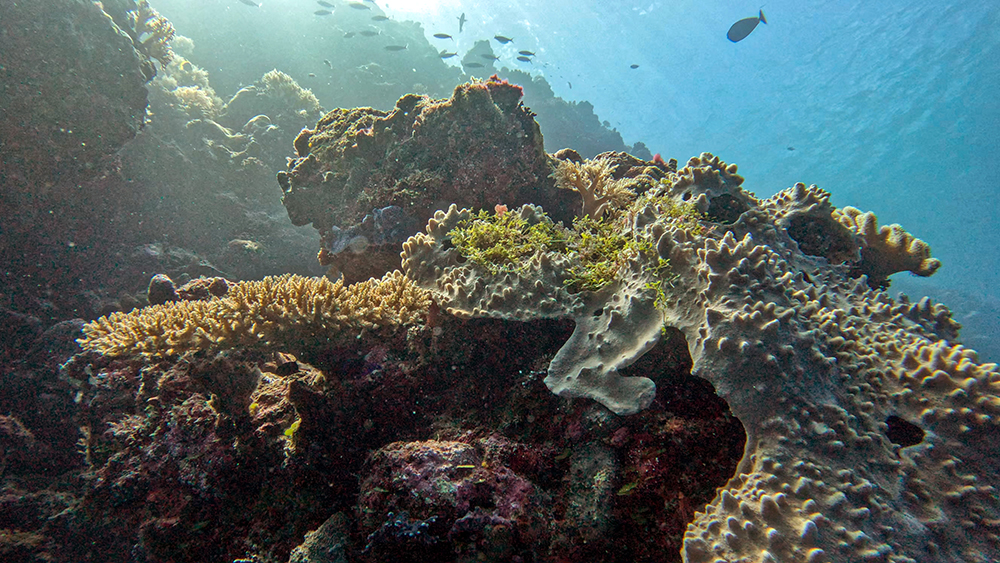
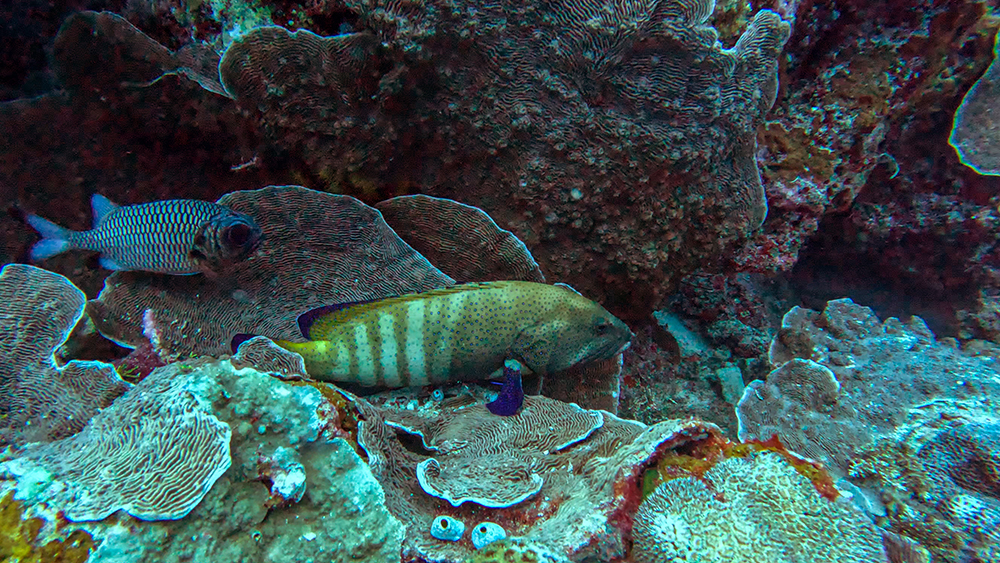
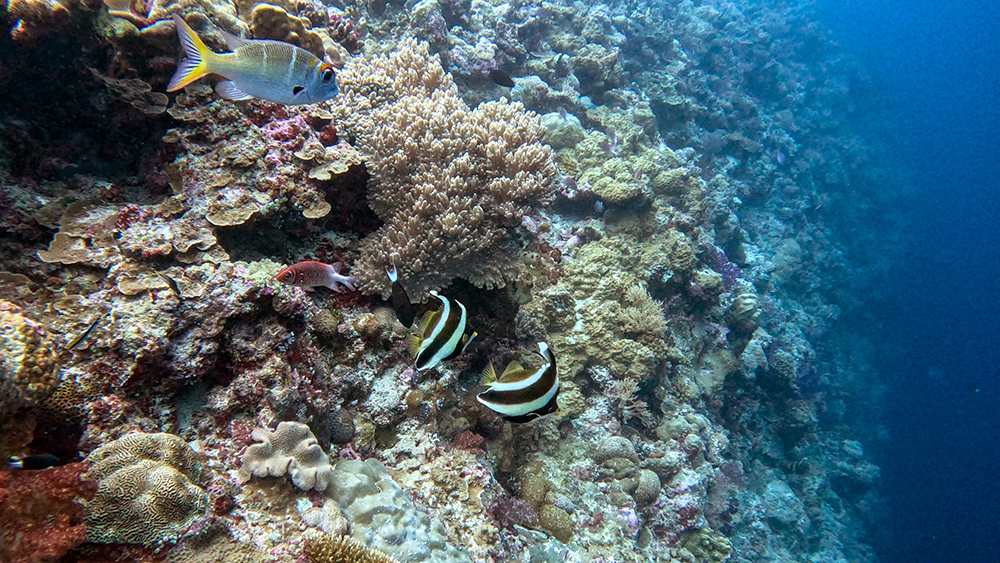
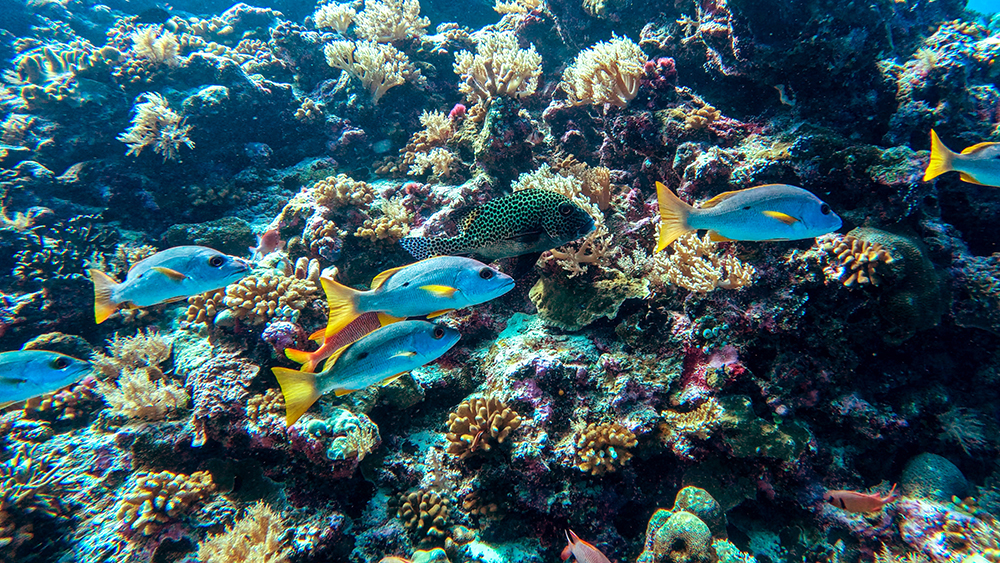
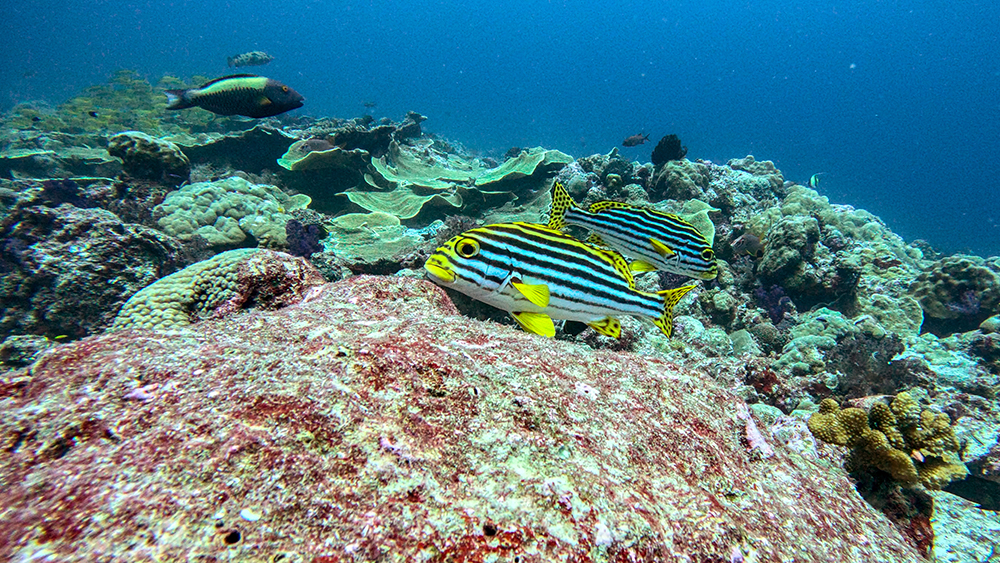
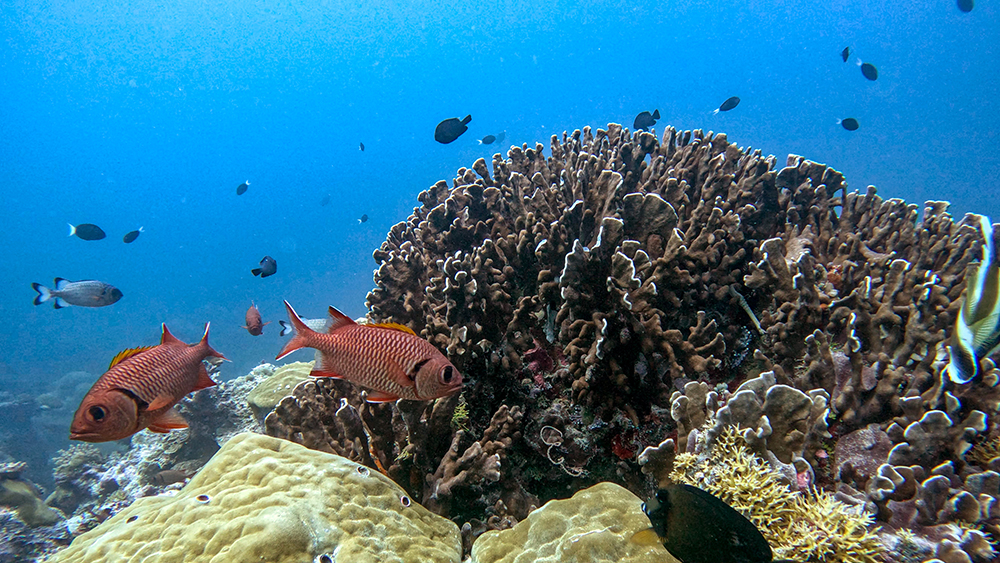
Along the way, we encountered scores of vibrant reef fish, including leopard sweetlips, squirrelfish and common snappers, and a blotched fairy basslet and some other anthias.

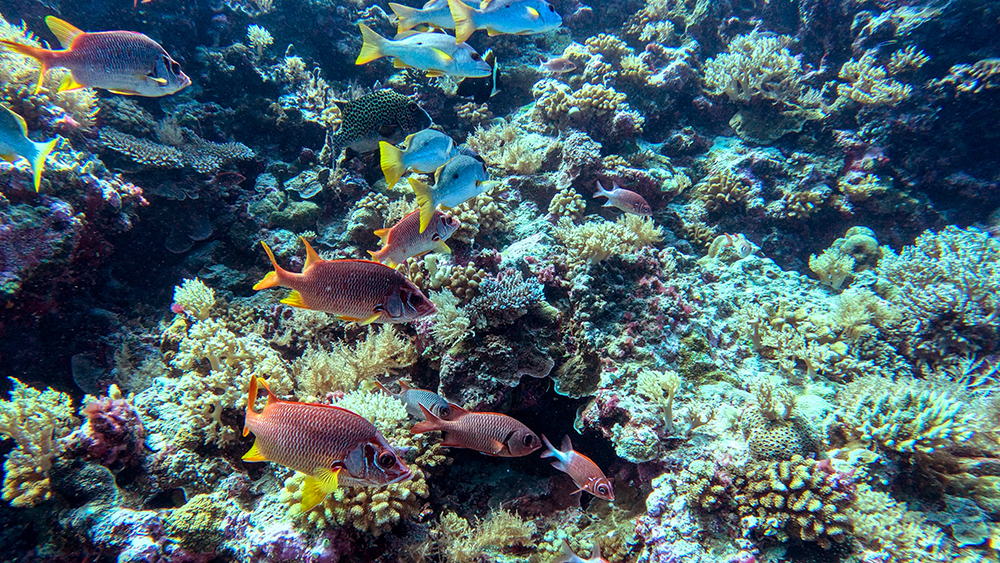
It became obvious that this was a popular dive site when we did our safety stop and saw that we were surrounded by dozens of plumes of bubbles from all of the other divers that were still below us. Back on the boat, we spent our surface interval diving back into the water to swim. Everyone on board was so happy with the weather that we just couldn’t contain ourselves. Many of us did flips off the bow (myself excluded), and we all cheered whenever someone did a successful flip.
Our next dive site, which was only a couple minutes ride away, would be the highlight of our two days with Blue Marlin. We were finally going to dive the Blue Corner, which is widely considered the best dive site in Palau. Seeing as Palau is widely considered one of the best places to dive in the world, I had very high hopes for this one. In our dive briefing, Tomi told us to be ready to use our reef hooks for real on this one. We entered the water and began our descent, as I wondered if the Blue Corner could possibly live up to its stellar reputation.
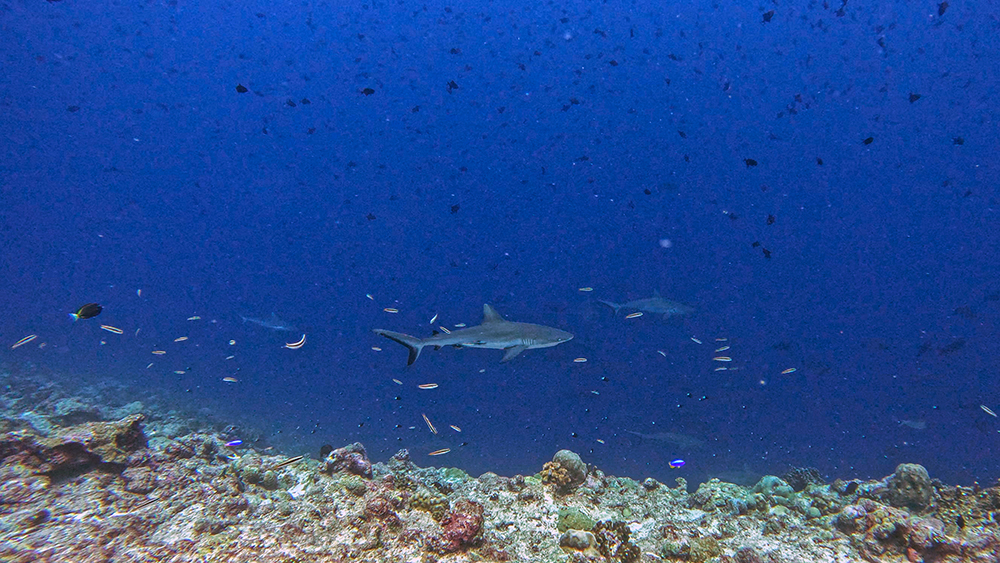
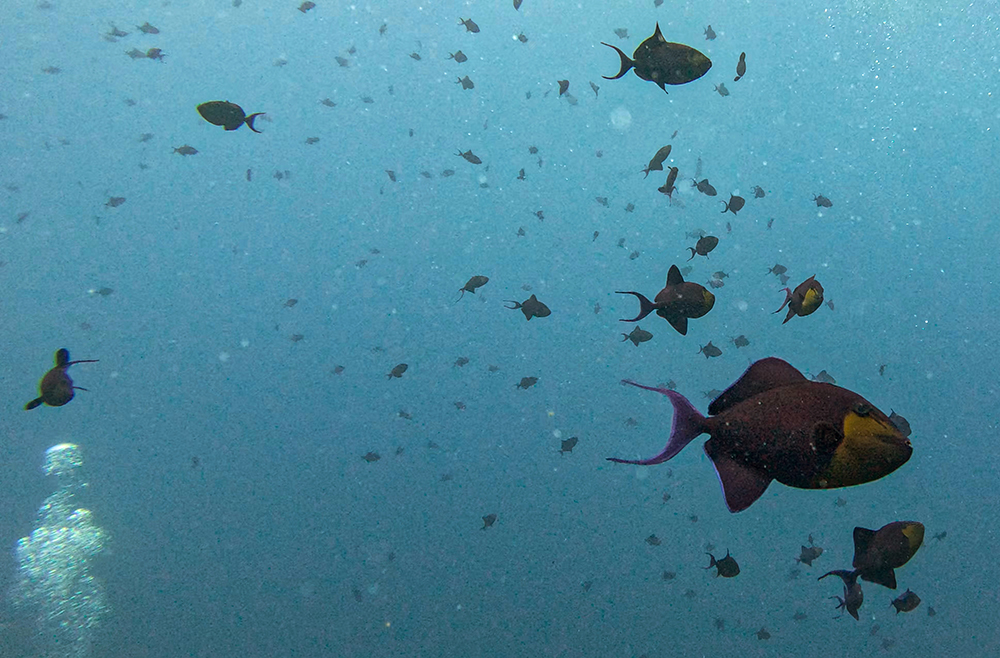
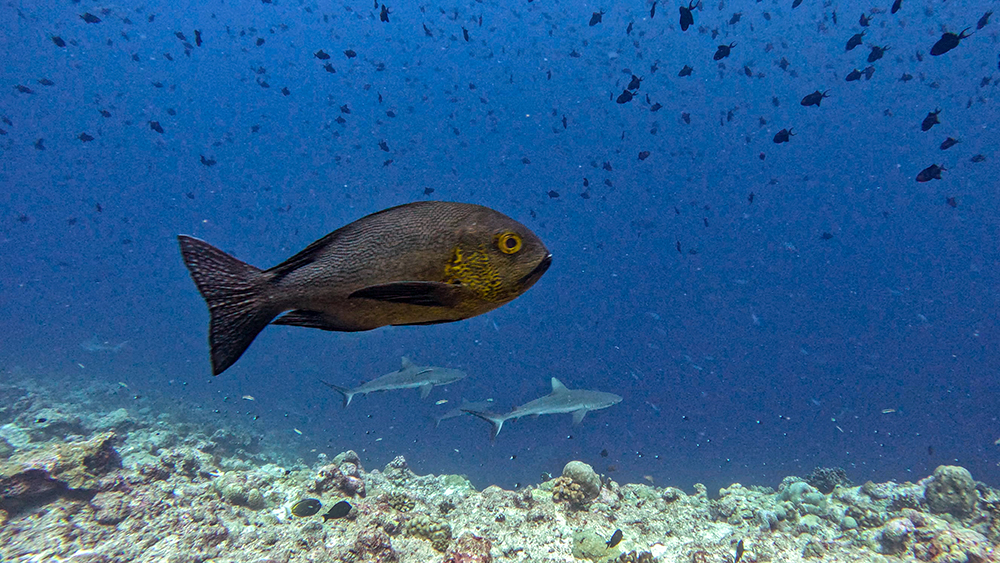
One thing the Blue Corner is particularly known for is sharks. The site borders a fathomless drop-off where sharks cruise on by in large groups, unconcerned with the divers who hook into the reef and watch them swim past. Our group started seeing sharks as soon as we reached our bottom depth of about twenty meters. Dozens of them glided back and forth as we swam through a school of small triggerfish.
Since the sharks were already out in force, Tomi found an open spot on the reef and signaled for us to take out our reef hooks. Following his instructions from the briefing, I retrieved my hook, which was attached to a daisy-chained length of rope, from my BCD pocket. I found a solid looking bit of rock on the sea floor, secured my hook into it, and then inflated my BCD. The added air in my BCD caused me to float upwards until I hit the end of the rope and it was pulled taught. Floating there like a kite, I looked over to Vince who had also successfully hooked the reef. Now we were both ready to relax and enjoy the show.
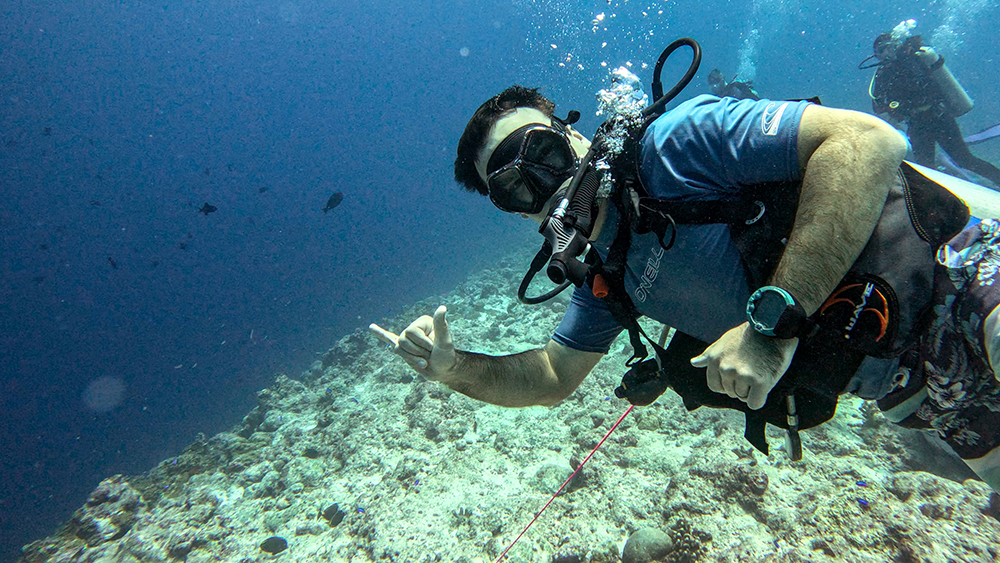
As we floated, staring out at a blue abyss, I noticed two things. First was the sharks of course. I could see as many as ten of them swimming back and forth in front of us, and my eyes kept scanning the blue, waiting for more to appear. Second was my air consumption. Floating there motionless meant that I was working on the best SAC rate I’ve ever recorded. The needle on my pressure gauge went virtually nowhere as I enjoyed the shark-filled view.
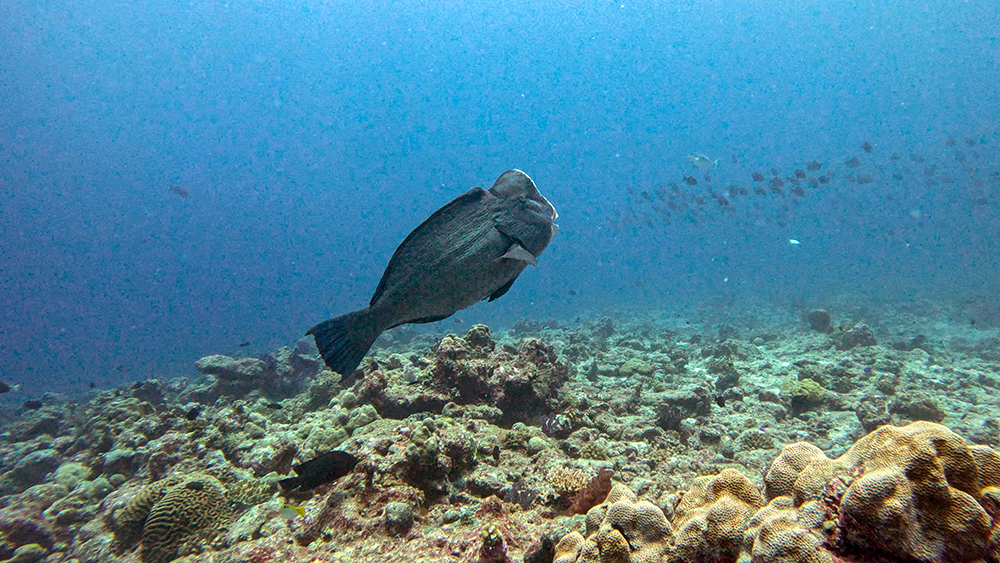
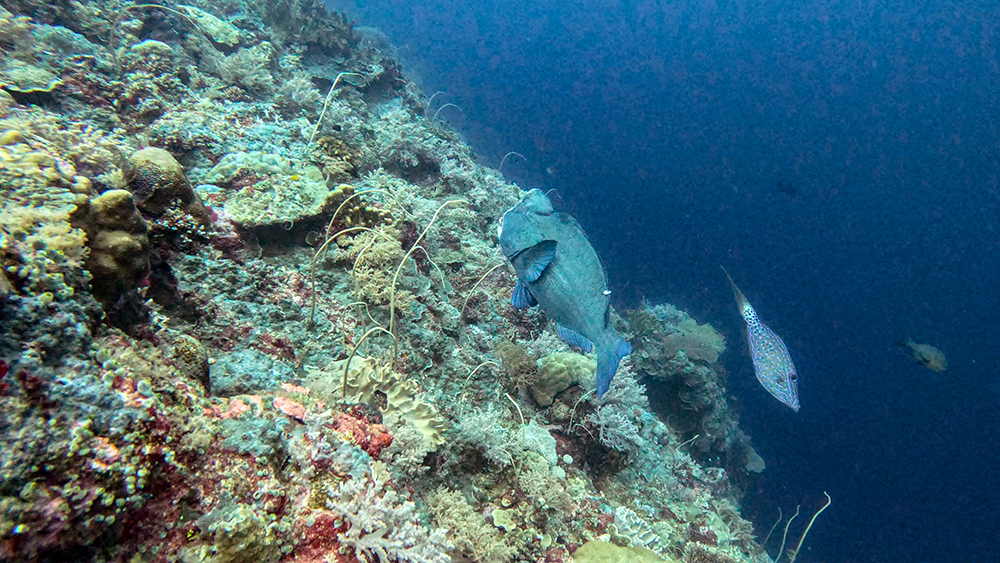
We got to float and watch the sharks swim by for several minutes before Tomi signaled for us to unhook and follow him up away from the drop-off. We still had plenty of time left to search for other interesting creatures before returning to the surface. There was, of course, a school of barracuda, a sight that was becoming commonplace at this point. I also got quite close to a bumphead parrotfish. This is one of my favorite fish species. It’s hard to tell without a human in the photo for reference, but bumpheads are quite large. They can grow up to five feet in length and weigh up to 165 pounds!
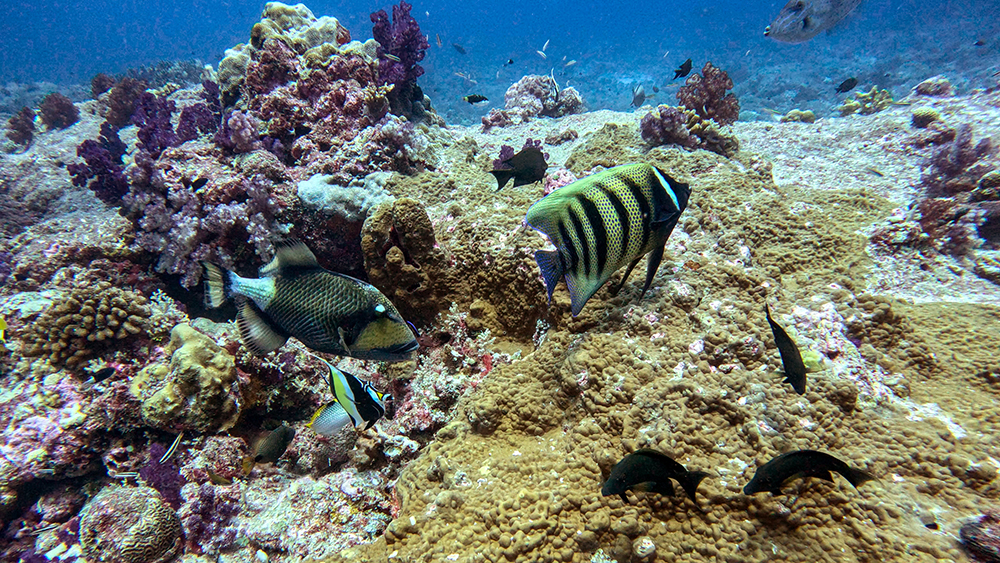
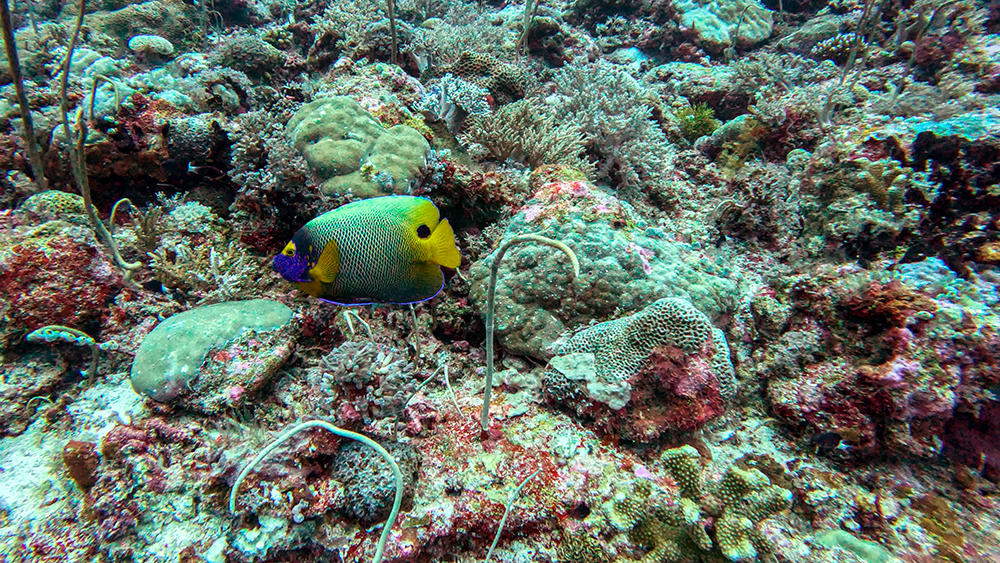
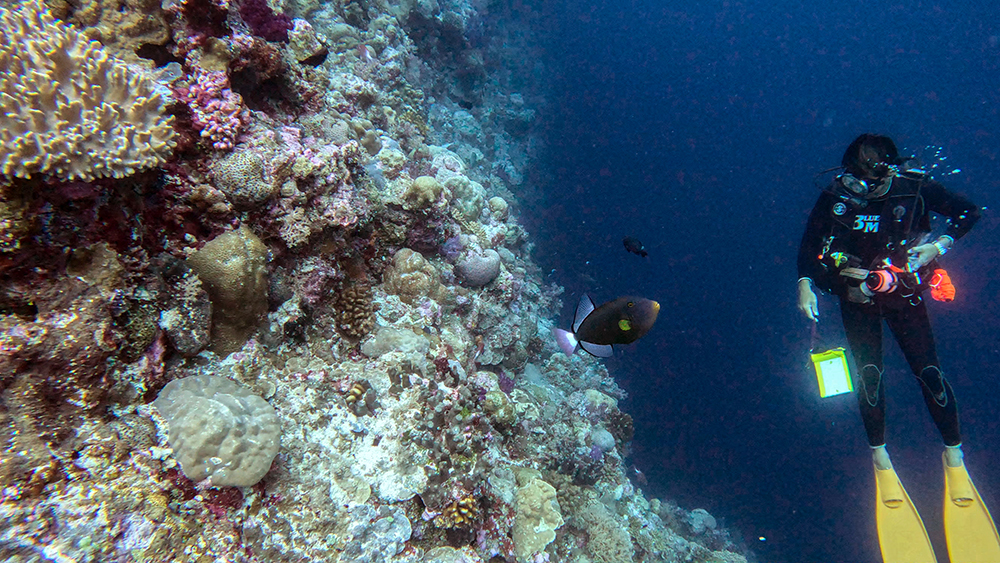
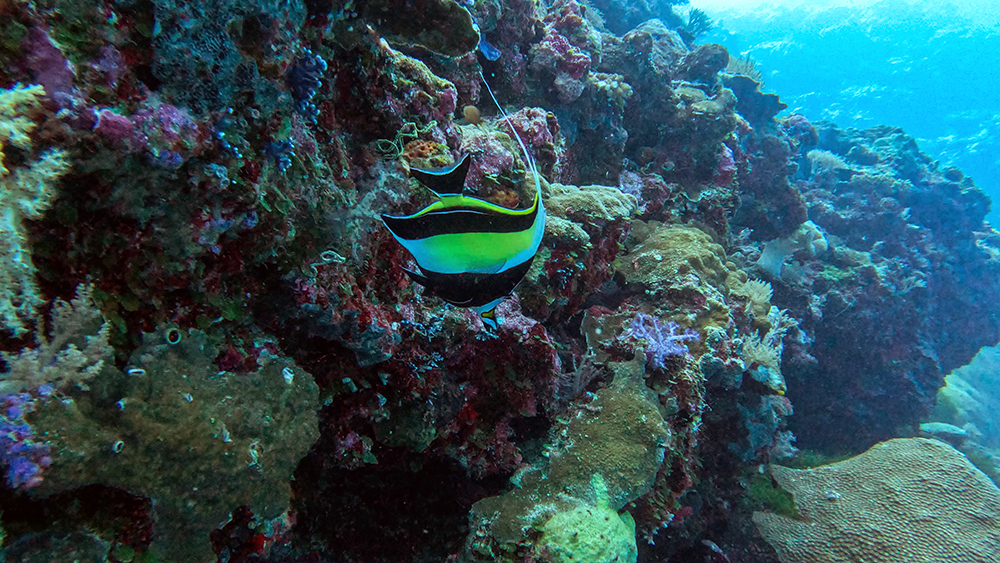
A short while later, I spotted a titan triggerfish, Moorish idol, sixbar angelfish, scrawled filefish, and blueface angelfish all gathered in one place.
Finally I got a close encounter with one of the main species I’d been hoping to see on this dive, a Napoleon wrasse. These colorful giants are an endangered species, and can grow up to six feet long (although most won’t get that big). I swam over to get a better look at the wrasse, and to my delight, it veered toward and passed just a few feet in front of where I was floating.

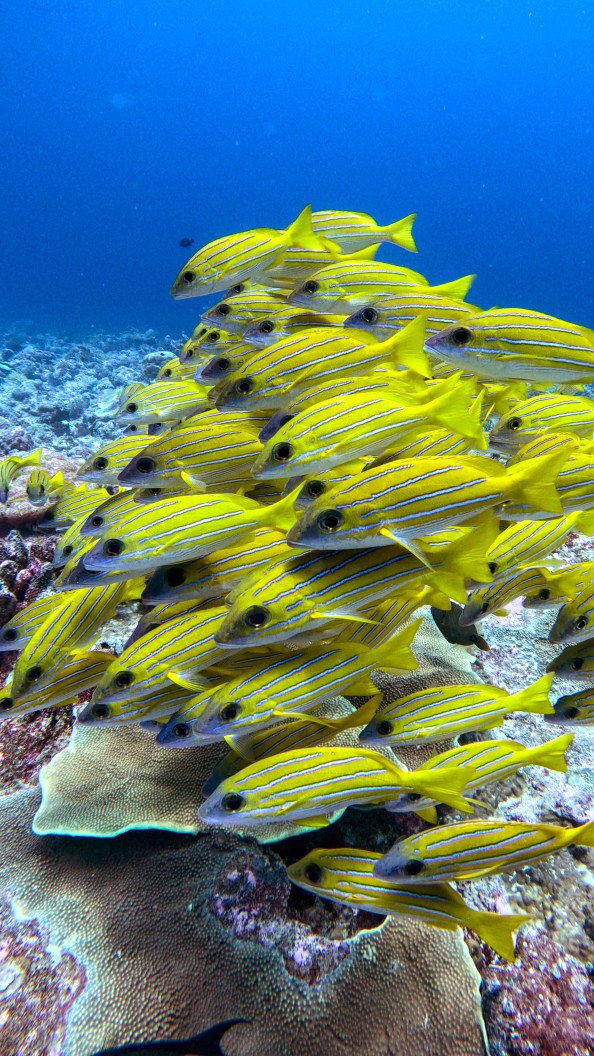
There were still endless amounts of fish to be seen, but by now we were approaching fifty minutes underwater, and it was time to start our safety stop. At the very last minute, we found a grouper, a couple of oriental sweetlips, and a school of bluestripe snappers, who hovered together when we swam near them. Then it was time to return to the boat for another bento box lunch. When we breached the surface, I noticed that I had 110 BAR of air leftover-over half a tank. The motionless float on the reef hook had really saved me a lot of air consumption, this was definitely a new personal record.
The consensus as we ate our lunch aboard the dive boat, was that the Blue Corner absolutely measured up to its reputation. I wished we could just jump back in and do another dive right there, but we still had one more very famous site to hit that afternoon. Our captain steered the boat toward the German Channel, and we watched turtles bob up for air, and the shadows of blacktip reef sharks just below the surface along the way.
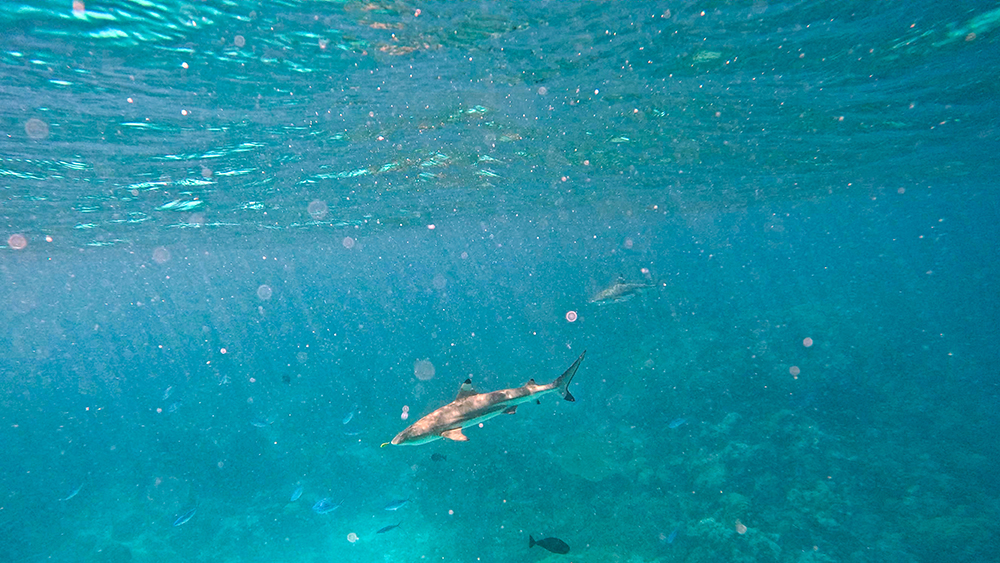
The German Channel is named such because it was artificially carved out of the reef when Palau was a German colony. The long gauge through the reef is visible from the surface because it is a different shade of blue than the surrounding water, and it looks unnaturally straight and perfect. The dive site is a known manta ray cleaning station, and I was very hopeful that we would see a manta as we dropped into our final dive of the trip.
As luck would have it, we saw one at the very beginning of the dive! It swooped down over the heads of a group of divers taht had gathered to watch, looking more like it was flying than swimming. It had been a long time since I had seen a manta ray, and I was just as awed by its size, beauty, and grace as I remember being years ago when I first saw on in Indonesia.
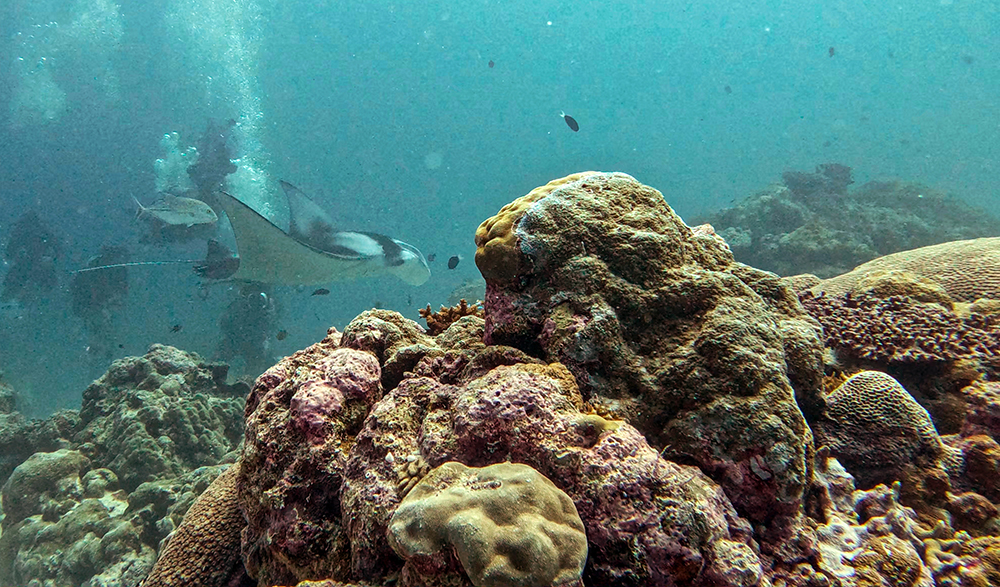
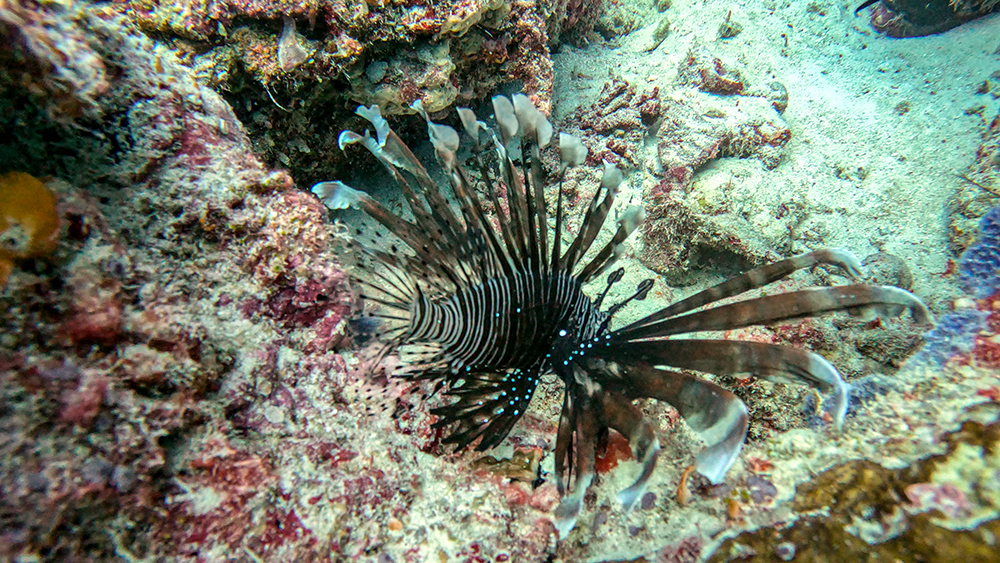
After that, the dive was full of smaller, although still beautiful, fish. We saw a moray eel, a lionfish, and more leopard sweetlips. Then we got to see one last school of barracuda before returning to the surface for the last time.
Rainbows shined in the sky as we boated back to Koror where we celebrated me and Vince’s 50th dive. Blue Marlin gave us souvenir t-shirts that said “50 Dives” on the back, and we posed for pictures with the shirts.
Later on, we met up with Rachel and Jared, who were carrying a bag of fish they’d caught on their deep sea fishing tour that day. It felt like we hadn’t seen them in months since we’d been separated for the past two days, and we all had a lot to catch up on over dinner at a nearby restaurant called Tori Tori. The restaurant’s chef prepared Rachel and Jared’s fish as we all regaled each other with stories of everything we’d done in each other’s absence.
One thing was for sure, it had been an eventful introduction to Palau for all of us. We were all thoroughly enjoying our time there so far, and were very much looking forward to two more days of exploring the Rock Islands. As everyone but me devoured their artfully prepared fish (I don’t like fish and opted for vegetable tempura instead), we discussed plans for the short time we had remaining on our trip. After dinner, we ran into Lars, Seb, and George and got to say goodbye to them, since they would all be leaving Koror soon. Our trip was creeping towards its end too, but I was so happy that we didn’t have to say goodbye to Palau just yet. That night, I went to sleep with thoughts of sharks and wrasse swimming through my imagination. With all of the amazing things we’d already seen in Palau, it was impossible not to feel excited for what was still yet to come!






 birdsoftheairtravel.com
Thank you , Kaiti, for the continuation of your adventures, and beautiful photography!
Joanna
Wonderful images of your underwater experiences. Thanks for sharing.